NATO Secretary General and European Commission President Stress a More European NATO to Reduce U.S. Dependence
- Input
- 2026-07-08 07:03:06
- Updated
- 2026-07-08 07:03:06
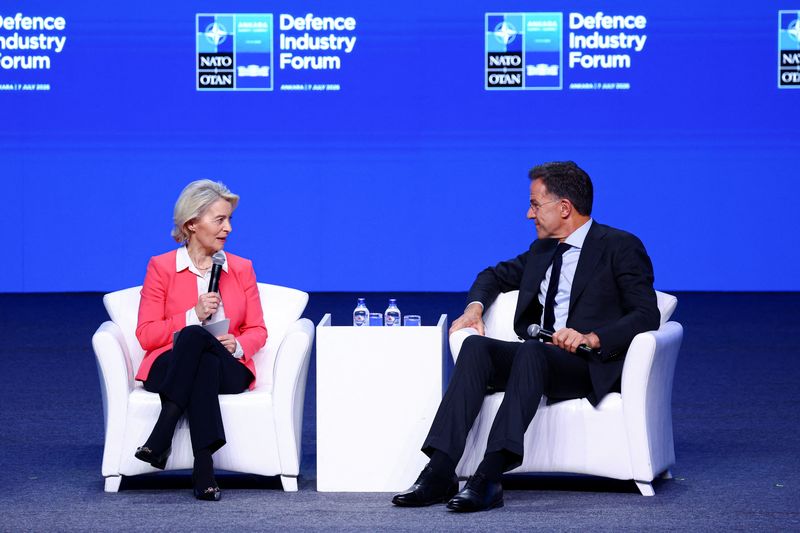
At the annual North Atlantic Treaty Organization (NATO) summit in Ankara, Turkey, European leaders declared their determination to reduce their long-standing security dependence on the United States and build a more Europe-centered NATO, Financial News reported.
On the 7th local time, Euronews reported that European Commission President Ursula von der Leyen and NATO Secretary General Mark Rutte attended a defense forum held ahead of the summit and emphasized closer cooperation between the EU and NATO, as well as greater interoperability.
At the event, Rutte said, "We can no longer continue a structure that depends too heavily on the United States, as we did in the past." He added, "To preserve the Atlantic alliance, paradoxically, we must become 'more European.'" He said NATO would handle command structures and standards, while the EU would take charge of industry, investment, and regulation, creating a "stronger Europe within a strong NATO." Of the EU's 27 member states, 23 are currently members of NATO.
This declaration by Europe's leadership appears closely tied to the unilateral moves the White House has taken over the past few months. The United States launched a surprise strike on Iran without sufficient prior coordination with European allies and has also gradually reduced U.S. military assets stationed in Europe, drawing strong backlash and concern from allied nations.
Feeling the urgency, European countries are sharply increasing defense spending in an effort to show Donald Trump that Europe is sharing the burden of security.
Poland, the Baltic states, and the Nordic countries have raised military spending to unprecedented levels in order to meet the new defense target of 5% of Gross Domestic Product (GDP). However, some member states, including Spain, Belgium, Luxembourg, and the Czech Republic, are still increasing defense spending too slowly, leaving the issue as a challenge within NATO.
The EU has unveiled a massive financial plan to strengthen Europe’s own defense capabilities. On the day, von der Leyen proposed a total package worth 285 billion euros, or about 492 trillion won, including 150 billion euros to be secured through the SAFE funding program and a provisional allocation of 135 billion euros in the next EU budget proposal.
Von der Leyen explained, "In the current geopolitical crisis, a major surge in defense investment is essential." She added, "Since European taxpayers' money is being used, research and development will be carried out within Europe and turned into quality jobs."
Rutte also warned that a "massive increase" in the defense industrial base is needed on both sides of the Atlantic to counter Russia’s formidable military economy. He said, "Russia has now turned its entire economy into a wartime system, to the point that even car factories are producing military supplies." He urged, "Europe, Canada, and the United States must move together."
He then said, "Russia is now working together with North Korea, Iran, and China." He added, "The threat is right in front of us. We must never respond complacently," calling on allies to wake up to the danger.
jjyoon@fnnews.com Yoon Jae-joon Reporter