Semiconductor Boom Puts Annual Operating Profit of 400 Trillion Won Within Reach, While Finished Products Such as TVs Are Left Behind [Samsung Electronics' Record-Breaking Results]
- Input
- 2026-07-07 18:21:28
- Updated
- 2026-07-07 18:21:28
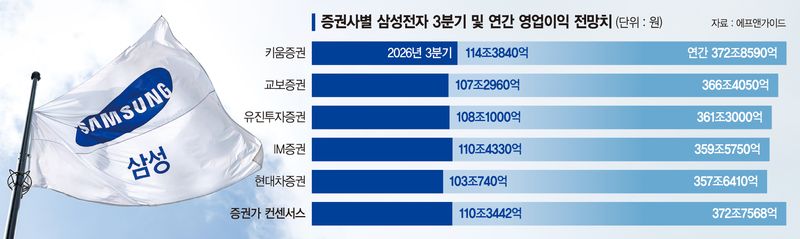
■"Annual operating profit could even reach 400 trillion won"
According to FnGuide on the 7th, the consensus operating profit forecast for Samsung Electronics in the third quarter is 110.3442 trillion won, while the fourth-quarter estimate stands at 120.2492 trillion won. Adding the first-quarter operating profit of 57.2328 trillion won and the preliminary second-quarter figure of 89.4 trillion won brings projected annual operating profit to about 373 trillion won. With the memory boom driven by rising investment in AI servers, the DS Division is expected to lead overall earnings and set another all-time high.
Some analysts, however, say memory price gains may not be as steep as they were in the second quarter. That has raised concerns about a so-called memory peak-out, or a slowdown after prices reach a high point. Still, securities firms believe the overall memory market is unlikely to weaken, as supply shortages are expected to continue amid stronger investment in AI data centers and rising HBM demand, even if the pace of price increases slows somewhat.
Choi Bo-young, a researcher at Kyobo Securities, said, "Memory prices for DRAM and NAND were originally expected to rise only in the single digits, but recent forecasts are calling for increases of around 20%, which seems to have eased some of the concern." She added, "The earnings trend should remain strong in the third quarter as well."
Still, the memory shortage and sharp price increases, along with the growing market share of Chinese memory products as Chinese chipmakers gain ground, are issues that will need close attention. Tim Cook, the CEO of Apple, who is often called a supply-chain master, recently compared the current rise in memory prices to "a flood that happens once every 100 years" in an interview with foreign media. He also said, "I have never seen anything like this in any field." Apple is reportedly reviewing the use of memory from ChangXin Memory Technologies (CXMT), China’s largest DRAM maker, as part of efforts to diversify its supply chain.
■Semiconductors are surging, but TVs and home appliances are struggling
Unlike the DS Division, rising memory prices are weighing on the profitability of the set business. Industry sources expect the DX Division to post operating profit of only around 1 trillion won in the second quarter. Analysts also say the television and home appliances businesses are likely to barely avoid losses, as higher memory costs are increasing manufacturing expenses.
Strong memory prices are adding cost pressure to the DX Division, which produces finished products such as smartphones, televisions, and home appliances. According to market research firm TrendForce, prices for general-purpose DRAM rose 58% to 63% in the second quarter from the previous quarter, while NAND flash memory prices climbed 55% to 60%. Since it is difficult to pass the full increase in memory costs on to product prices, weaker profitability appears unavoidable. The trend is expected to continue in the second half of the year. TrendForce forecasts that general-purpose DRAM prices will rise another 13% to 18% in the third quarter, while NAND flash memory prices will increase by 10% to 15%.
In addition, the TV business is facing weak global demand and aggressive low-price competition from Chinese companies, making it difficult to defend profitability. The home appliances business is also expected to see only limited improvement, as sluggish consumer demand, logistics costs, and raw material prices continue to weigh on results. The Mobile business is likewise expected to slow because of higher memory-related costs. Son In-jun, a researcher at Eugene Investment & Securities, said, "The MX Division is likely to remain in the red throughout the year," adding that "memory cost pressure is the biggest reason."
An industry official said, "The semiconductor business is fully benefiting from higher memory prices, but the set business has a structure that makes it difficult to reflect the full rise in component costs in product prices." The official added, "For the time being, the earnings gap between the DS and DX divisions is likely to widen further."
soup@fnnews.com Lim Su-bin, Lee Dong-hyeok Reporter