Supermarkets Revise Procurement Strategies to Import Chilean Salmon and Australian Mangoes
- Input
- 2026-07-07 18:10:32
- Updated
- 2026-07-07 18:10:32
"The price of imported blueberries has risen significantly," Mr. Choi said. "Even though they are from Chile, at this price, I think it would be better to buy small packages of fresh domestic blueberries instead. " As the era of the won-dollar exchange rate hovering around 1,500 won becomes entrenched and volatility in exchange rates and logistics costs has increased following the Middle East war, the fresh food procurement strategies of buyers in the retail industry are rapidly changing.
While the priority in the past was finding the cheapest source, recently, establishing a supply chain capable of securing stable volumes has emerged as the top priority. ■ Shift from 'Price' to 'Supply Stability' According to industry sources on the 7th, as external variables such as exchange rates, international market prices, climate change, and geopolitical risks interact in a complex manner, buyers in the retail industry are determining production regions by considering not only price competitiveness but also supply continuity, logistics lead times, and quality stability. Measures to cope with high exchange rates are expanding to include changes in payment structures.
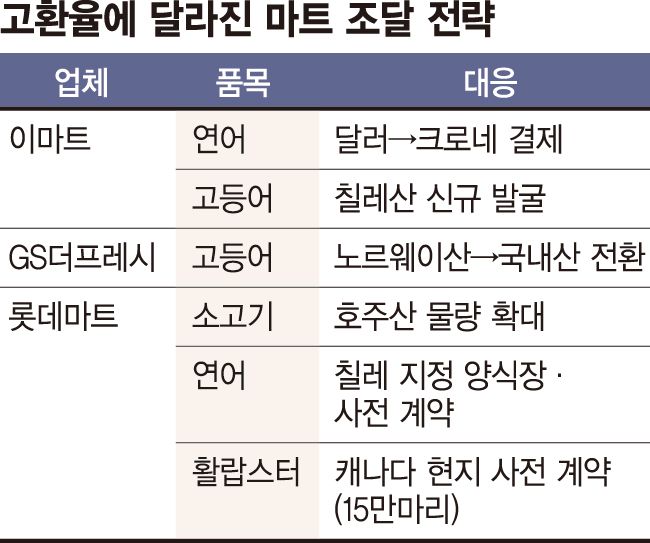
At the end of last year, E-Mart switched the payment currency for frozen Norwegian salmon from the existing US dollar to the Norwegian local currency, the Krone. This measure was taken to reduce the exchange rate burden caused by the strong dollar, thereby lowering price volatility by changing the existing payment structure itself. Along with this, E-Mart has also been pursuing diversification of production regions, such as by newly introducing Irish beef and Australian Calypso mangoes.
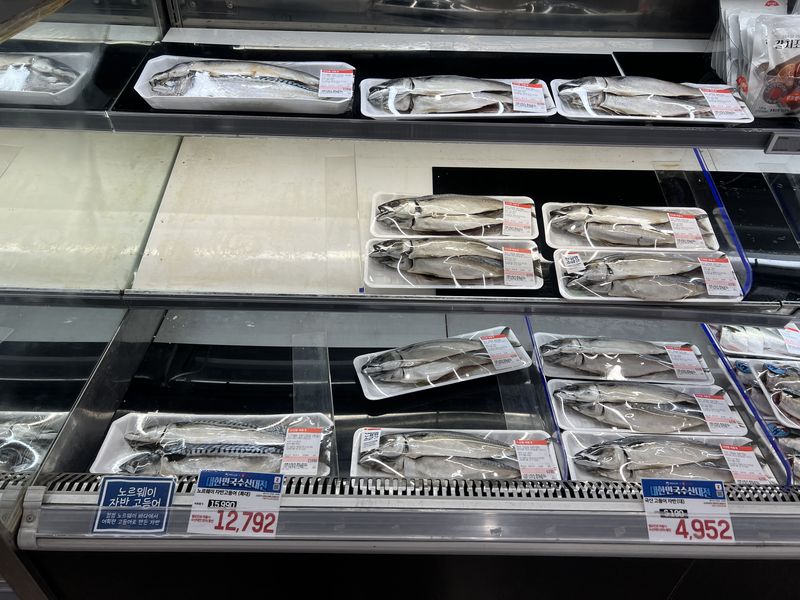
Mackerel is the item where this supply chain restructuring is most clearly evident. As the price of Norwegian mackerel rose sharply due to high exchange rates and the Norwegian government's reduction of fishing quotas, GS The Fresh switched the raw material for its "boneless mackerel" from Norway to domestic sources in January of this year. Previously, Norwegian raw materials were processed in China and imported as finished products, but the company has now changed its procurement structure to secure domestic raw materials, process them at partner overseas factories, and supply them domestically.
Jeong Bo-chan, a Product Planner (MD) in the Seafood Team at GS The Fresh, stated, "As the trend of high exchange rates continues for the long term, we are operating our procurement strategy to reduce dependence on specific countries and diversify our suppliers. " He added, "We select production regions by comprehensively considering not only price but also supply continuity, logistics lead times, and sensitivity to exchange rates. " E-Mart also plans to replace about half of its existing Norwegian volume this year by newly sourcing Pacific mackerel from Chile to replace Norwegian Atlantic mackerel.
An E-Mart seafood buyer explained, "While price competitiveness was the most important criterion in the past, securing production areas capable of stably supplying quality above standards has now become more critical. " He added, "In actual operations, rather than simply comparing the prices of imported goods, we are focusing on expanding prior consultations with domestic producers and discovering new sources. " ■ From Changing Payment Currency to Pre-contracts For items where it is difficult to find alternative sources, companies are responding by strengthening pre-contracts and direct sourcing.
Lotte Mart is refining its procurement strategies to suit the characteristics of each product category. In response to rising prices for U. S.
beef this year, the volume of Australian beef was increased by approximately 10% compared to the previous year. For salmon, starting last year, the company became the first in the domestic retail industry to operate a designated farm in Chile, securing raw materials through pre-contracts. Additionally, regarding live lobsters, the company secured 150,000 units through a pre-contract with a local Canadian partner last May, an increase of about 20% from the previous year.
The industry anticipates that, given the inability to control exchange rates, strategies to reduce dependence on specific countries and diversify production areas will be further strengthened in the future. "The recent restructuring of supply chains is an extension of the response to high exchange rates that has persisted since last year, rather than a sudden reaction," said an industry official. "As external uncertainties such as exchange rates, international raw material prices, and geopolitical risks continue, strategies to reduce dependence on specific countries and diversify production sources will be further strengthened in the future.
"
clean@fnnews.com Lee Jeong-hwa Kim Hyun-ji Reporter