Banks' Foreign Currency Liabilities Reach $238.8 Billion ... A 50-Won Rise in the Exchange Rate Would Add 12 Trillion Won in Won Terms [The New Normal of High Exchange Rates (Part 2)]
- Input
- 2026-07-07 18:10:16
- Updated
- 2026-07-07 18:10:16
■ Rising exchange rates increase the burden of foreign currency liabilities
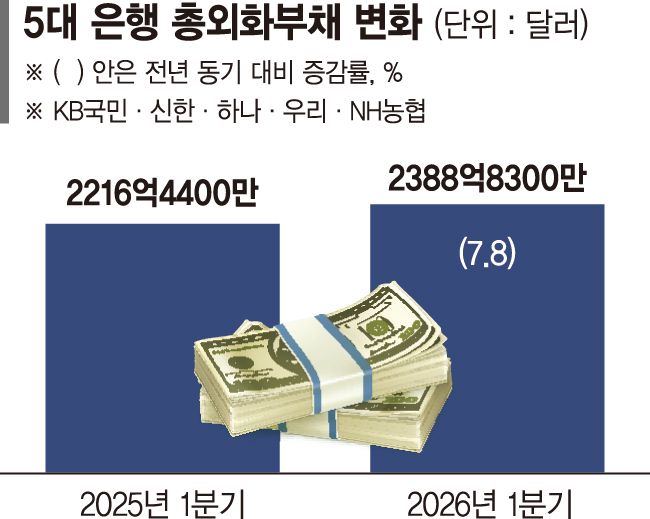
According to the financial sector on the 7th, the five major banks — KB Kookmin Bank, Shinhan, Hana Bank, Woori Bank and NH NongHyup — held a combined $238.883 billion in foreign currency liabilities at the end of the first quarter this year. That was up $17.239 billion, or 7.8%, from $221.644 billion a year earlier. Total foreign currency liabilities include foreign currency deposits, foreign currency call money, foreign currency borrowings, foreign currency-issued financial bonds and other liabilities.
The increase appears to reflect stronger demand from companies to hold dollars in a high-exchange-rate environment, along with expanded foreign exchange transactions. Exporters have delayed selling dollars, while importers have secured dollars in advance for payments, which seems to have boosted foreign currency deposits. As of the 11th of last month, the five major banks' corporate dollar deposit balances stood at $54.371 billion, the highest level since the end of January 2023, when they reached $55.255 billion.
The problem is that the won is weakening further. In the first quarter of this year, the average won–dollar exchange rate was 1,465.16 won per dollar, higher than 1,450.98 won in the fourth quarter of last year. In the second quarter, it rose to 1,501.6 won, the highest quarterly average since the IMF Crisis. Last month, it climbed as high as the 1,520-won range.
A higher exchange rate increases the burden on banks. Even if the dollar-denominated debt remains unchanged, the won-equivalent amount rises as the won–dollar exchange rate goes up. For example, based on total foreign currency liabilities at the end of the first quarter, a 50-won increase in the exchange rate would raise the simple won-equivalent amount by about 11.9 trillion won. Because foreign currency assets are also converted into won, this cannot be treated as an immediate loss. Still, a weaker won can lead to higher RWA and add pressure on management of the common equity tier 1 ratio (CET1 ratio).
A prolonged period of high exchange rates could also raise banks' funding costs. When foreign currency bonds mature or foreign currency borrowings come due, refinancing costs depend on dollar funding rates, conditions in the swap market and investor demand. If companies delay converting export proceeds or increase dollar holdings in anticipation of further exchange-rate gains, banks may see foreign currency deposits rise. But they must then manage those funds in line with their foreign currency liquidity ratio and maturity structure.
That said, foreign currency borrowings have not risen sharply, so this is not seen as an immediate foreign currency liquidity crisis. At the end of the first quarter, the five major banks' foreign currency borrowings totaled $37.127 billion, up only $760 million from a year earlier. Compared with the $17.239 billion increase in total foreign currency liabilities over the same period, the rise in borrowings accounted for just 4.4%.
A financial sector official said, "Banks' foreign currency liquidity indicators are currently above regulatory requirements, and because foreign currency assets and liabilities are managed in balance, exchange-rate fluctuations do not immediately translate into losses or a liquidity crisis." The official added, "However, if the high exchange rate persists, it could weigh on capital ratio management and limit room for loan growth."
■ Insurance companies also feel the impact of high exchange rates
The insurance industry is also closely watching the burden from a prolonged period of high exchange rates. Insurers with large overseas bond portfolios hedge currency risk through currency swaps and other tools. The longer the exchange rate stays high, the heavier the hedging costs may become.
Insurers have been increasing investments in high-quality overseas bonds, including U.S. Treasuries, because domestic long-term bond supply is limited. In the process, they must renew hedging contracts, and if high exchange rates continue, refinancing costs could rise.
A stronger dollar also creates pressure on the management of the Korean Insurance Capital Standard (K-ICS) ratio. As the won-equivalent value of foreign currency assets rises, market risk charges related to foreign exchange may increase. However, the impact differs by insurer depending on the size of overseas investments and foreign currency exposure.
An insurance industry official said, "At present, the situation remains manageable, but if high exchange rates persist, hedging costs and the burden of managing the K-ICS ratio could increase, so we are continuously monitoring exchange-rate volatility."
[email protected] Ye Byeong-jeong Reporter