Hanwha Ocean Fails to Secure 60 Trillion Won Canadian Submarine Order... NATO Was a High Barrier
- Input
- 2026-07-07 05:34:02
- Updated
- 2026-07-07 05:34:02
According to foreign media reports on the 7th, Canadian Prime Minister Mark Carney announced on the 6th (local time) at the Halifax Naval Base in Nova Scotia that Germany's TKMS had been finally selected as the preferred bidder for the CPSP project. This conclusion was reached after a fierce competition over the past 10 months between South Korea and Germany regarding the economic and security benefits that would bring to Canada.
However, Prime Minister Carney added that if negotiations with TKMS fail, he reserves the right to initiate negotiations with the next-ranked candidate, Hanwha Ocean. The CPSP is a massive defense project to replace the Canadian Navy's aging Victoria-class submarines with next-generation submarines.
When combining construction costs and maintenance, repair, and overhaul (MRO) costs that will continue for the next 30 to 50 years, the total project cost approaches 60 trillion won. From the outset, the prevailing analysis in the defense industry was that Germany, a NATO member, held the upper hand.
This is because, from the perspective of Canada, which has recently been pursuing the strengthening of Arctic security and the expansion of interoperability among NATO member states as key defense priorities, the 212CD platform, jointly developed by Germany and Norway, received high marks in terms of connectivity with the NATO operational system. Nevertheless, Hanwha Ocean achieved a remarkable feat by overturning the unfavorable situation through an all-encompassing 'package strategy' that went beyond simple vessel supply, making it onto the final shortlist.
Subsequently, by forming an organic 'one team' with the government and HD Hyundai Heavy Industries, it performed well while engaging in a fierce battle until the very end. The Korean government also stepped forward to provide active support to make this project a symbolic achievement for K-defense exports.
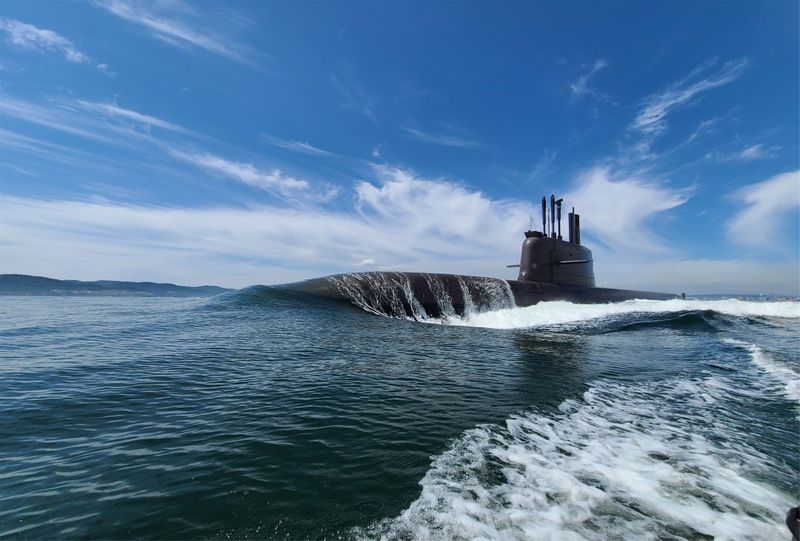
Hanwha Ocean sent an actual submarine to Canada earlier this year to demonstrate its performance, and government and political figures from both countries visited Canada in succession to engage in support diplomacy. The Globe and Mail, a leading Canadian media outlet, assessed the bidding war by stating, "South Korea and Germany waged a fierce competition for about a year, rarely seen in the history of Canadian defense procurement.
"
Courtesy of Hanwha Ocean [Financial News] Hanwha Ocean ultimately failed to overcome the high hurdle of being a "NATO member" in the Canadian Next Generation Submarine Project (CPSP), which has a total project cost of 60 trillion won. The bidding war concluded with Germany's ThyssenKrupp Marine Systems (TKMS) being selected as the final preferred bidder. However, Hanwha Ocean is being praised for demonstrating the textbook example of a "mega-package order" by forming a "one team" with the government and HD Hyundai Heavy Industries based on rapid delivery and price competitiveness, and by proposing large-scale local industrial cooperation.
[email protected] Kim Dong-ho Reporter