Investors Rush to Samsung Electronics and SK hynix 2x ETFs, Ignoring KOSDAQ
- Input
- 2026-07-06 18:25:42
- Updated
- 2026-07-06 18:25:42
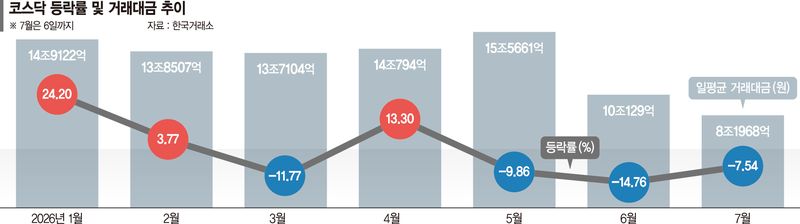
According to Korea Exchange on the 6th, KOSDAQ closed at 847.07, down 21.34 points, or 2.46%, from the previous session. That marked the year’s low and represented a 30.92% drop from the annual high of 1,226.18 recorded on April 27.
KOSDAQ has fallen 8.47% so far this year. That stands in sharp contrast to KOSPI’s 91.05% surge over the same period. Last year, KOSPI jumped 75.63% while KOSDAQ rose only 36.46%, and this year’s underperformance has deepened further.
As KOSPI climbed sharply and drew in funds, KOSDAQ saw liquidity weaken as trading value sank to a yearly low. Trading value on KOSDAQ came to 610.63 billion won that day, the lowest of the year. That was less than a quarter of the 2.53341 trillion won recorded on January 26, the busiest trading day so far this year. So far this month, average daily trading value on KOSDAQ has been 819.69 billion won, still below 1 trillion won.
Last month, average daily trading value on KOSDAQ was 1.01229 trillion won, down 35.67% from the previous month’s 1.55661 trillion won and the lowest monthly figure of the year. That contrasts with KOSPI, which posted a record average daily trading value of 5.03471 trillion won last month.
The KOSDAQ market is seen as having weakened as investment flowed into large-cap semiconductor stocks. In particular, analysts say the concentration intensified after the launch of single-stock leveraged exchange-traded funds (ETFs) tied to Samsung Electronics and SK hynix in late May.
Han Ji-young, an analyst at Kiwoom Securities, said, "Trading value in single-stock leveraged products tied to Samsung Electronics and SK hynix accounts for more than 20% of KOSPI trading value." She added that this could increase volatility in market liquidity overall.
Policy expectations are rising as efforts to improve KOSDAQ’s fundamentals move forward, including the recent implementation of measures to delist penny stocks trading below 1,000 won. In particular, if a promotion-and-relegation system is introduced to divide the KOSDAQ market into tiers such as premium and standard, investors expect the market’s fundamentals to improve around stronger companies, which could lift sentiment.
Lee Byung-hwa, an analyst at Shinhan Investment & Securities, said, "The KOSDAQ promotion-and-relegation system is expected to bring a structural revaluation of KOSDAQ valuations by removing weak companies and reclassifying stronger ones." He added that it would likely improve the quality of investable stocks and investor perception at the same time.
On the other hand, some say the policy impact will be limited. Lee Jae-won, an analyst at Yuanta Securities Korea Co., Ltd., said, "Individual investors, who have been driving the market higher, are selling KOSDAQ and buying KOSPI net when KOSPI falls sharply, so a trend reversal in KOSDAQ is unlikely." He added, "Even if the promotion-and-relegation system is introduced, there is a risk that liquidity will be concentrated only in top stocks in the premium segment."
jisseo@fnnews.com Seo Min-ji Reporter