Olive Oil Prices Surge on Europe Heat Wave... Will Chicken Prices Rise in Korea?
- Input
- 2026-07-06 18:18:12
- Updated
- 2026-07-06 18:18:12
■ Olive, sunflower and canola oil prices surge amid climate anomalies
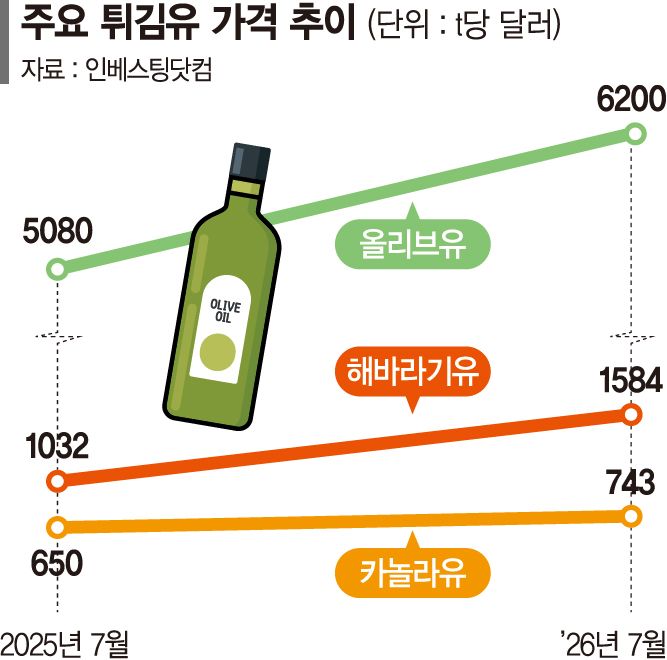
According to Investing.com on the 6th, the international price of olive oil stood at $6,200 per ton, up $1,120, or 22.1%, from $5,080 in July last year. Europe has recently been suffering from climate change. After a dry winter with below-normal rainfall, heat waves topping 40 degrees Celsius have hit the region, putting not only olives, sunflowers and fruit crops but also livestock farming under strain.
In fact, data released last month by the European Commission showed that EU olive oil export volume from January to April this year fell to 5.88 million tons, down 1.05 million tons, or 15.2%, from 6.93 million tons a year earlier, indicating that the impact of abnormal weather is now being felt in earnest. In addition, the won–dollar exchange rate has risen by more than 160 won since last year, from the mid-1,300 won range to the mid-1,500 won range, further increasing the cost burden companies feel for raw materials.
Genesis BBQ Group, which uses olive oil as a major frying oil, is also on alert. BBQ Chicken uses blended olive oil with a 50% olive oil ratio for frying. Last year, 95.3% of olive oil imported into Korea came from Spain, Italy and Greece, leaving the company directly exposed to export declines and price increases caused by the heat wave in Europe.
Although they are not mainly imported from Europe, the international prices of sunflower oil used by bhc for frying and canola oil used by Kyochon F&B are also rising. Sunflower oil has climbed from $1,032 to $1,584, up $552, or 53.5%, compared with last year, while canola oil has risen from $650 to $743, up $93, or 14.3%. Italy, France and Spain have traditionally grown sunflowers domestically, but the heat wave has caused significant damage to sunflower-growing areas. As a result, sunflower oil imports have surged, adding to upward pressure on prices. Crop conditions for rapeseed, the main raw material for canola oil, are also weak.
■ Pressure mounts for chicken price increases
Rising frying oil prices are also fueling signs of chicken price hikes. Depending on the franchise, one container of frying oil is enough to fry about 50 to 70 chickens. That accounts for roughly 5% to 7% of chicken prices. In April, Kyochon F&B raised its supply price for frying oil by 10%, with headquarters absorbing half of the increase. bhc raised frying oil prices by 20% in December last year. In simple terms, franchise owners are now bearing about 0.25% to 0.5% of chicken prices. Earlier, Goobne Chicken reduced the raw weight of its boneless menu items from 800 grams to 700 grams before cooking and raised prices for side dishes such as spicy chicken feet and Cajun fries.
An industry official said, "Even as raw material costs rise, headquarters are absorbing as much of the increase as possible." The official added, "Rather than raising chicken prices, we are reviewing various options, including higher prices for side dishes and drinks, to minimize the burden on franchisees and consumers."
security@fnnews.com Park Kyung-ho Reporter