China Pushes Through U.S. Containment to Challenge Semiconductor Dominance ... Massive IPOs Are Its New Bet
- Input
- 2026-07-06 18:15:12
- Updated
- 2026-07-06 18:15:12
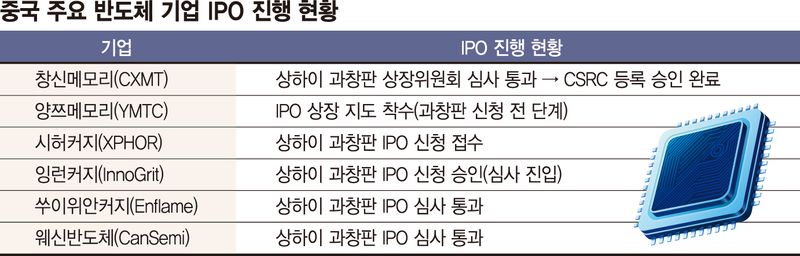
According to industry sources on the 6th, ChangXin Memory Technologies (CXMT), China's largest DRAM maker, plans to raise 29.5 billion yuan, or about 665.23 billion won, through an IPO on the Shanghai Stock Exchange (SSE). CXMT has already completed registration approval for the listing. The funds will be used to improve DRAM storage technology, upgrade manufacturing lines, and develop next-generation DRAM technologies. After struggling with losses through last year, CXMT's performance has improved rapidly this year, helped by the expansion of AI data centers and a surge in memory prices.
■ Large-scale IPOs set to accelerate in the second half
YMTC, one of China's leading 3D NAND flash memory makers, is also preparing for an IPO. The company has already begun the listing process and currently has a monthly production capacity of 200,000 wafers at two plants. It is expected to bring a third factory online in Wuhan toward the end of the year.
Recent Chinese media reports, including Global Times, said the Shanghai Stock Exchange announced that it had received an IPO application from XPHOR, a silicon photonics company, for listing on the SSE STAR Market, a trading board dedicated to Chinese science and technology stocks. XPHOR reportedly plans to raise 2.43 billion yuan, or about 54.8 billion won, to expand production capacity for silicon photonic chips used in AI computing and data centers, develop and commercialize next-generation products, and build its own R&D hub.
The Shanghai Stock Exchange also said it had received an SSE STAR Market IPO application from InnoGrit, a developer of storage controller chips. On the 15th of last month, EnFlame, a cloud AI chip developer, and CanSemi, a 12-inch wafer manufacturer, passed IPO review. The two companies are reportedly seeking to raise a combined 13.5 billion yuan, or about 342.8 billion won.
■ Building an ecosystem with large-scale long-term capital
The IPO rush among Chinese semiconductor companies is being seen as a strategy to secure funding for massive capital expenditures and technology development. In the memory semiconductor industry, price cycles and technology transitions happen at the same time, making long-term capital essential to turn the current boom into investment in next-generation technologies.
Another factor is that national funds set up by the Chinese government and support from local governments are no longer enough to meet the surging demand for AI chip investment. Raising market capital through IPOs offers the advantage of securing large-scale, long-term funding more stably.
There is also an underlying push to accelerate supply chain localization in response to U.S. technology containment. The aim is to build a domestic ecosystem spanning equipment, materials, and components, while concentrating private capital to speed up technological self-reliance.
Global Times said the IPO boom in China's semiconductor industry "reflects the growth of future industries and the drive for technological self-reliance." Wu Qing, chairman of the China Securities Regulatory Commission, said in a speech at the Lujiazui Forum on the 17th of last month that, as part of reforms to the SSE STAR Market, he would "support more 'hard-tech' companies in areas such as quantum technology, embodied intelligence and biomanufacturing to go public." Hard-tech refers to core technologies that require long-term R&D and involve significant technical challenges.
Meanwhile, the IPO rush among Chinese semiconductor companies could also weigh on South Korean firms. If listing proceeds flow into general-purpose DRAM and other segments, South Korea's semiconductor industry may be forced to defend prices while also maintaining a technological edge. Jonghwan Lee, professor of System Semiconductor Engineering at Sangmyung University, pointed out that "if DRAM supply increases in China, prices will inevitably fall from current levels." He added that "profitability could be lower than under the current three-way oligopoly of Samsung Electronics, SK hynix and Micron."
[email protected] Hong Chaewan Reporter