Seoul villas are selling for over 100 million won per 3.3 square meters... Songpa, Eunpyeong, Gangseo and Gwangjin see heavy buying
- Input
- 2026-07-06 18:13:25
- Updated
- 2026-07-06 18:13:25
According to actual transaction data from the Ministry of Land, Infrastructure and Transport, a villa in Jayang-dong, Gwangjin District, Seoul, traded for 860 million won in May. The land area is 17.1 square meters, which means the land share alone is worth more than 100 million won. A villa in Sadang-dong, Dongjak District, where a redevelopment project is under way, is valued at more than 100 million won per 3.3 square meters based on land share. A local broker in Jayang-dong said that half of villa buyers are in their 30s, adding that they are purchasing with future new-apartment subscription rights in mind.
The Seoul villa market is showing signs of overheating. Demand for new-apartment subscription rights tied to redevelopment and reconstruction projects is pouring in, especially from younger buyers. Villa prices have posted their strongest rise in 18 years this year, and transaction volume is also surging.
■ Seoul villa prices hit an 18-year high
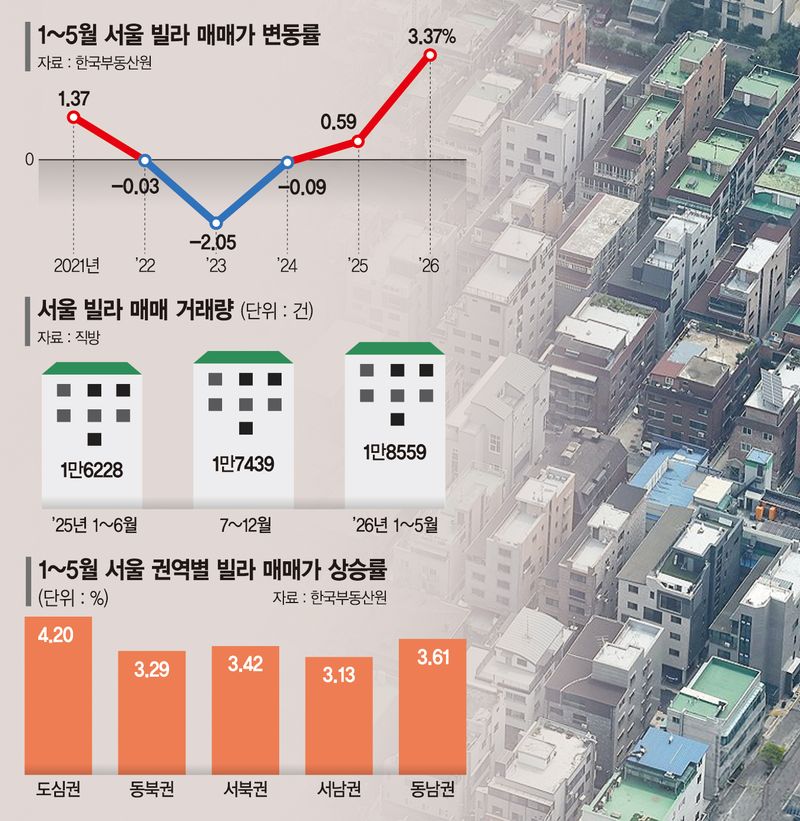
According to monthly statistics released by the Korea Real Estate Board (KREB) on the 6th, villa sales prices in Seoul rose 3.37% from January to May this year. By region, the downtown area saw the biggest gain at 4.20%. All other areas also rose by more than 3%.
During the same period, Seoul apartment prices rose 3.81%. The gap between apartment and villa price growth is not large. A review of the monthly data shows that this year's increase of 3.37% is the highest in 18 years, since 2008, when prices jumped 9.61%. In 2008, the New Town boom drove Seoul villa prices up 13.17% on an annual basis.
Ko Jun-seok, a professor at Yonsei University, said that apartment prices were soaring at the time while supply was limited. He added that it was a period when investment in aging villas peaked, as the New Town projects gained momentum.
Villa transactions are also rising sharply. An analysis commissioned from Zigbang showed that Seoul villa transactions from January to May this year reached 18,559, already surpassing the 16,228 recorded in the first half of last year. Based on the first half of this year, the total is expected to exceed 20,000. In the second half of last year, transactions were in the 17,400 range.
Villa trading is concentrated in certain areas. Of the 18,559 transactions from January to May, 5,645, or 30.4%, were in four districts: Songpa, Eunpyeong, Gangseo and Gwangjin.
■ For redevelopment sites, 100 million won per 3.3 square meters is the norm
The main reason the villa market is heating up is the sharp rise in mid- to low-priced apartment values. Villas, which are relatively more affordable, are seen as a way to secure new-apartment subscription rights through redevelopment and reconstruction projects.
According to local brokers, in redevelopment areas such as New Planning projects and Moa Town projects, a land-share price of more than 100 million won per 3.3 square meters is now standard.
By contrast, villas outside redevelopment zones are barely trading at all. The villa market is also becoming increasingly polarized.
Demand is also being boosted by the fact that Seoul's land transaction permit system applies only to apartments. In the early stages of a project, villas that are not designated as separate permit zones can still be purchased with tenants in place.
There is also considerable demand from buyers willing to live through the redevelopment process. Areas designated as redevelopment zones, such as Moa Town and New Planning projects, are subject to the permit system. Younger buyers who are focused on project safety are making investments with a 10- to 20-year horizon.
Kim Je-gyeong, head of Tumi Real Estate Consulting, said that for villa investments, the best-case scenario is a site that has already received project approval if safety is the priority. He added that even having a redevelopment zone designation is relatively safe. He also warned that even after a cooperative is established, it can take at least 10 years before move-in, and investors should factor in the risks of long project timelines.
[email protected] Lee Jong-bae
[email protected] Lee Jong-bae Reporter