OpenUSD set for launch as stablecoin competition shifts from issuance to distribution [Crypto Briefing]
- Input
- 2026-07-06 10:25:21
- Updated
- 2026-07-06 10:25:21
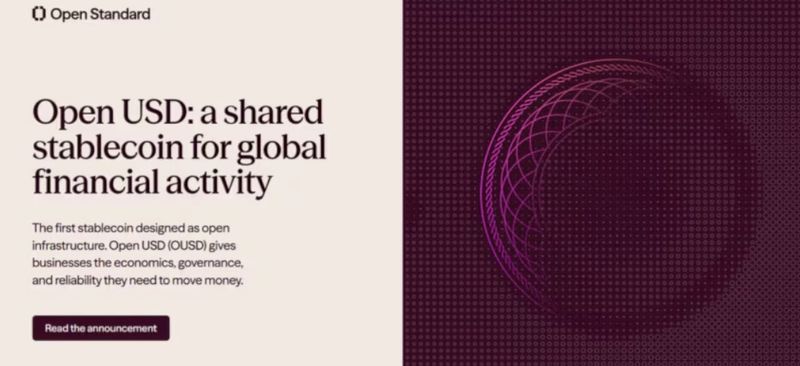
[Financial News] The Open Standard consortium, led by global payments company Stripe, plans to launch a new dollar stablecoin, OpenUSD (OUSD), in the second half of this year. Because OUSD will not charge issuance or redemption fees and will distribute reserve investment income to participating distributors, it is expected to affect how profits are shared across the stablecoin industry.
According to foreign media and industry sources on the 6th, Circle Internet Group's stock, listed on the U.S. market, fell after OUSD challenged the dollar stablecoin market, which is currently dominated by Tether (USDT) and USD Coin (USDC). Analysts say OUSD's revenue model could pressure the profitability and distribution bargaining power of existing players such as Circle Internet Group.
According to Investing.com, Circle's stock closed at $62.63 on the 30th of last month, down 17.55% from the previous day, after news of OUSD's launch broke. The decline continued on the following day, the 1st of this month, but on the 2nd it rebounded 4.31% to $64.62 as technical buying and bargain hunting emerged on oversold concerns.
Brokerage analysts view OUSD's debut not as an immediate blow to Circle's fundamentals, but as a sign that concerns over margin compression from the new competitor's profit-sharing model have already been priced in. Since OUSD has not been officially launched yet, they say further verification is needed on whether it can secure liquidity and expand its use cases.
Open Standard said OUSD is built on three core principles: zero issuance and redemption fees, no cap on issuance, and distribution of reserve investment income to distributors. While Tether and Circle have enjoyed high margins by directly capturing large interest income generated from reserves made up of U.S. Treasuries and other assets, OUSD will deduct only a small management fee for operating costs and then distribute all reserve income to consortium members based on their contribution to circulation.
Market experts say this structure could directly threaten Circle's market share. Lee Jun-ho, a researcher at Hana Securities, said, "OUSD is structured to minimize issuer profits and allow distributors to share reserve income," adding, "That gives companies enough incentive to choose OUSD instead of existing USDC."
More than 140 players have joined the OUSD alliance, including payment companies such as Visa, Mastercard, and American Express, as well as major financial institutions such as BlackRock, BNY, and Standard Chartered, and big tech companies including Google and Samsung Electronics.
For Circle, Coinbase is a key variable. Coinbase is a core distribution partner for USDC and a major partner that has shared reserve income with Circle. Eugene Investment & Securities said Coinbase's participation as an early OUSD member creates a structure in which it becomes both a key distribution partner for Circle and a stakeholder in a competing stablecoin network.
Still, some remain cautious about assuming OUSD will take hold quickly. Jeremy Allaire, CEO of Circle, said on social media that "a structure that gives all revenue to distributors will erode the capacity to invest in long-term financial infrastructure." He also pointed to the risk that decision-making could slow in a consortium made up of dozens of competing companies, while USDC's established ecosystem and network effects remain major barriers. Sungwook Hong, a researcher at NH Investment & Securities, said, "We cannot overlook the first-mover advantage and liquidity of USDC, which has already issued more than $73 billion," adding that "OUSD's app ecosystem openness and ability to respond quickly should be tested."
Samsung Electronics, Shinhan Financial Group, and Dunamu were among the Korean companies named in the OUSD consortium. Analysts say this could become an important benchmark for the future introduction and institutionalization of won-denominated stablecoins. Kim Se-hee, a researcher at Eugene Investment & Securities, said, "In the won stablecoin market as well, distributors with retail touchpoints and payment networks will gain stronger bargaining power than issuers," adding that "a consortium model involving banks, card companies, exchanges, and big tech firms is likely."
[email protected] Kim Mi-hee Reporter