"Will my stock be delisted too?" KOSDAQ launches a survival campaign
- Input
- 2026-07-05 06:00:00
- Updated
- 2026-07-05 06:00:00
[Financial News] As delisting requirements have been tightened, stock splits among listed companies in South Korea have surged 24-fold in a year. With splits aimed at avoiding penny-stock thresholds and mergers designed to prevent market-cap shortfalls, companies are now moving aggressively to keep their listings.
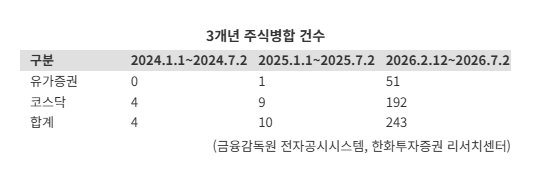
According to the securities industry on the 6th, a total of 243 stock splits by domestic listed companies were recorded from Feb. 12, when the delisting reform plan was announced, through the 2nd of this month. That is more than 24 times the 4 cases seen in the same period of 2024 and the 10 cases in 2025. By market, there were 51 on the Korea Exchange Main Board and 192 on the KOSDAQ market, showing a far heavier concentration in KOSDAQ.
The sharp increase in stock splits appears to stem from the tougher delisting rules. In February, the FSC and Korea Exchange announced a "delisting reform plan for the swift and strict removal of distressed companies," and the exchange revised its listing rules accordingly. As a result, from the 1st, the market-cap thresholds for KOSPI and KOSDAQ were raised to 30 billion won and 20 billion won, respectively, and penny stocks priced below 1,000 won were also added to the delisting criteria.
Analysts say the newly introduced sub-1,000-won penny-stock rule has especially encouraged stock splits. A stock split combines multiple shares into one to lift the share price. For example, a 5-for-1 split reduces the number of shares to one-fifth while multiplying the reference price by five. It does not change a company's value, but it is effective in meeting the 1,000-won price threshold.
There have also been a series of mergers aimed at meeting market-cap requirements. Humax disclosed on June 30 that it would absorb Humax Holdings. In the merger filing, the two companies cited the delisting reform plan as one of the reasons for the deal, saying the risk of being designated as a monitored company and being delisted had increased.
NP also gave a similar explanation in its merger with Wizwix Studio. NP announced the absorption merger on April 9, and the merger date is set for the 14th. As of the 3rd, NP's market capitalization stood at 18.4 billion won, below the KOSDAQ delisting threshold of 20 billion won.
However, it remains unclear whether these self-help measures will lead to stronger fundamentals. Stock splits and intra-group mergers may help companies meet delisting requirements, but they do not guarantee revenue growth or improved profitability. Critics also warn that if companies focus more on share-price management and maintaining their listings than on R&D and capital investment, the reform's goal of restoring market trust could be undermined.
Market watchers expect capital transactions aimed at preserving listings, such as stock splits, mergers and rights offerings, to continue in the second half of the year as the tougher delisting rules take full effect.
"For listed companies, it is reasonable to use every lawful measure available to overcome the risk of delisting," said Eom Su-jin, a researcher at Hanwha Investment & Securities. "But KOSDAQ firms with limited human and financial resources should be cautious about putting everything on the line to preserve their listings while pushing core competitiveness to the back burner."
[email protected] Choi Du-seon Reporter