Power Transmission Towers Halted by Fear of Electromagnetic Waves, Based Only on a '2B Classification' [Lee You-beom's Eco & Energy]
- Input
- 2026-07-04 06:00:00
- Updated
- 2026-07-04 06:00:00
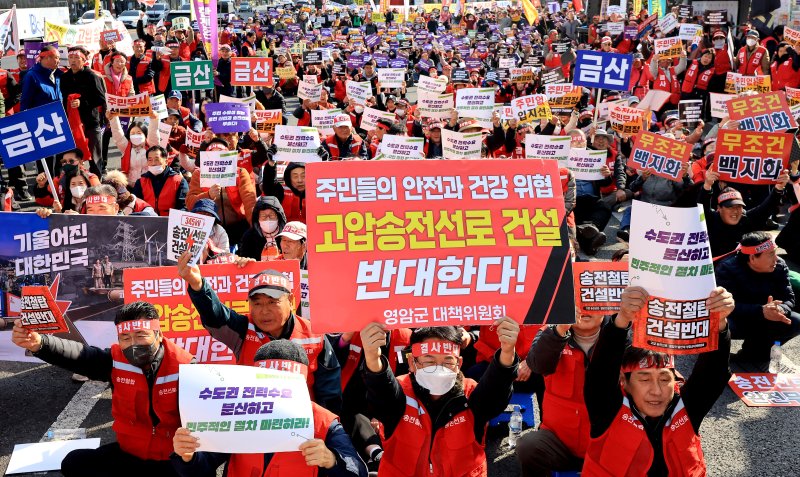
[Financial News] The Donghaean-Singapyeong high-voltage direct current (HVDC) project took 88 months to break ground, while the Bukdangjin-Sintangjeong transmission line was delayed by 150 months. One of the main arguments used by opponents of transmission tower construction is the claim that electromagnetic waves cause childhood leukemia. The International Agency for Research on Cancer (IARC) has been cited for classifying extremely low-frequency magnetic fields as Group 2B carcinogens, but scientists point out that this classification indicates the possibility of harm, not its magnitude, and follow-up studies have failed to prove causation.
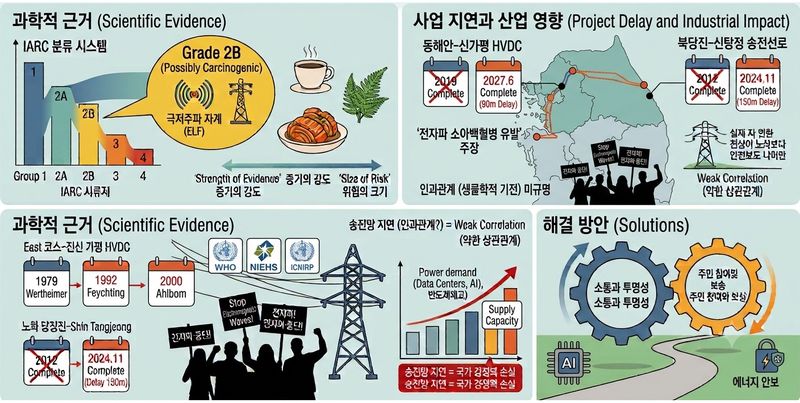
Group 2B carcinogen, in the same category as kimchi and coffee
What is generated by transmission lines is an extremely low-frequency (ELF) magnetic field, which is different from ultraviolet rays and X-rays, the types commonly known to be dangerous. Ultraviolet rays and X-rays are ionizing radiation with strong energy that directly destroys the atomic structure inside the body, and their harmful effects have already been proven. By contrast, extremely low-frequency magnetic fields belong to non-ionizing radiation, which is far weaker and generally understood by physicists to lack the power to directly destroy cells or genes. In 2002, the World Health Organization (WHO)-affiliated International Agency for Research on Cancer classified extremely low-frequency magnetic fields as Group 2B, or a 'possibly carcinogenic' agent. The same category also includes pickled vegetables, coffee and bracken. Being designated a carcinogen does not automatically mean it poses a strong risk. The IARC classification system is meant to sort substances by whether they may cause cancer, not to measure actual risk.The basis for the classification was an epidemiological study that began in the United States in 1979. Nancy Wertheimer reported that the incidence of childhood leukemia among children living near power substations was 2.29 times higher. In 1992, the Karolinska Institute in Sweden published the Feychting report, saying that the incidence of leukemia among children living near transmission lines was 2.7 to 3.8 times higher above certain magnetic-field exposure levels. The Swedish government even used that finding to remove many transmission towers from residential areas. Later, the key evidence cited by IARC for the Group 2B classification was a 2000 meta-analysis by Swedish epidemiologist Anders Ahlbom, which combined studies from nine countries and found that children continuously exposed to magnetic fields above 0.4 microtesla (μT) had a statistically significant higher risk of leukemia. However, only about 1% of the population was exposed at that level, and a clear dose-response relationship, in which risk falls proportionally as exposure decreases, was not established. Childhood leukemia is also a very rare disease, so even if relative risk rises several times, the absolute increase in actual cases remains small, according to epidemiologists.
There was a correlation, but no causal link was found
A number of follow-up studies and international joint research projects led by the WHO later failed to confirm a consistent causal relationship between electromagnetic wave exposure and childhood leukemia. That is because no biological mechanism has been identified to explain the statistical correlation seen in the early studies. The National Institute of Environmental Health Sciences (NIEHS) also described the evidence for the carcinogenic potential of extremely low-frequency magnetic fields as 'weak' in a 1999 congressional report. Researchers also raised the possibility that the observed correlation may have resulted from other environmental factors, such as housing density and traffic volume, or from bias in study design.
WHO guidelines also state that the evidence linking extremely low-frequency magnetic fields to childhood leukemia is weak, and that it is unclear whether reducing exposure would have any meaningful health effect. WHO has never recognized low-level magnetic-field exposure from power facilities as having a proven effect on the human body. In South Korea, the government manages exposure using the 83.3 μT public exposure limit recommended by the International Commission on Non-Ionizing Radiation Protection (ICNIRP), through a notice issued by the Ministry of Trade, Industry and Energy. This is among the stricter international recommendations, and actual measurements near transmission lines are mostly far below that level. However, uncertainty has not been completely resolved. For that reason, some local governments, including the Seoul Metropolitan Government, apply a target of 1 μT, far below international standards, to schools and hospitals near newly built transmission lines. That stricter standard, however, is not applied retroactively to homes near existing transmission towers, where the international recommendation remains in force.
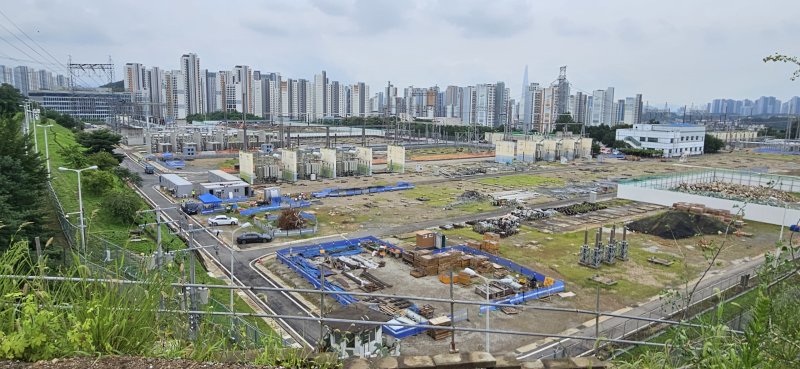
Transmission tower construction has been delayed by fear based on weak evidence
The projects actually brought to a halt by fear of electromagnetic waves are not few. The second phase of the East Coast-to-capital-area HVDC project went to an administrative appeal after Hanam City refused to approve the expansion of the Dongseoul substation, its final destination. The move followed opposition from residents of the nearby Gamil New Town, who disrupted project briefings over concerns about electromagnetic-wave harm and submitted more than 12,000 signatures calling for a complete cancellation. KEPCO countered that measured electromagnetic waves at the entrance of the nearest apartment complex were 0.02 μT, lower than the 0.12 μT emitted by a convenience store refrigerator. Even so, the original completion target of 2019 has slipped through 2025 and 2026, and has recently been pushed back to 2029. Last May, the government also suspended site-selection procedures for 27 transmission lines nationwide for a month, citing opposition from civic groups and residents. Claims about electromagnetic-wave harm are a constant feature of the resistance.
Meanwhile, electricity demand is rising even faster. The National Assembly Research Service (NARS) projects that 732 new data centers by 2029 could create as much as 49 GW of additional power demand, while South Korea's current power supply capacity is only around 110 GW. No matter how many power plants are built, electricity cannot reach where it is needed if the transmission grid is not in place. The industry fears that every delay in the grid will translate directly into a loss of industrial competitiveness.
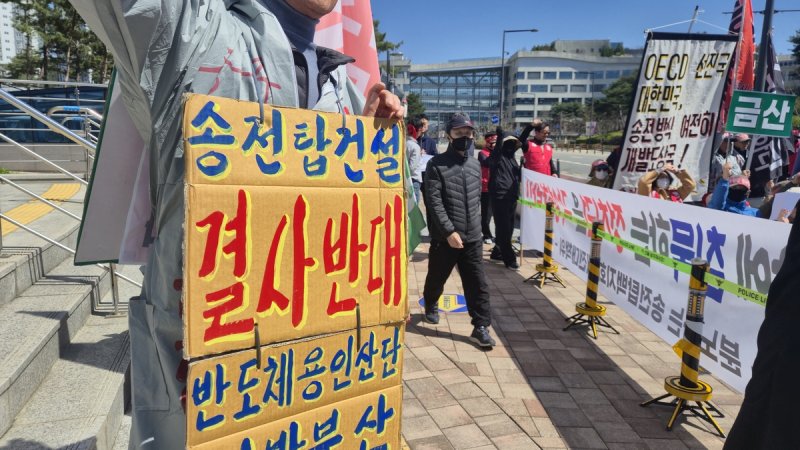
The real problem is not electromagnetic waves, but distrust
The biggest domestic flashpoint over the harmful effects of electromagnetic waves was the 2008 Miryang transmission tower dispute in South Gyeongsang Province. Korea Electric Power Corporation (KEPCO) clashed fiercely with residents while installing a 765 kV high-voltage transmission line. Opponents claimed that electromagnetic waves would cause leukemia, but there was little scientific evidence to support that claim. Instead, criticism grew that the government and KEPCO had failed to communicate properly with residents. At the time, many said the conflict was less about electromagnetic waves than about trust, compensation negotiations and procedural legitimacy.
In other words, many experts believe that distrust in the project implementation process, rather than scientific uncertainty, played a larger role in the expansion of the electromagnetic-wave debate. A similar pattern is repeating in the recent conflict over the 345 kV transmission line in the southwest coast region. The real cause of the backlash, critics say, is not electromagnetic-wave harm itself, but site selection carried out without resident participation and an inadequate compensation system.
It is true that electromagnetic waves were classified as a possible carcinogen, but that was a precautionary judgment meaning the possibility could not be ruled out, not proof of causation. Domestic and international studies suggest that the uncertainty is not an established risk substantial enough to justify project delays measured in months, or even 150 months. The key issue is how transparently the government and project operators explain that uncertainty, and how substantively they guarantee resident participation. With power demand from semiconductors and artificial intelligence now looming, minimizing delays caused by weakly supported fears is also a matter of energy security.
Climate, the environment and energy are like two sides of the same coin. Depending on how energy is produced, it can accelerate global warming, or changes in climate and the environment can affect energy demand and supply.[Lee You-beom's Eco & Energy]This column visits readers every Saturday with issues in climate, the environment and energy, which are inseparable from one another. If you subscribe to the reporter's page, you can receive it more conveniently.
[email protected] Lee You-beom Reporter