Weak June U.S. Job Gains Likely to Put More Focus on Inflation at the Fed
- Input
- 2026-07-03 13:39:31
- Updated
- 2026-07-03 13:39:31
[Financial News] U.S. employment data for June showed a marked slowdown, ending the overheated pace seen over the past three months.
The Federal Reserve is expected to keep interest rates unchanged for now as it focuses on inflation.
Yahoo Finance reported on the 2nd local time that the number of new jobs created in the United States in June rose by only 57,000, down from the previous three months. That was far below Wall Street's forecast of 113,000.
The unemployment rate stood at 4.2%, edging down from 4.3% in the previous month and matching market expectations.
Strong employment figures for April and May were also revised sharply lower. April payroll gains were cut by 31,000 from the original estimate to 148,000, while May was revised down by 43,000 to 129,000.
That brought the average monthly job gain over the past three months to about 111,000. It is still notably stronger than the scenario some Fed officials outlined earlier this year, when they said the labor market could be considered balanced even with zero job growth.
Jeffrey Roach, chief economist at LPL Financial, said he was concerned that more people are giving up on job searches altogether. He pointed to the labor force participation rate, which fell 0.3 percentage point to 61.5%.
Still, he added, "For now, the labor market is holding up, which gives the Fed room to keep its focus on price stability."
Krishna Guha, vice chairman at Evercore ISI, said the Fed is likely to view the June jobs report not as a "labor market recession," but as a return to normal after overheating. In a report, Guha said, "The Fed led by Chairman Warsh puts inflation first and rejects any mechanical link between labor market strength and inflation." He added, "The real impact of this jobs report on the outlook for rates will be limited. The path of rates will be determined by variables that affect the inflation outlook directly, rather than by employment."
Indeed, according to the CME FedWatch Tool, markets are pricing in an 80% chance that the Fed will leave rates unchanged at this month's FOMC meeting. The probability of a rate hike in September or October slipped slightly from 50% before the jobs report to 46% afterward.
Before the data release, Fed officials had said the labor market remained stable. Mary Daly, president of the San Francisco Federal Reserve Bank, said at an event in Spain, "The labor market is stable, and no single report will change that assessment."
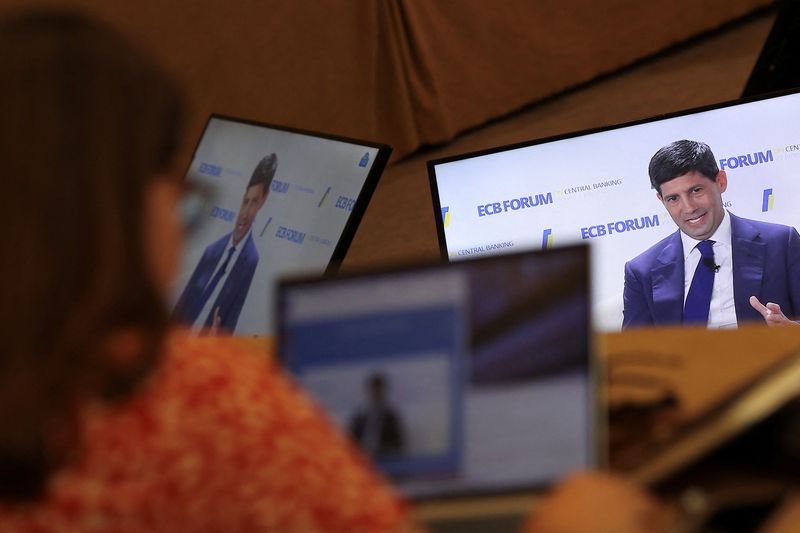
Fed Chairman Kevin Warsh also described the labor market as "solid" at the central bank forum in Portugal. He dismissed concerns that artificial intelligence could trigger mass unemployment, stressing that technological change would ultimately create more jobs and prosperity. Criticizing the view that automation reduces overall labor demand, he said, "When the internet first came into the world, who knew it would create 1.5 million Uber driver jobs? We are only in the first or second inning of this revolution."
But apart from his optimism about employment, Warsh reaffirmed a hawkish stance on the Fed's other mandate: price stability. He said inflation remains too high and vowed to keep monetary policy restrictive until price growth returns to the Fed's 2% target.
Warsh said bluntly, "Prices are too high right now." He added, "Anyone who thought the Fed would settle for inflation above 2% will be disappointed. We will make price stability in the United States a reality."
The core Personal Consumption Expenditures Price Index, the Fed's preferred inflation gauge, rose 3.4% in May from a year earlier, marking its highest level since October 2023. Fed officials have also sharply raised their forecasts for this year's overall inflation to 3.6% from 2.7%, while lifting their core inflation outlook, which excludes food and energy, to 3.3% from 2.7%.
[email protected] Yoon Jae-jun Reporter