On a day when the KOSPI fell 7.9%, these were the stocks 'seasoned investors' bought
- Input
- 2026-07-03 06:00:00
- Updated
- 2026-07-03 06:00:00
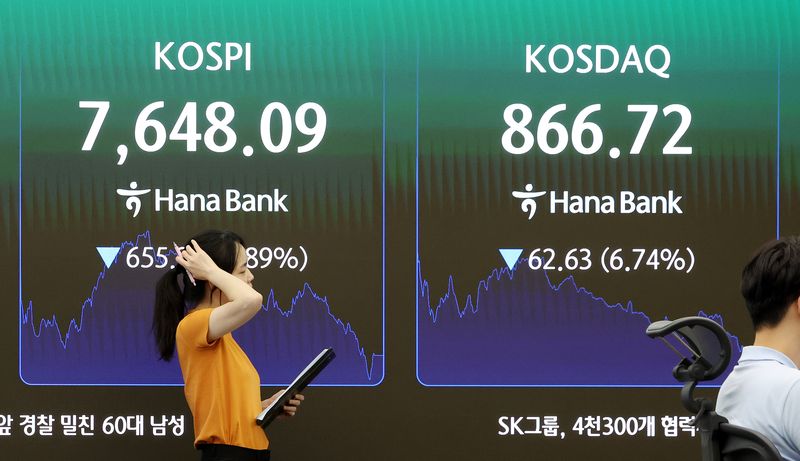
[Financial News] The KOSPI (Korea Composite Stock Price Index) tumbled by nearly 8% as foreign investors launched a massive sell-off. Samsung Electronics and SK hynix also fell more than 9% and 14%, respectively, dragging down all of the large-cap stocks. Individual investors, however, bought more than 6 trillion won worth of Samsung Electronics and SK hynix on a net basis even in the crash. Foreign investors and institutions, by contrast, shifted into other stocks instead of semiconductors, taking a sharply different investment approach.
According to the Korea Exchange on the 3rd, the KOSPI closed on the 2nd at 7,648.09, down 655.32 points, or 7.89%, from the previous session. The KOSDAQ Index also ended the day at 866.72, down 62.63 points, or 6.74%.
Heavy program selling hit the market from the opening bell, and a sell-side circuit breaker was triggered on the Korea Exchange Main Board at 9:07:03 a.m. after a sharp drop in KOSPI 200 Index Futures. Later, at 12:47:15 p.m., a sell-side circuit breaker was also triggered in the KOSDAQ market as volatility widened in KOSDAQ 150 Futures and the spot index.
Large-cap stocks also fell across the board. Samsung Electronics closed at 286,000 won, down 9.06% from the previous session, losing the 290,000-won level. SK hynix ended the day at 2,187,000 won, down 14.57%.
Foreign investors led the plunge on the Korea Exchange Main Board with net sales of 5.133 trillion won. Institutions also sold a net 475.7 billion won. Individual investors, meanwhile, bought a net 5.396 trillion won.
What stood out most was the buying pattern of individual investors. In a single day, they bought a net 4.593 trillion won of SK hynix and 2.0228 trillion won of Samsung Electronics. The combined net buying in those two stocks alone reached 6.6158 trillion won, showing that individual demand was effectively concentrated in Samsung Electronics and SK hynix. Samsung Electro-Mechanics, the third-most net-bought stock by individuals, drew 345.3 billion won, far behind the top two.
Foreign investors and institutions made different choices. Aside from a net purchase of 110.9 billion won in Samsung Electronics preferred shares, foreign investors mainly bought LEENO Industrial Inc. (80.5 billion won) and Hyundai Motor Company (72.5 billion won). Institutions also ranked SK Square (263.8 billion won), KB Financial Group (135.1 billion won), and Shinhan Financial Group (89.2 billion won) among their top net purchases. Even in the sharp downturn, foreign investors and institutions did not aggressively buy Samsung Electronics or SK hynix.
Market watchers say the concentration of individual investors in the semiconductor blue chips has become even more pronounced. After funds recently flowed into Samsung Electronics and SK hynix through single-stock leveraged exchange-traded funds (ETFs), bargain-hunting money also poured into the two names during the sell-off, making the divide in investment behavior even clearer.
A securities industry official said, "Individual investors have recently been trading more around Samsung Electronics and SK hynix than around the index," adding, "As concentration in the flagship stocks deepens, index volatility could rise as well, so it is necessary to closely monitor supply and demand trends."
Lee Jae-won, a researcher at Yuanta Securities, said, "This correction was a bout of volatility driven by overheated positions and profit-taking amid concentration in large-cap stock flows, rather than a slowdown in AI demand." He added, "Since there is no confirmed damage to fundamentals, short-term volatility and companies' long-term competitiveness should be viewed separately."
[email protected] Choi Doo-sun Reporter