"A KRW 3 Trillion Forced Sale? I Never Thought It Would Happen, But It’s Truly Terrifying"... The Fear of 'Debt Investing' Becomes Reality [World of Retail Investors]
- Input
- 2026-07-03 06:00:00
- Updated
- 2026-07-03 06:00:00
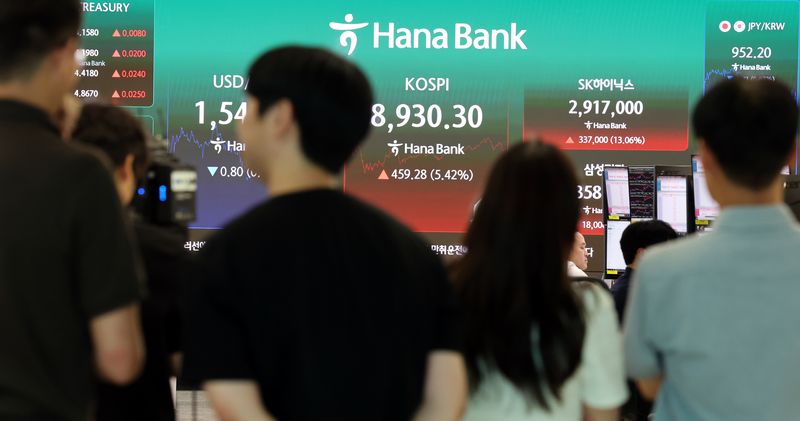
[Financial News] # Office worker L, 38, was originally a Samsung Electronics shareholder. Since early this year, he had been increasing his holdings with money he had planned to put into savings, keeping his portfolio at a reasonable level. As the KOSPI (Korea Composite Stock Price Index) broke through 8,000, his gains kept growing. That was when the problem began. Caught up in the ongoing semiconductor rally, he was easily swayed by people around him saying, "Semiconductors still have more room to run" and "You should even borrow money to buy more now."In the end, L bought about half again as much as his existing holdings through a margin loan. He did not think it was an excessive investment, since margin exposure accounted for only a little over 20% of his total portfolio. But in June, as KOSPI volatility surged and daily swings of 5% to 8% continued, trouble arrived.His margin maintenance ratio fell below the required level, and with no spare cash to add collateral, L had to watch the position be forcibly liquidated at the closing call two trading days later.
Forced sales in the first half: KRW 3.1525 trillion... KRW 969.9 billion in June alone
L’s story captures the dark side of the domestic stock market in the first half of this year. According to the investment banking industry on the 2nd, the volume of forced sales of securities from January to June reached KRW 3.1525 trillion.
It jumped from KRW 216.6 billion in January and KRW 248.3 billion in February to KRW 558.5 billion in March, when the shock from the U.S.-Iran war was severe. It then fell back to KRW 264.2 billion in April, but turned upward again as volatility increased amid record-high debt investing, reaching KRW 794.6 billion in May. Last month, when volatility hit extreme levels, forced sales of securities came to KRW 969.9 billion.
As KOSPI doubled from the 4,200 level to the 8,400 level, the scale of forced liquidations also kept setting new monthly records. With the market rising on the back of large semiconductor names such as Samsung Electronics and SK hynix, concentration intensified. At the same time, volatility increased through single-stock leveraged Exchange-Traded Funds (ETFs), leading to a surge in debt investors facing forced sales of securities, analysts said.
"If I hadn’t added more, I could have held on"... Once the collateral ratio collapsed, even the choice disappeared
If L had invested only his own money from the start, he likely would have been able to ride out the sharp decline. Instead, he was trapped by the painful reality of forced sales of securities, where investors lose their ability to choose.
A forced sale of securities on a margin loan occurs when an investor buys stocks with money borrowed from a brokerage but fails to meet the required maintenance ratio, prompting the brokerage to dispose of the shares held as collateral.
In cases like L’s, the purchased shares are pledged as collateral. If the stock price falls and the collateral value drops below the maintenance ratio set by the brokerage, the firm gives the investor a chance to add more collateral. If the shortfall is not covered, the brokerage can forcibly sell the shares at the closing call on the second trading day after the collateral deficiency occurs. Kim Seok-hwan, a researcher at Mirae Asset Securities, pointed out that "in a sharp downturn, the biggest risk is not the price drop itself, but the forced liquidation."
The dangerous combination of FOMO and leveraged ETFs
One notable pattern behind the surge in debt investing in the first half was the tendency to buy more on margin during a rising market. The driver was fear of missing out (FOMO). The margin lending balance, a key indicator of debt investing, rose from around KRW 27 trillion at the beginning of January to a record KRW 38.6328 trillion on June 24. That is an increase of more than KRW 11 trillion in just six months.
The problem is that this psychology tends to become strongest at the most dangerous time, namely near the market peak. On top of that, volatility in the stock market was amplified by single-stock ETFs based on Samsung Electronics and SK hynix, making the impact of forced sales of securities even greater.
A securities industry official told Newsis on the 2nd that "forced sales are being triggered by extreme volatility, and those forced sales are in turn increasing volatility, creating a vicious cycle," adding that "in a highly volatile market like the current one, investors need to be cautious about leveraged investing."
I don’t want to become someone who keeps saying, "I should have bought, I should have sold, I should have held..." Every day, it feels like everyone else is doing well in stocks, real estate, and investing except me. The world of investing is hard no matter how much you study, so please clap along and empathize[World of Retail Investors]If you want to receive it conveniently, please subscribe to the reporter page.We also welcome tips from retail investors who have investment stories they would like to share.
[email protected] Kim Hee-sun Reporter