Lee: Mega Projects Are Not a Favor to the Regions, but a Historic Decision... Budget to Be Given Top Priority
- Input
- 2026-07-02 14:38:37
- Updated
- 2026-07-02 14:38:37
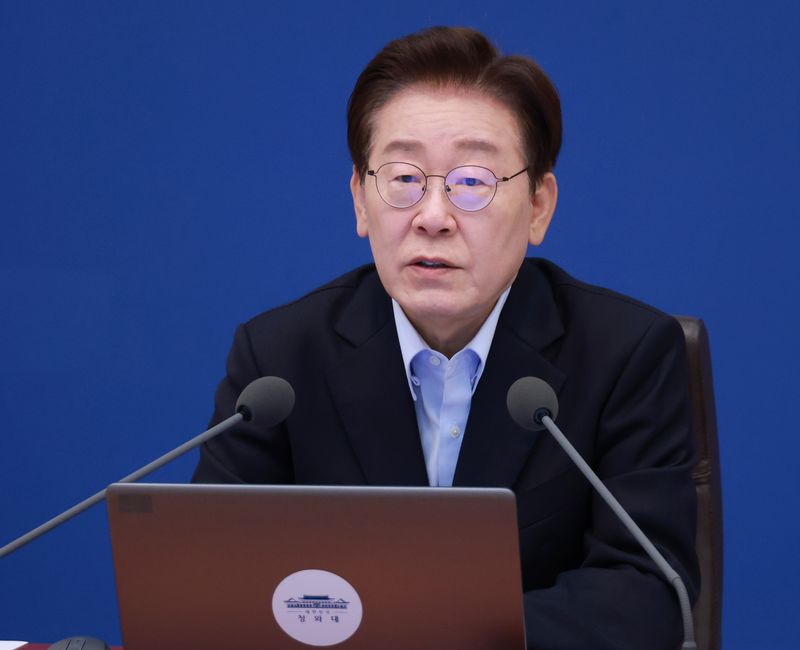
[Financial News] On the 2nd, President Lee Jae-myung described the three major mega projects as "the only path for South Korea to become the final winner of the Fourth Industrial Revolution (4IR) and a historic decision for future generations," and ordered officials to speed up related policy and legal revisions as well as budget allocation by placing them at the top of the national agenda.
In his opening remarks at the 40th senior aides' meeting, held that day at the Yeomin Building in Cheong Wa Dae, Lee said, "The world is now facing a civilizational transformation triggered by the AI revolution." He added, "Major countries are mobilizing all national capabilities to wage a new industrial war."
He then stressed, "To win the global high-stakes economic war, where even a half-step delay means falling behind forever, we must concentrate all our capabilities through bold strategies and swift execution."
He also said, "In the 1970s, the Park Chung Hee administration opened the path to export-led growth by fostering heavy and chemical industries, and in the 2000s, the Kim Dae-jung administration paved the way for becoming a powerhouse in IT technology." He added, "The three mega projects of the People's Sovereignty Government will become the third stepping stone for South Korea to stand tall as a leading industrial power with overwhelming advantages."
He also addressed the goal of easing concentration in the Capital Region. Lee said, "If we diversify the growth axis nationwide beyond the Capital Region, which has already reached its limits, it will become the driving force to transform the entire country into a Korean-style Silicon Valley."
Lee instructed, "Cheong Wa Dae and the government must place the revision of related policies and laws, as well as budget allocation, at the very top of national priorities and accelerate project implementation." He added, "Please also make every effort to establish and carry forward additional investment plans."
He also urged, "For this path, which will be responsible for South Korea's next 30 years and open wider doors of opportunity for young people across the country, I ask the public, businesses, the government, and the political community to unite their strength."
Lee also identified reducing polarization as a key task alongside creating future growth engines. He said, "Reducing the deep-seated imbalances and gaps throughout society is one of the biggest tasks we must address at the same time."
He continued, "If we leave K-shaped polarization unchecked, productivity will fall, growth potential will be damaged, and even national unity and social stability will be shaken." He emphasized, "We must respond with a range of policies, with the mindset that the success or failure of state affairs depends on easing polarization."
To that end, he ordered officials to "make every effort to strengthen the basic social safety net, build a fair labor market, revitalize neighborhood economies, and establish an asset ladder for everyone, including young people." He also said, "Please make sure to use the recently expected additional tax revenue efficiently and create stable investment resources for future generations."
He also called for disaster preparedness during the rainy season. Lee said, "The full monsoon season begins this week," adding, "July's monsoon is unusual, and there are concerns about extreme rainfall, such as monster downpours."
Lee said, "Along with efforts by the central government, what is truly important is the role of local governments on the front lines." He added, "Since this is the early stage of the term and many local governments have new leaders, there is a risk of neglecting emergency response, so special caution is needed."
He then instructed, "All local governments should closely manage their disaster response systems and carry out thorough preemptive inspections of vulnerable sites such as landslide-prone areas, semi-basement homes, aging construction sites, and storm drains."
[email protected] Seong Seok-woo Reporter