A weaker yen is helping push the won down as the exchange rate hits 1,550 won
- Input
- 2026-07-03 06:00:00
- Updated
- 2026-07-03 06:00:00
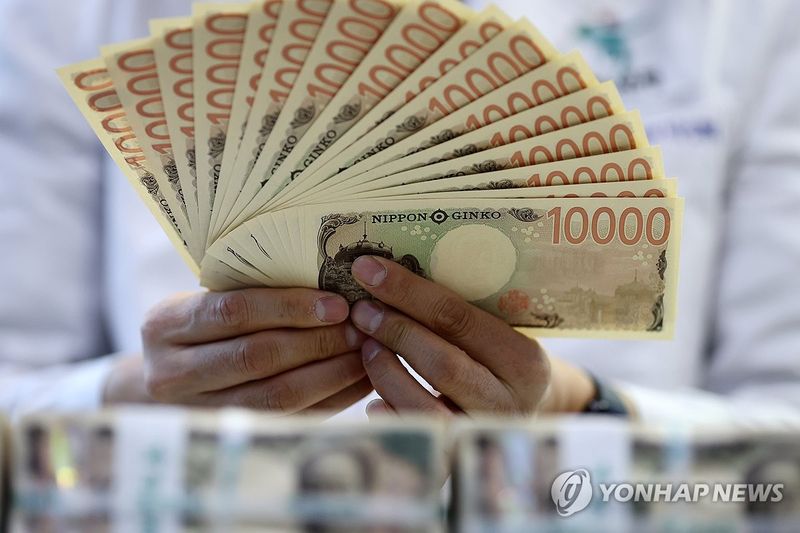
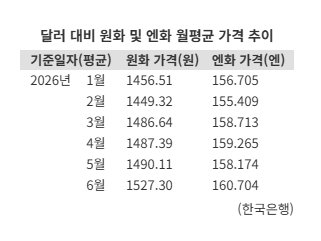
According to the Bank of Korea's Economic Statistics System (ECOS) on the 3rd, the average yen price against the U.S. dollar in June stood at 160.704 yen. Earlier, in March, it rose to 158.713 yen from 155.409 yen in February, and it continued its upward trend in April at 159.265 yen and in May at 158.174 yen, holding in the 158-159 yen range.
It eventually closed at 162.605 yen on the 1st, similar to the level seen in December 1986, shortly after the Plaza Accord was signed to deliberately push the dollar lower, when it traded in the 158-163 yen range. The Korean won has shown a similar pattern. The average won-dollar exchange rate was 1,449.32 won in February, then kept rising to 1,486.64 won in March, 1,487.39 won in April, and 1,490.11 won in May, before reaching 1,527.30 won in June. On the 2nd, it ended the session in the 1,555-won range.
Although both countries are earning dollars through stronger trade performance, their exchange rates have not stabilized. South Korea posted a record second-highest Current Account Balance of $28.29 billion in April, while Japan's figure for the same month also rose 64.9% from the previous month to 3.9078 trillion yen, or 1.5378 trillion yen more, reaching 3.9078 trillion yen.
Markets see this not as a coincidence but as synchronization. In fact, the Bank of Korea's 2026 March Monetary and Credit Policy Report showed that when the correlation coefficient for synchronization with the won was calculated for the second half of last year, the yen came in at 0.53, up 0.18 points from 0.35 in the first half. That increase was stronger than those for China, which rose from 0.33 to 0.42, and Taiwan, which edged down from 0.58 to 0.57.
Common economic and financial structures are leading the foreign exchange market to treat the won and the yen as a single group. First, policy rates, which form the basis of exchange rate determination, are lower than those in the United States. The U.S. policy rate stands at 3.50% to 3.75%, while South Korea's is 2.50% and Japan's is 1.00%. As global capital flows toward higher-yielding assets, demand for the dollar rises and its value inevitably increases. In Japan's case, it has moved away from zero interest rates, but the environment for the yen carry trade — borrowing yen at low rates to invest in overseas assets — remains intact.
They also share a floating exchange rate system. China and Taiwan, two neighboring Asian economies, operate managed floating exchange rate systems that keep currency fluctuations within a certain range, but the currencies of South Korea and Japan are far more sensitive to external variables such as the dollar, interest rates, and international oil prices.
Investment commitments to the United States — $350 billion for South Korea and $550 billion for Japan — are also a drag on currency declines. Market participants say the won and the yen will struggle to strengthen as dollar outflows are already scheduled. Once actual fund disbursements begin, investment is expected to concentrate in the early stages, raising expectations that the exchange rate could even test 1,600 won.
Among the two, the won appears to be weakening faster than the yen. The won-yen exchange rate, which stood at 915.06 won at the start of the year, rose to 952.25 won on the 1st. That means it now takes 37.19 won more, or 4.06% more, to buy 100 yen than it did six months ago.
Conversely, if the yen turns stronger, the won could also rebound. That could happen if Japan buys yen using its massive foreign exchange reserves, which stood at $1.383 trillion at the end of May and ranked second in the world, or if it raises policy rates to narrow the gap with the United States. Even so, the Takaichi administration's large-scale fiscal plan makes it look difficult for the yen to escape its weakness.
Park Sang-hyun, a researcher at iM Securities, said, "What has fueled the super-weak yen is Prime Minister Sanae Takaichi's aggressive expansionary fiscal policy plan," adding that it is "deepening concerns over Japan's fiscal soundness and leading to yen weakness."
Cho Yong Gu, a researcher at Shinyoung Securities, said, "It is necessary to stabilize the exchange rate through close coordination not only with the United States government and the Federal Reserve System (Fed), but also with Japan," and added, "In the medium to long term, standing currency swap arrangements with major countries will also be needed."
[email protected] Kim Tae-il Reporter