After Self-Congratulating Over the KOSPI, Foreigners Are Fleeing the Korean Stock Market [Why Stocks Move]
- Input
- 2026-07-02 09:15:13
- Updated
- 2026-07-02 09:15:13
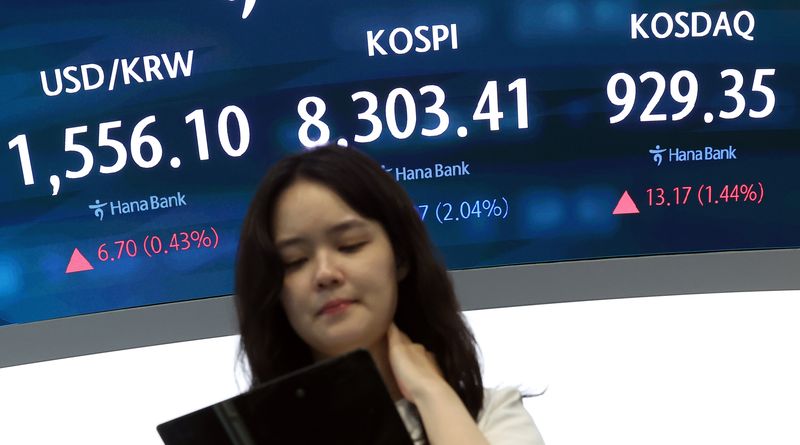
[Financial News] While the KOSPI (Korea Composite Stock Price Index) has repeatedly hit record highs, foreign investors have been heavily selling Korean stocks. Their net selling this year has exceeded 150 trillion won, and they sold nearly 50 trillion won worth of shares in June alone.
According to the Korea Exchange on the 2nd, foreigners net sold 48.6248 trillion won in the Korea Exchange Main Board during June. That was about 3.9 trillion won more than the 44.7146 trillion won in net selling recorded in May from the 4th to the 29th.
Foreign investors continued to sell throughout this year’s KOSPI rally. From January 2 to July 1, cumulative net selling reached 150.7475 trillion won. Since last month’s 19th, they have kept up a streak of net selling on the Korea Exchange Main Board, maintaining their bearish stance.
Foreign selling was concentrated in large-cap semiconductor stocks. In June, foreigners net sold 20.774 trillion won of Samsung Electronics and 19.7146 trillion won of SK hynix. That means more than 40 trillion won worth of shares in just those two names were dumped into the market. About 83% of foreign net selling in June was concentrated in Samsung Electronics and SK hynix.
Individual investors, meanwhile, absorbed most of the foreign selling. Over the same period, they net bought 17.1193 trillion won of Samsung Electronics and 15.6326 trillion won of SK hynix. Combined net buying in the two stocks came to 32.7519 trillion won.
A source in the securities industry said, "As liquidity is concentrated in a few major semiconductor stocks, the gap between sectors is widening further." The source added, "Many stocks outside semiconductors are being relatively left behind despite the index gains, and market polarization is intensifying."
Market participants believe that foreign profit-taking and individual investors’ chasing of the rally are likely to keep the semiconductor-centered flow in place for now. They expect the next key variable to be whether foreign funds return or buying spreads to sectors outside semiconductors.
Moon Da-woon, an analyst at Korea Investment & Securities Co., Ltd., said, "The large-scale foreign net selling in the first half was the result of a combination of profit-taking after the sharp rise in the domestic market, portfolio rebalancing, and won weakness caused by a strong U.S. dollar." He added, "Given how quickly the KOSPI has surged in a short period, it will not be easy to expect foreigners to turn into net buyers of Korean stocks in the second half as well."
Moon said, "If uncertainty over U.S. monetary policy eases, dollar strength may gradually cool, but until a clear shift to a weaker dollar emerges, the won–dollar exchange rate is likely to remain at a high level in the 1,500 won range." He added, "If the won–dollar exchange rate breaks above the previous peak of 1,560 won, it will be difficult to find a clear resistance level, so the upper end should be left open as far as 1,600 won."
[email protected] Choi Du-seon Reporter