The U.S. Chooses Annual Review Instead of Renewing the North American Trade Deal as Is
- Input
- 2026-07-02 10:41:48
- Updated
- 2026-07-02 10:41:48
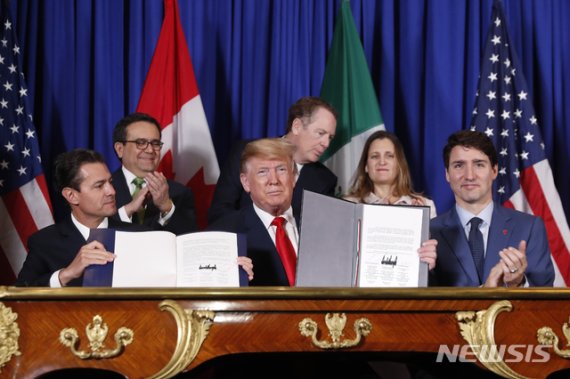
On the 1st local time, the Office of the United States Trade Representative (USTR) said, "The United States does not agree to renew the USMCA in its current form," adding, "Accordingly, the USMCA will not be renewed." It continued, "The United States will continue consultations with Mexico and Canada to address the agreement's shortcomings and the trade deficit issues with those countries," and added, "The agreement will remain in effect until the issues are resolved or the agreement expires."
A senior Trump administration official explained that "President Trump decided not to formally agree to renew the USMCA without first resolving the existing problems, in order to protect the interests of American workers, businesses, and farmers." The official added, "The United States and President Trump are reshaping trade policy to pursue reciprocity and balance, and to open overseas markets," and said, "We will carry out the USMCA review within the broader context of trade policy."
The USMCA is the agreement Trump signed in 2018 during his first term, replacing the North American Free Trade Agreement (NAFTA). The deal is broadly based on tariff-free free trade, and the deadline for deciding whether to extend it under a sunset clause was today. If an extension, or renewal, is agreed upon, a new 16-year term is set. If no agreement is reached, the deal remains in force for another 10 years under annual reviews.
The rules of origin for automobiles are expected to become a key issue in future renegotiations. Under the current USMCA, more than 75% of the value of parts for passenger cars and light trucks must be sourced from North America. However, the Trump administration is reportedly considering raising that threshold to 82%, with 50% of that coming from the United States. According to CNBC, the auto industry is concerned that such a move would require enormous costs to restructure supply chains and could increase investment uncertainty.
[email protected] Hong Chaewan Reporter