More Than 400 U.S. Local Newspapers Join Joint Legal Action Over Unauthorized AI Use by OpenAI and Microsoft
- Input
- 2026-07-02 09:24:04
- Updated
- 2026-07-02 09:24:04
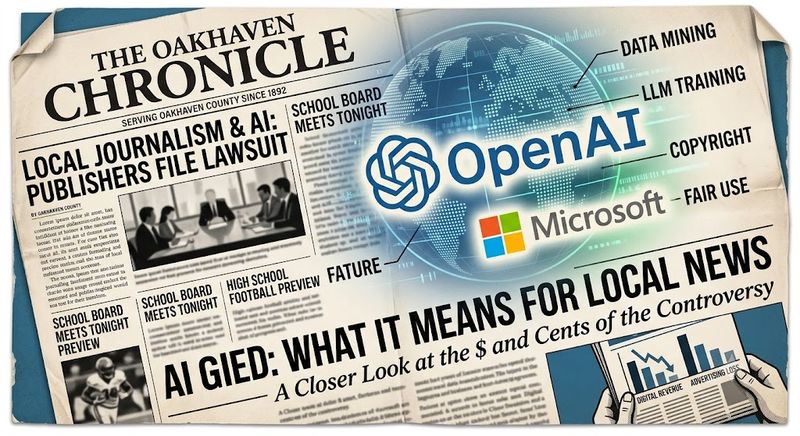
[Financial News] It has been revealed that 35 newspaper publishers, which own about 400 local and regional media brands across 33 U.S. states, recently filed a federal copyright infringement lawsuit against OpenAI and Microsoft (MS) in the United States District Court for the Southern District of New York.
The news organizations said they were taking legal action because the big tech companies had scraped decades of reporting without permission to train AI models and had paid nothing in return.
Online news outlet Review reported that there were allegations that local newspaper coverage, ranging from scandals involving school boards to high school football team news and disputes over local zoning changes, had been used without permission as training data for the generative AI chatbot ChatGPT.
In their complaint, the publishers described the AI companies' conduct as "industrial-scale automated scraping." They also accused the big tech firms of rendering useless the paywalls and access controls that news organizations had built to survive.
The publishers argued that OpenAI and MS not only copied articles without authorization and used them to train the large language models (LLM) behind ChatGPT and Microsoft Copilot, but also deliberately deleted "copyright management information" that could identify the original authors, erasing traces of ownership in the process.
The business impact on local news outlets is severe. If an AI chatbot summarizes a newsroom's reporting and delivers it directly to users, there is little reason for those users to visit the outlet's website. That leads to lower traffic and, ultimately, drains the advertising, subscription, and licensing revenue that local newspapers rely on most.
OpenAI said it sees no legal problem with the lawsuits brought by the media industry.
OpenAI spokesperson Drew Pusateri said the company's AI models are "trained on public data available on the internet" and argued that this approach falls under the copyright law principle of "fair use."
The situation is similar to Spotify's past standoff with musicians, when the world's largest music streaming platform insisted that "exposure on the platform itself is compensation" and only later introduced a royalty payment structure after sustained legal and institutional pressure.
Experts point out that "data available on the internet" is not the same as "free data that can be used however one wants." Just because an Instagram post is public does not mean a company has the right to take it, repackage it into a commercial product, and sell it. Publishers are placing that argument at the center of their large-scale lawsuits.
The lawsuit is part of a broader legal battle over generative AI technology, including the ongoing case brought by The New York Times (NYT). According to foreign media reports, this is the 26th lawsuit against OpenAI and the 11th against MS, signaling that the legal war between AI and copyright is far from over, Review reported.
For many financially strained local U.S. news organizations, the outcome of this trial is expected to be a major turning point that could determine whether journalism survives or local voices disappear.
[email protected] Yoon Jae-jun Reporter