U.S. House Judiciary Committee: South Korea 'discriminatory attacks' on Coupang and other U.S. companies
- Input
- 2026-07-02 02:30:10
- Updated
- 2026-07-02 02:30:10
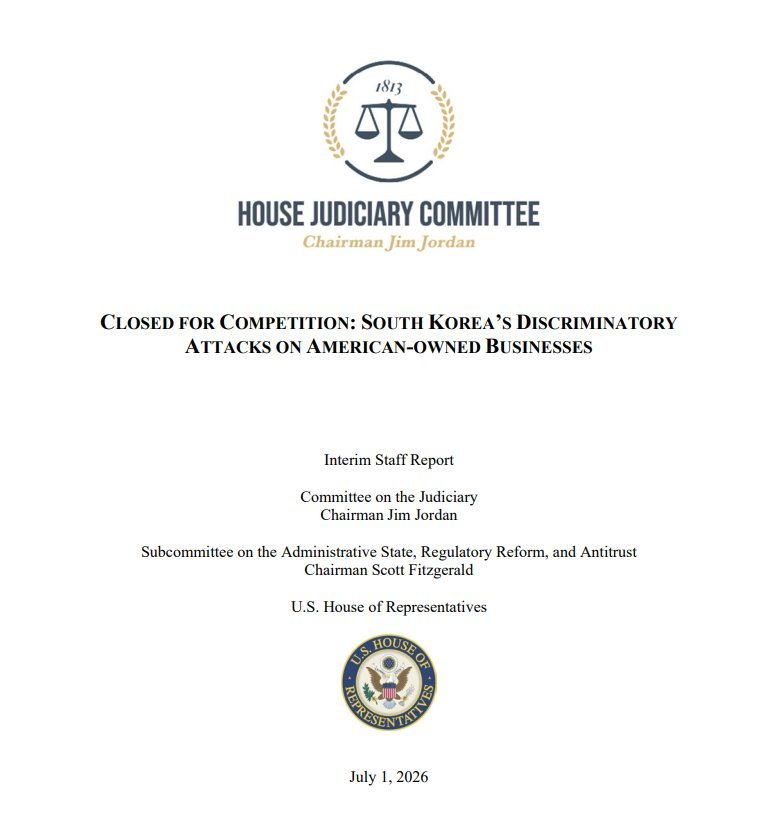
The U.S. House Judiciary Committee claimed in a report released on the 1st local time that South Korea is discriminately targeting U.S. companies, including Coupang.
In an interim report titled "Closed Competition: South Korea's Discriminatory Attacks on American-Owned Companies," the committee said South Korea has a history of discriminating against U.S. companies and cited the recent, ongoing harassment of Coupang, an innovative U.S. tech company and e-commerce platform, as a prime example.
The interim report, written by committee staff, stated that South Korea has a long history of economically discriminating against foreign companies. It cited coercive investigative tactics, excessive regulatory burdens, and massive fines and penalties designed to punish U.S. companies as examples of such discriminatory behavior. The report argued that these actions make it harder for them to compete effectively with Korean companies.
The report devoted particular attention to the Coupang case.
It said that Coupang has been a persistent target of the South Korean government, adding that South Korea has relentlessly investigated the company, imposed unfair demands through regulators, and even threatened to shut down its operations. It also noted that hostility toward Coupang had continued for years and escalated significantly after a former employee stole a limited amount of customer data from the company. The report downplayed the large-scale data theft as a "limited" incident.
The report also claimed that after the incident, the South Korean government spread false information about Coupang, describing the company as if it were a criminal organization and launching numerous investigations, many of which were unrelated to the case itself.
It further said that South Korea forced Coupang into dangerous recovery work, including sending employees to China to retrieve devices and obtain statements from the former employee who stole the data. The report accused South Korea of lying about its involvement in the process and threatening to indict the company's U.S. CEO. It strongly criticized authorities for pressuring the company to recover or destroy the data after treating the leak as a serious national security threat. While South Korea considers those demands justified, the committee described them as trade discrimination and corporate harassment.
The report said South Korean regulators repeatedly targeted Coupang, imposed hostile and discriminatory regulations, and levied large penalties on the company unlike those imposed on Korean competitors. It did not mention that Coupang effectively dominates the South Korean e-commerce market and has few meaningful rivals.
According to the report, the South Korean government misled the public about the investigation, Coupang's role in the data breach, and the government's own role in the post-incident recovery process.
Based on testimony and documents, the Judiciary Committee report claimed that the Korea Fair Trade Commission (KFTC) is particularly aggressive in targeting U.S.-owned companies. It said the agency regularly uses coercive enforcement practices, including early-morning raids, days-long interrogations, and even threats of criminal prosecution, to force compliance.
It also alleged that South Korea has weaponized its laws to curb the ability of innovative U.S. companies to compete effectively in the Korean market and has pushed anti-competitive laws that prevent U.S. companies from successfully competing with Korean tech companies.
The report said the South Korean government's attacks on Coupang are harming U.S. citizens and companies, noting that they sell billions of dollars' worth of products each year through Coupang's online platform.
It argued that South Korea's economic discrimination against U.S. companies is part of a broader pattern of governments abroad weaponizing laws and regulations to protect domestic industries from U.S. industry, and said this directly violates the trade agreement recently reached with the United States.
The report said the committee has previously raised concerns about South Korea's economic discrimination against U.S. companies and will continue monitoring the issue to inform legislative reforms aimed at better protecting U.S. companies and consumers.
[email protected] Song Kyung-jae Reporter