KOSPI Soars 101% While KOSDAQ Falls 1% as Market Polarization Deepens
- Input
- 2026-07-02 08:12:37
- Updated
- 2026-07-02 08:12:37
[Financial News] In the first half of this year, South Korea's stock market staged a record-setting rally, but the divide within the market widened even further. KOSPI more than doubled, led by Samsung Electronics and SK hynix, while KOSDAQ was left essentially flat.
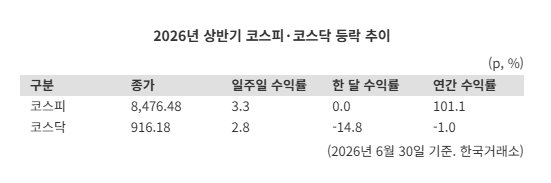
According to Korea Exchange on the 2nd, KOSPI rose 101.1% from the end of last year in the first half, while KOSDAQ fell 1.0%. With the gap in returns exceeding 100 percentage points, the market is being viewed as one driven by a handful of large-cap semiconductor stocks.
Market participants say this rally is different from a broad-based bull market that spreads across sectors. As funds have concentrated in semiconductors such as Samsung Electronics and SK hynix, strong stocks have become even stronger, while weaker names have continued to be left behind.
In fact, the combined market capitalization share of Samsung Electronics and SK hynix expanded from about 35% at the start of the year to 55% at the end of the first half. With the two semiconductor stocks accounting for more than half of KOSPI's market cap, they effectively drove the index higher. By contrast, major KOSDAQ names such as Alteogen Inc., EcoPro and EcoPro BM saw sharp corrections and failed to rebound.
Capital flows are also reinforcing the tilt toward large-cap stocks. In the first half, individual investors bought a net 45.5982 trillion won of Samsung Electronics and 40.8212 trillion won of SK hynix. That means 86.4194 trillion won flowed into just those two stocks. Exchange-traded fund (ETF) money also poured into semiconductor and AI-related products, while the expansion of performance-linked retirement pension investments added to the trend.
Lee Jun-young, a researcher at Eugene Investment & Securities, said, "Except for part of the semiconductor AI value chain, KOSDAQ has been lagging behind KOSPI in attracting funds because there has been no trend reversal in existing leading sectors such as rechargeable batteries and biotechnology." He added, "Even within the same semiconductor theme, KOSDAQ stocks are seeing relatively weak capital flows, so the gap between the two markets is not narrowing."
The securities industry is placing more weight on the possibility that the semiconductor-led market will continue in the second half. That is because expanded global AI investment, improving memory-chip conditions and domestic mega projects are likely to translate into better earnings for semiconductor companies. Recent brokerage reports also suggest that semiconductors are expected to post the strongest profit growth in the second-quarter earnings season.
Yang Il-woo, a researcher at Samsung Securities, said, "Current earnings consensus for the semiconductor sector is at a level that can be achieved even without a major rise in semiconductor prices." He added, "In the second half, earnings estimates are likely to be revised upward further." He also forecast that "the strength centered on semiconductors and other AI value-chain stocks will continue through the third quarter, and after that the momentum may spread to financial and domestic-demand sectors."
[email protected] Choi Du-seon Reporter