The United States Expected to Announce Refusal to Extend USMCA
- Input
- 2026-07-01 14:40:55
- Updated
- 2026-07-01 14:40:55
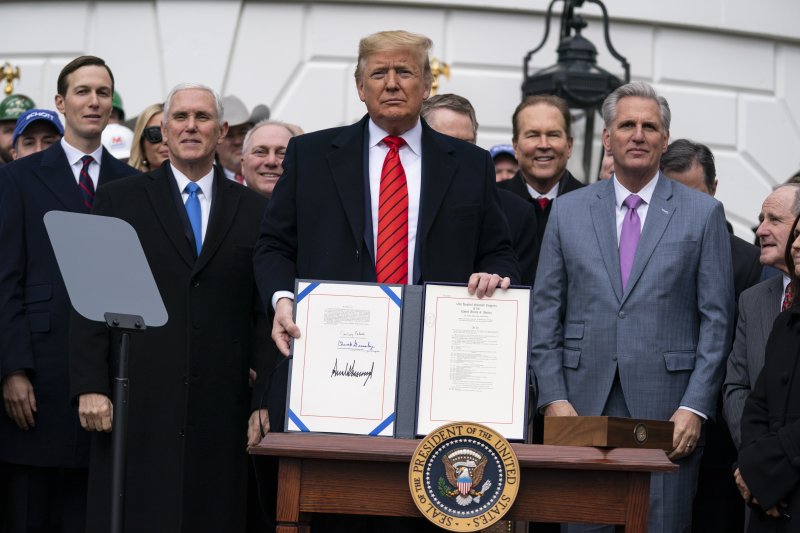
[Financial News] U.S. media, including The Washington Times, reported on the 30th local time that the United States is expected to formally announce its refusal to extend the North American Free Trade Agreement (NAFTA) with Mexico and Canada, the United States–Mexico–Canada Agreement (USMCA).
The Times said the Trump administration will announce on the 1st that it will not sign off on an extension of USMCA, as it moves to launch efforts to dismantle the North American free trade pact it has pursued over the past decade.
Under the USMCA provisions, the agreement will automatically expire on July 1, 2036, unless all three member countries agree to a 16-year extension. With the United States refusing to extend the pact, USMCA will enter a mandatory annual review cycle in which its continuation must be reassessed every year for the next decade. If all three countries had agreed to an extension, the next joint review would have been scheduled for 2032.
During his first term, the Trump administration touted USMCA as a trade achievement after revising NAFTA, the existing North American free trade pact. But the agreement now appears headed toward a gradual dismantling over the next 10 years.
Last month, President Trump said, "I have no intention of renewing USMCA," adding, "NAFTA was the worst trade deal in history, so I fixed it and created USMCA, but I have the right to end it at any time."
He said the reason for pushing to end the agreement was that Americans had nothing more to gain from Canada or Mexico. Addressing the North American trading partners, Trump signaled a hardline independent course, saying, "They need everything from us, but we don't need their cars, their lumber or their energy."
Trade representatives from the United States, Canada and Mexico are scheduled to hold a video conference on the 1st to discuss whether to extend the agreement, but the U.S. policy shift is expected to make the talks difficult. Canada has been strongly urging both the United States and Mexico to extend the pact.
According to The Times, the decisive factor behind Trump's decision to turn his back on the USMCA he created was the sharp increase in the trade deficit with Mexico.
During his first administration, companies shifted supply chains from China to Mexico on a large scale after the United States imposed high tariffs on Chinese-made imports.
According to the Bureau of Economic Analysis, the United States posted a $46 billion goods trade deficit with Canada and a $197 billion deficit with Mexico last year.
In the auto sector, the United States imports $128 billion worth of finished vehicles and parts annually from Canada and Mexico, while exports total $81 billion. To reduce the trade deficit, the Trump administration imposed a 25% tariff last year on auto parts from Canada and Mexico.
The United States is currently holding formal talks only with Mexico.
The Times reported that there are no formal negotiation plans with Canada because of issues such as restrictions on imports of U.S. livestock products and the removal of U.S. liquor from store shelves, but USTR chief Jamieson Greer has continued talks with Canada's chief trade negotiator, Dominic LeBlanc.
Jamieson Greer, the U.S. Trade Representative, is reportedly coordinating a third round of revision talks with Mexico during the week of July 20. This suggests that the United States wants sweeping changes rather than a complete scrapping of the agreement. Greer also warned during a congressional hearing last year that "approving USMCA as it stands is not in the national interest," signaling major revisions.
Some in the business community, however, see the chance of a complete collapse of USMCA as low.
Scott Lincicome, an economist at the libertarian Cato Institute, wrote in an op-ed that "Trump may be toying with the withdrawal card, but it is likely a bluff." He argued that the economic benefits of the agreement are simply too large. In fact, trilateral trade among the three countries reached $1.99 trillion in 2024, while foreign direct investment (FDI) totaled $380 billion, up 37% and 16%, respectively, from when the agreement took effect in 2020.
Voices are also emerging from U.S. politics and civic groups.
Fifteen Democratic senators led by Tammy Baldwin of Wisconsin sent a letter to USTR chief Jamieson Greer, calling for stronger USMCA rules to ensure that Mexico and Canada fulfill their labor market commitments. They criticized the fact that hourly wages for workers in Mexico's auto and electronics manufacturing sectors remain only $3 to $5, lower than in China, saying this is causing U.S. companies to move large numbers of jobs overseas. They also urged strict enforcement of the ban on imports of products made with forced labor. In March, another 21 Democratic lawmakers sent a letter calling for stronger environmental rules.
By contrast, David Clement, policy director at the U.S. consumer advocacy group Consumer Choice Center, urged an extension of the agreement, saying that "ending or weakening USMCA would not strengthen America's negotiating power, but would only increase uncertainty, leading to lower investment and reduced exports to the United States."
[email protected] Yoon Jae-jun Reporter