[Editorial] Leveraged ETFs Are Shaking the Market, and the Financial Authorities Bear Heavy Responsibility
- Input
- 2026-06-30 18:05:58
- Updated
- 2026-06-30 18:05:58
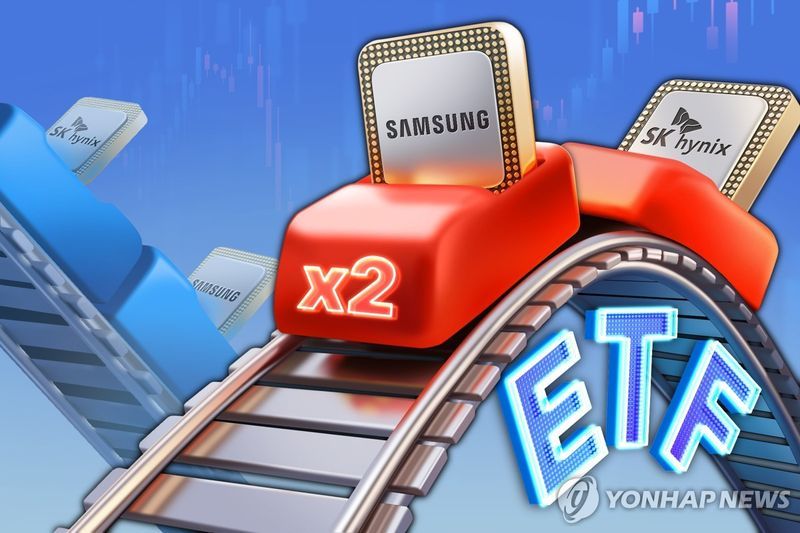
In the stock market recently, funds have been pouring into Samsung Electronics and SK hynix on expectations of a semiconductor supercycle, creating a volatile trading environment in which prices swing 5% to 10% a day. With single-stock leveraged ETFs based on those two names now on the market, ultra-short-term trading using these products has surged. That is because their structure tracks twice the daily return, allowing traders to seek large gains if they correctly predict the direction over a short period. Some have likened it to a "heads-or-tails gambling table," saying it has become a breeding ground for speculative day trading. One product posted a daily turnover rate of as much as 1,261%, meaning the entire volume changed hands more than 12 times in a single day.
More than 8 trillion won in retail money has flowed into these products, deepening market distortions. Samsung Electronics and SK hynix already account for an overwhelming share of market capitalization, and the sharp swings in leveraged ETFs are adding to overall market volatility. If those two stocks rise, the KOSPI can climb even when most other stocks fall. One securities firm report found that after the launch of single-stock ETFs, more than 95% of domestically listed companies saw their shares decline, yet the KOSPI remained strong. The top gainers were also dominated by SK hynix leveraged ETFs. The KOSDAQ has also remained weak, even slipping below the 1,000-point level. Experts cite the concentration of funds in large semiconductor stocks as one of the main reasons.
The craze for single-stock leveraged ETFs is spreading in global markets as well, and criticism that they increase volatility is widespread. But the market structure in the United States is different from Korea's. Hundreds of single-stock leveraged ETFs are listed there, so investment is less concentrated in a handful of names. Even NVIDIA, the flagship stock, accounts for only about 8% of the S&P500. That is a very different situation from Korea, where market influence is concentrated in a small number of stocks.
As volatility in the domestic stock market has grown, ultra-high-risk leveraged futures products based on the KOSPI and individual stocks have also appeared overseas. Single-stock ETFs were originally introduced to redirect demand for Hong Kong-listed leveraged ETF investments into the domestic market, but the results fell far short of expectations. Instead, critics say they have only expanded a new speculative market in a regulatory blind spot. Binance, the world's largest cryptocurrency exchange, has even listed a KOSPI 150-times leveraged futures product.
The financial authorities have also begun preparing countermeasures, including restrictions on promotion and stronger investor education. But as the side effects are worsening by the day, more sophisticated and stronger safeguards are needed. They should tighten deposit requirements, reduce credit extension limits, and raise margin ratios. In addition, they must put together a comprehensive package to reduce market instability, including measures similar to a circuit breaker mechanism that would restrict trading in overheated markets, before it is too late.