Concerns Grow Over Prolonged U.S. Inflation... 9 of 10 Investment Banks Withdraw Rate Cut Forecasts
- Input
- 2026-06-30 09:55:55
- Updated
- 2026-06-30 09:55:55
Wall Street Says the Rate Cut Cycle Is Over
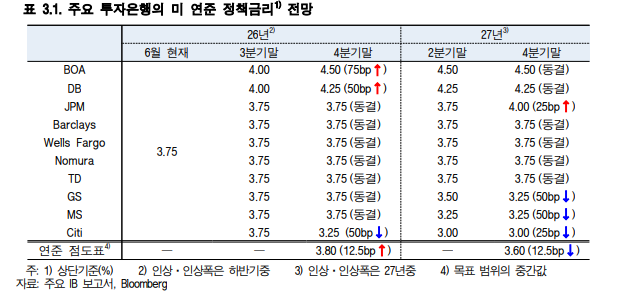
In a report released on the 29th local time, titled "U.S. Economic Outlook and Key Issues for the Second Half of 2026," the Bank of Korea New York Office said most investment banks now believe the Federal Reserve's rate-cutting cycle has ended. Among the 10 major investment banks, nine have withdrawn their forecasts for a rate cut this year. Of those, seven expect rates to remain unchanged through year-end, while two forecast a rate hike. Only one bank still expects a cut. The current U.S. benchmark rate stands at 3.50% to 3.75%.
The Bank of Korea New York Office said the main reason for the change in outlook was upward pressure on U.S. inflation. A Bank of Korea official explained, "Investment banks expect U.S. inflation to stay above 3% through year-end, driven by high oil prices from the Middle East and stronger demand linked to AI, far above the Federal Reserve's 2% inflation target."
Data Center Power Demand Is Also a Factor in Inflation
The Bank of Korea New York Office also identified three major factors behind rising U.S. inflation. Kim Jwa-gyeom, deputy head of the Bank of Korea, said, "Through the second half of this year, oil prices are expected to remain elevated, and the effects of supply chain disruptions will likely feed into producer prices and then add pressure to consumer prices." He added that increased AI investment is expected to push up prices for key items such as semiconductors and computer equipment, further lifting inflation.
Massive electricity demand from data centers is also contributing to inflation. Goldman Sachs estimated that higher power prices will raise U.S. Personal Consumption Expenditures (PCE) inflation by 0.2 percentage points in 2026, 0.15 points in 2027, and 0.1 points in 2028. The Federal Reserve Bank of Dallas also projected that rising electricity costs will increase annual PCE inflation by 0.04 to 0.13 percentage points each year through 2030. It added that if all planned data centers begin operating and the expansion of wind power or solar power is delayed more than expected, the impact on inflation could widen by as much as 1 to 2 percentage points.
Meanwhile, investment banks expect the U.S. labor market to remain stable. They forecast monthly job gains of 50,000 to 100,000 in the second half of this year, with the unemployment rate staying in the low 4% range. However, they said wage growth is gradually slowing, suggesting the labor market is not overheated enough to fuel inflation.
[email protected] Lee Byung-chul Reporter