"We spent 22 years educating them through doctoral studies, and now they stay home"... Half are 'jobless' upon graduation
- Input
- 2026-06-29 14:29:04
- Updated
- 2026-06-29 14:29:04

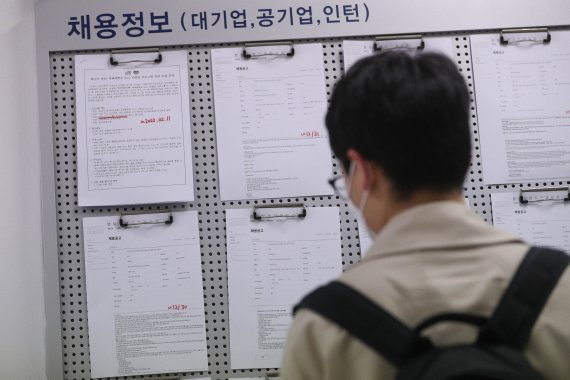
[Financial News] The share of people with doctoral degrees who still could not find jobs has topped 30% for the first time. Among newly minted young Ph.D. holders, more than half were unemployed. Although the number of doctoral degree recipients has risen to an all-time high, the supply of high-quality jobs for Ph.D.-level talent has not kept pace.
Jobless Ph.D. holders top 30% for the first time... economically inactive population rises
According to the results of the National Data Office's "2025 survey of new doctoral degree recipients in Korea" on the 29th, 66.7% of the 10,498 respondents were either currently employed or had already secured a job.
The unemployment rate was 27.7%, while the share of economically inactive people who were neither employed nor looking for work came to 5.6%. In total, the proportion of "jobless" respondents, including those searching for work but unable to find a job and those not even job hunting, reached 33.3%. It was the first time since the survey began in 2014 that the jobless rate had exceeded 30%.
The share of jobless new Ph.D. holders was 25.9% as recently as 2018, remaining in the mid-20% range. But it jumped to 29.3% in 2019, fluctuated between 28% and 29% afterward, and then exceeded 30% last year. The year-on-year increase of 3.7 percentage points was also the largest on record.
One major reason for the increase in jobless Ph.D. holders is the rise in the number of economically inactive people who are not even looking for work despite having no job.
The unemployment share rose by 1.1 percentage points from 26.6% in 2024 to 27.7% last year, while the economically inactive share jumped by 2.6 points from 3.0% to 5.6%. This is seen as the result of high-quality "Ph.D.-level" jobs, such as full-time professor positions, permanent posts at government-funded research institutes, and permanent R&D jobs at large corporations, failing to grow as fast as the number of doctoral graduates.
According to the Ministry of Education of the Republic of Korea's "2025 basic education statistics," the number of full-time faculty members at higher education institutions, including universities, junior colleges and graduate schools, stood at 86,701, down 617 from a year earlier, or 0.7%. By contrast, the number of non-full-time faculty rose by 4,261, or 2.8%, to 153,923.
New Ph.D. employment is even harder... jobless rate hits 51.1%
Young new Ph.D. holders were found to be facing the greatest difficulty in finding jobs.
Among 569 respondents under the age of 30 who earned doctoral degrees last year, 51.1% were jobless, the highest figure since the survey began. The share of economically inactive people in the same age group also surged from 2.6% in 2024 to 7.9% last year.
Those aged 30 to 34 accounted for the largest number of doctoral degree recipients across all age groups, at 3,836, but their jobless share was also close to half at 44.2%. The jobless share also reached the highest level since the survey began in every other age group, including 35 to 39 (32.8% of 1,899 people), 50 and older (22.7% of 2,015), 40 to 44 (22.1% of 1,218), and 45 to 49 (16.6% of 961).
Some observers say younger Ph.D. holders entering the labor market without work experience are facing a particularly severe job market, and that the spread of artificial intelligence has also contributed in part to a decline in entry-level hiring for research and office jobs.
[email protected] Kim Su-yeon Reporter