"Will the 'roller-coaster KOSPI' keep running in July?" ... Will volatility ease as earnings season begins?
- Input
- 2026-06-29 07:54:52
- Updated
- 2026-06-29 07:54:52
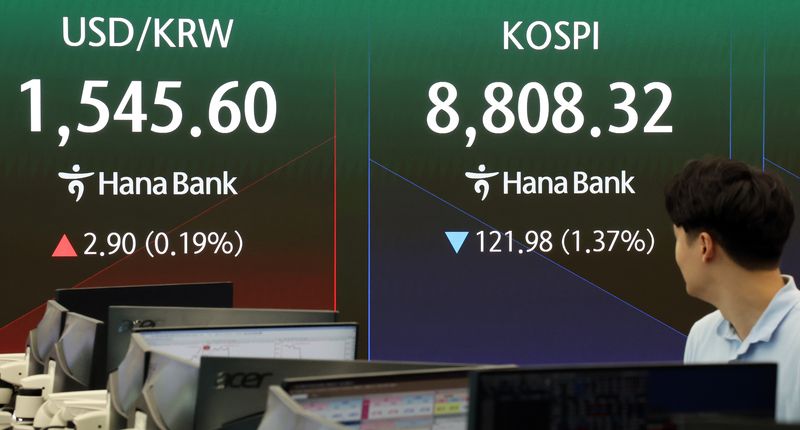
[Financial News] The KOSPI (Korea Composite Stock Price Index), which posted a dizzying series of swings throughout June, is drawing attention as investors wonder whether it can show a relatively steadier trend during July's earnings season.
According to Yonhap News Agency on the 28th, securities firms expect Samsung Electronics and SK hynix to post strong second-quarter results. However, they also warned that volatility could persist next month, given upcoming U.S. inflation data, a Federal Open Market Committee (FOMC) meeting, and the National Pension Service's domestic stock rebalancing.
According to the Korea Exchange and Yonhap Infomax, buy and sell sidecars were triggered 10 times on the main board this month amid sharp swings in KOSPI. Of those, buy and sell sidecars were each triggered five times, and the circuit breaker mechanism was activated three times.
A sidecar is triggered when the KOSPI 200 Index moves up or down by more than 5% and holds that level for one minute. The circuit breaker mechanism is activated when KOSPI falls by more than 8% from the previous day's close and stays there for one minute. In particular, the circuit breaker has been triggered 11 times in history, and three of those cases occurred this month alone. That shows just how extreme KOSPI's volatility has been in June.
Market watchers say liquidity has concentrated in a few large semiconductor stocks, making the entire index swing sharply whenever those names are hit by external shocks. Samsung Electronics and SK hynix alone accounted for 56.48% of KOSPI's market capitalization as of the June 26 close.
Analysts also point out that volatility widened further after leveraged and inverse products tied to Samsung Electronics and SK hynix were launched last month. A clear example came on June 26, when news broke that Apple was raising prices on some products because of memory shortages and significantly revising its next-generation chip roadmap. Samsung Electronics and SK hynix fell 5.30% and 8.36%, respectively, at the close, and KOSPI plunged 5.81%.
Lee Jae-won, a researcher at Yuanta Securities, said the KOSPI's sharp drop was due to "the unwinding of semiconductor-heavy positions rather than a new major negative factor." He added that "as Samsung Electronics and SK hynix account for nearly 60% of market capitalization, their share-price moves have become closely tied to index movements." He also noted that "the combination of single-stock leveraged ETFs and passive flows into ETFs concentrated on top-cap stocks has amplified selling pressure even from small noise."
Against this backdrop, the KOSPI 200 Volatility Index (VKOSPI) also surged intraday to 97.78 on the 24th, its highest level since the 2008 financial crisis. Securities firms believe the current turbulent market is likely to continue for some time as the strong semiconductor concentration persists. They say they cannot rule out factors that could fuel concerns about liquidity tightening in the second half and a possible peak-out in semiconductors.
The second-quarter earnings outlook for semiconductor stocks, which lead the domestic market, is bright. Micron Technology, often seen as a barometer of the semiconductor industry, posted a surprise second-quarter result, and both Samsung Electronics and SK hynix are expected to report strong earnings as well.
Samsung Electronics, which will release preliminary results on July 7, has a consensus operating profit estimate of 84.1 trillion won. SK hynix, which will announce results on the 23rd, is expected to post 63.2 trillion won. Chae Min-sook, a researcher at Korea Investment & Securities, said, "Although the price increase in commodity DRAM remains strong despite a tight supply environment, customers' ability to absorb higher prices is weakening because price levels are already very high, exceeding an 80% operating profit margin for memory suppliers. As we move from the second half of 2026 into 2027, quarterly gains are likely to slow."
She added, however, that "this should not be viewed as a peak-out of the cycle." She said attention should be paid to the fact that the much higher absolute price levels compared with past cycles are being maintained steadily over the medium to long term, upgrading the profit level of memory suppliers.
Still, concerns about the broader macro environment surrounding the stock market continue. International oil prices rose as the United States–Iran war pushed up crude prices, driving inflation higher and leading markets to expect major countries, including South Korea, to raise benchmark interest rates in the second half. Although oil prices have eased since the two sides signed a Memorandum of Understanding (MOU) on ending hostilities, inflation remains elevated and U.S. market interest rates are still high.
Lee Jae-won, a researcher at Hana Securities, said, "The key variable to watch alongside falling international oil prices is U.S. market interest rates." He added, "The U.S. 10-year Treasury yield is currently around 4.4%, reflecting rising real rates, growth expectations, and concerns over benchmark rate hikes. It is higher than before the United States–Iran war broke out."
As the Bank of Korea is also expected to raise rates twice in the second half, market attention is focused on how that tightening stance will affect domestic stocks. Shin Hyun-song, governor of the Bank of Korea, has already been sending repeated signals of a rate hike ahead of next month's Monetary Policy Board meeting.
In addition, with the National Pension Service's temporary rebalancing measures set to expire at the end of this month, there is speculation that it may begin reducing its domestic stock allocation from July. The NPS's allowable domestic stock share has been expanded to as much as 28.8%, but since KOSPI has risen sharply and at one point surpassed the 9,300 level, analysts say a sizable rebalancing will be unavoidable.
[email protected] Kim Hee-sun Reporter