Vietnam Is Changing Day by Day: What Does To Lam’s Reform Envision? [Kim Kwan-woong’s Pick]
- Input
- 2026-06-28 19:05:50
- Updated
- 2026-06-28 19:05:50
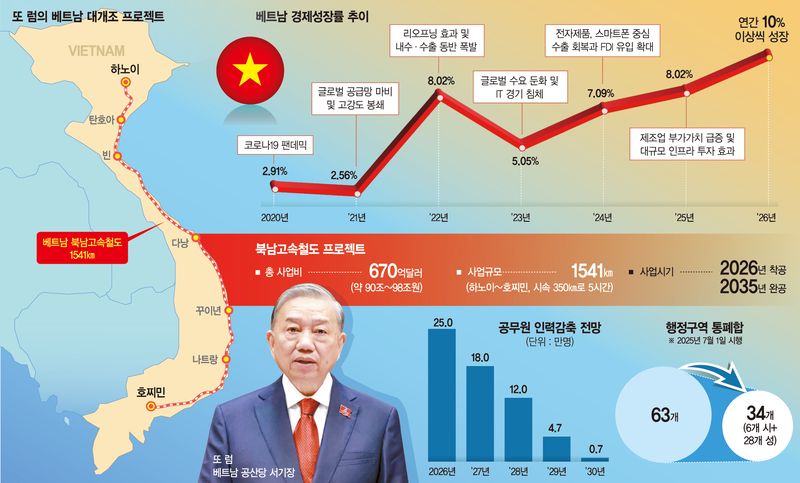
Some have described him as a 'Vietnamese Xi Jinping,' but To Lam is reshaping the country through strong leadership. In particular, last year’s abrupt consolidation of administrative districts and the intense anti-corruption campaign have made it clear that 'Vietnam is changing.' An administration once defined by 'bribes' and 'connections' is now beginning to operate strictly within the legal framework. Administrative processing has also become much faster. For foreign investors who were once bewildered by an unfamiliar system, Vietnam’s bureaucracy is now becoming predictable.
The bureaucracy itself has also become much younger. By placing officials born in the 1970s, many of whom studied abroad and have strong practical skills, at the center of economic ministries, the government is showing a very different face from the past. This is a scene that would have been hard to imagine among older officials who placed greater emphasis on war and revolutionary ideology.
To Lam is pushing Vietnam’s leading companies to enter key industrial sectors and drive economic development. It is a move modeled on the Korean-style conglomerate system that powered industrial growth during Korea’s development era. Local firms such as Vin and Sun mostly made money in real estate before expanding into other businesses, but they had shown little interest in heavy and capital-intensive industries that support economic infrastructure. Now the government is cracking the whip, saying, 'You have made easy money for years, so now step into new businesses for the sake of national development.'
Vietnam’s economy grew by more than 8% last year. That was the first report card after To Lam took power. Starting this year, he has pledged annual double-digit growth. Yet across the economy, including industrial sites, capital is still severely lacking, and the basic technological capacity needed to sustain growth remains far off. Is this really possible amid two wars in Europe and the Middle East, and under the renewed trade pressure expected from Trump? Still, those on the front lines of Vietnam’s economy are not dismissing his words as empty rhetoric.
Vietnam is now entering a 'second Doi Moi' era. If the Doi Moi launched in the 1990s was a reform that opened communist-socialist Vietnam to the outside world and welcomed foreign capital, To Lam’s Doi Moi is a reform that seeks to give the entire economy an advanced technological character, building on the capital and systems accumulated over time.
■ Cutting off corruption at the root through administrative reform
Before becoming general secretary, To Lam led a powerful anti-corruption campaign as minister of public security. After years of sweeping investigations, backhanders and bribes in the public sector dropped sharply. But the aggressive anti-graft drive also produced side effects. Civil servants became reluctant to take responsibility, leading to a cautious culture in which administrative approvals were delayed. Factory permits and land acquisition approvals were often stuck for years, leaving foreign-invested companies frustrated.
To Lam has taken the knife to the system again. He declared, 'If you refuse to approve and just hold out, you will be punished.' In addition to corrupt officials, civil servants who delay administrative work without justifiable reason are now also subject to punishment. Vietnam’s bureaucracy has become noticeably faster. As both the central and local governments call for administrative reform, the inconvenience caused by bureaucracy has been greatly reduced.
Recently, To Lam merged the country’s 63 provinces and cities into 34 provincial-level units and slimmed down the civil service, cutting as many as 250,000 positions at once. The measure was implemented suddenly on July 1 last year without prior notice. In addition, he barred local officials from automatically holding the top post of chairman of the People’s Committee in their own home regions. The goal was to completely sever the deeply rooted corruption networks tied to local interests.
■ Is every investment welcome? FDI is also being restructured
Vietnam’s economy is also changing at remarkable speed. It is no longer just a simple production base built on low-wage labor. After years of Foreign Direct Investment (FDI) pouring in, Vietnam has built up economic resilience and is now declaring an 'era of prosperity through technology.'
Domestic companies in Vietnam were thrown into a frenzy last June when news broke of a revision to the Law on High Technology. The revision would sharply reduce the broad benefits that had been extended to foreign-invested firms and instead provide top-level incentives only to strategic sectors such as AI and semiconductors. In simple terms, foreign-invested companies that do not possess cutting-edge technology or fail to meet conditions such as transferring core technology to local firms would see their tax and other benefits reduced. Until now, tax incentives were granted mainly based on investment size or employment levels. But the new approach signaled the restructuring of FDI, with Vietnam choosing only companies that would contribute to its local component ecosystem. Fortunately, some sensitive provisions in the draft, such as localization ratios, were removed. Even so, the government made clear that it intends to achieve technological self-reliance by focusing and selecting FDI more carefully in the future.
Beyond administrative reform, To Lam also moved into financial reform by abruptly announcing Vietnam’s version of a real-name financial system on July 1 last year. After introducing mobile banking through non-face-to-face electronic identity verification in recent years and building the system, the government has now made it mandatory. The impact on Vietnamese society, which has traditionally valued cash, is significant. The government says the move is meant to curb voice phishing, illegal gambling, and money laundering, but its real intention is clear: to bring the underground economy into the open. Cash transactions remain widespread in Vietnam’s economy, and tax evasion is common because so many deals are conducted under borrowed names. If the real-name system takes hold, however, the government, which has long struggled with weak tax revenue, will find it easier to secure new sources of revenue. It is also expected to help money circulate more broadly across the economy, providing a much-needed boost to a capital-starved system.
■ To Lam’s confidence: 'We will grow by 10% every year'
In January, To Lam unveiled the 'Vietnam Vision 2045 Plan' and said the country would achieve economic growth of more than 10% a year starting this year. Behind that confidence are four major future master plans that will transform Vietnam: expanding transport networks through the North–South express railway and urban rail systems in major cities; turning Hanoi into a global city centered on the Red River; developing a marine economy that takes advantage of Vietnam’s geography, with coastlines on three sides; and building high-value industrial hubs in AI, semiconductors, and other strategic sectors. Through these plans, To Lam has made clear his ambition to completely restructure Vietnam’s economy.
First, the North–South express railway is set to move forward with the selection of a contractor by the end of this year. Hanoi City has also presented a concrete vision for developing the Red River, and some urban rail lines are being broken ground on at the same time as part of the push for a global Hanoi. To build a marine economy, the government has already merged administrative units centered on coastal and adjacent provinces and plans to begin large-scale port development soon. The vision for upgrading the industrial structure is already becoming reality. Samsung Electronics, which leads the global semiconductor industry, established a semiconductor subsidiary in Thai Nguyen Province in March and has already completed detailed discussions on local power and water supply.
■ A huge opportunity and challenge for Korea
To Lam’s reforms are emerging as both a huge opportunity and a challenge for Korea. That is because the major projects now underway in Vietnam are all areas Korea has already experienced decades ago and where it is among the best in the global market. But Korea must also recognize that if it does not understand Vietnam accurately under To Lam’s reform drive, it could easily run into trouble.
The mega-projects underway in Vietnam are so numerous that they are hard to count on one hand: the North–South express railway, the Ninh Thuan Nuclear Power Plant, urban rail transit, and the Red River development project, among others. But these giant infrastructure projects all require enormous funding, ranging from tens of trillions to hundreds of trillions of won. In particular, a business environment that is similar to Korea’s in some ways but different in others means projects are likely to face frequent obstacles. There is also the question of whether there will be enough stable demand once the infrastructure is completed and begins operation.
Above all, To Lam’s Vietnam does not allow exceptions in administration. That means even if a project runs into unexpected obstacles, leading to higher costs or delays, those risks can no longer be resolved through negotiation as they might have been in the past.
The North–South express railway is a case in point. The project would connect Hanoi and Ho Chi Minh City over a 1,541-kilometer stretch at 350 km/h in just five hours. The total project cost alone is estimated at $67 billion, or about 90 trillion to 98 trillion won. If surrounding station-area development is included, the figure easily exceeds $100 billion, or about 150 trillion won. But Vietnam has the soft ground typical of Southeast Asia, making design and construction technically difficult and raising the risk of unexpected costs. In particular, the Red River Delta at the starting point and the Mekong Delta near Ho Chi Minh City are classic ultra-soft ground zones where subsidence occurs. Unlike conventional rail, high-speed rail can lead to major disasters such as derailments if the track is warped by even a few millimeters, so treating soft ground requires enormous expense. Because the project is likely to be financed through public procurement, there are concerns that bidding too low could expose contractors to construction losses and even lawsuits over delays.
The same goes for railway operations. The risk of weak initial demand, as seen in Indonesia’s Bandung high-speed rail project, could easily lead to massive losses. At the same time, it is not possible to participate only in the profitable parts, such as signaling systems, rolling stock supply, and station-area development.
The Ninh Thuan Nuclear Power Plant is no different. KEPCO and other Korean companies are already talking as if the project has been won, but a closer look reveals many risk factors. The No. 2 unit, for which Korea, France, and China are competing fiercely, was originally designated in 2010 as a project for which Japan was the preferred negotiator. Yet there has not even been discussion of how to handle the sunk costs Japan has already incurred. Those costs are estimated in the tens of billions of won, but if one looks at a similar case Japan faced in the United Kingdom, they could reach several trillion won.
Vietnam has set 2035 as the target date for the Ninh Thuan plant to begin operation. Even if every procedure and construction step proceeds properly, that is an extremely tight schedule. If the deadline is missed, there is also the possibility of litigation. Negotiations over power purchases and electricity rates have not yet been reported either. For investors who must recover their costs through operations after completion, this is one of the most sensitive issues.
To Lam’s Vietnam is changing far too quickly. If we want to walk the path of prosperity together with Vietnam, now is the time for a more accurate perspective and a changed attitude.
[email protected]