Lovebug season arrives as complaints surge and a site sharing infestation locations emerges
- Input
- 2026-06-28 13:40:00
- Updated
- 2026-06-28 13:40:00
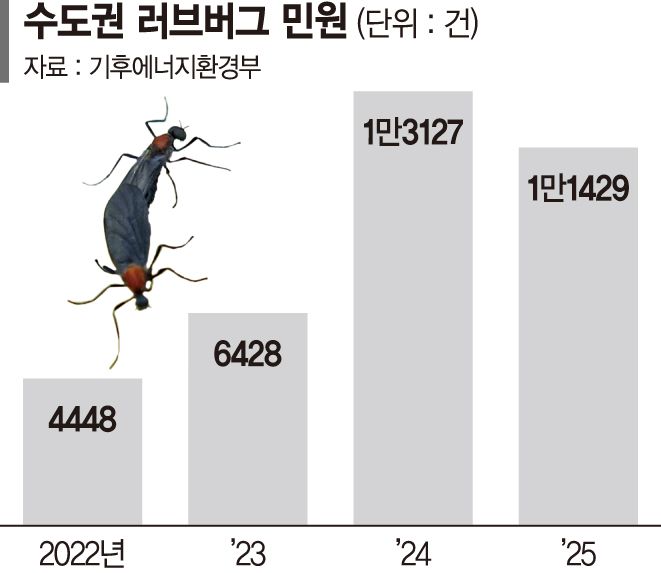
According to the Ministry of Climate, Energy and Environment on the 28th, complaints related to lovebugs filed in the Capital Region have increased 156.9% over the past three years. The number of complaints rose sharply from 4,448 in 2022 to 6,428 in 2023 and 13,127 in 2024. Another 11,429 complaints were filed last year, pushing the total above 10,000 for a second straight year.
Lovebugs are an invasive insect species that fly around in mating pairs. They mainly lived in warm regions such as Southeast China and Okinawa Prefecture, Japan, but have also been observed in Korea since 2022. They are known for gathering in swarms in city centers, residential neighborhoods, and forests alike, clinging to cars and people or blocking visibility and making outdoor activities uncomfortable.
This year, in particular, the infestation appears to have spread more widely than last year. At first, large numbers were found mainly in the northwestern part of the Capital Region, including Incheon and Seoul's Eunpyeong District, Seodaemun, and Mapo. This year, however, they have spread across Seoul and into Southern Gyeonggi. Experts believe rising temperatures linked to climate change have expanded the habitats suitable for lovebugs, which in turn has widened the areas where they appear.
As the affected areas have expanded, complaints and frustration from residents have continued to grow. Seo, 31, who lives in Ansan, Gyeonggi Province, said, "Last year, I hardly saw any near my home, but these days they are stuck all over the walls in my apartment hallway." She added, "They cling to the front door, so I have to be careful even when opening it, and they stick to my clothes too, which is very inconvenient." As a result, posts such as "Looking for someone to catch lovebugs for me" have continued to appear on Karrot Market, a secondhand trading platform. On social networking services, people are also sharing a range of "lovebug removal tips," including carrying a fan, spraying water with a bottle, wearing dark-colored clothes, and spraying lemon juice on window frames.
A website that shares lovebug infestation areas has also recently appeared. Users report lovebug sightings by region directly, and the site received more than 12,000 reports just this week.
Park Je-gu, 32, the creator of the site, told Financial News in a phone interview, "Last year, when lovebugs were at their peak, I felt it was difficult to see infestation information at a glance." He explained, "I created the site so that citizens experiencing damage can easily check lovebug activity in the areas they want and use that information in their daily lives, such as by avoiding those areas."
The National Institute of Forest Science predicted that the main activity period for lovebugs this year would be from June 15 to 29. However, experts say the outbreaks could continue into July, as lovebugs typically appear from June to July.
Yang Young-cheol, a professor in the Department of Health, Environmental, and Safety Sciences at Eulji University, said, "Like last year, lovebugs are expected to appear through mid-July this year as well." He added, "If heavy rain falls during the monsoon season, lovebug activity is likely to decrease, which should greatly ease public inconvenience."
Jang Yoo-ha, [email protected]