"Swinging" KOSPI is more volatile than during the dot-com bubble
- Input
- 2026-06-28 18:32:04
- Updated
- 2026-06-28 18:32:04
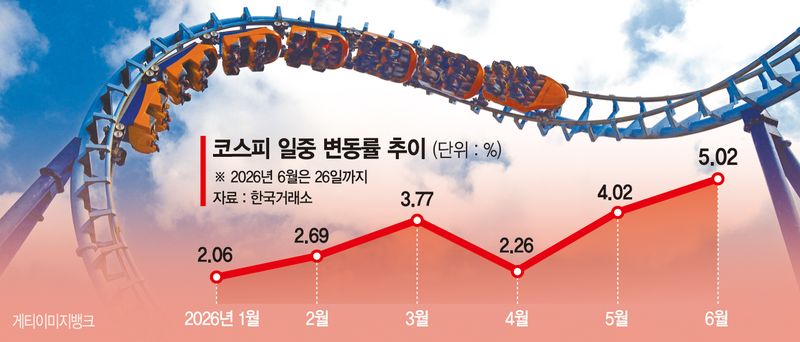
According to the Korea Exchange on the 28th, the average intraday volatility of the KOSPI (Korea Composite Stock Price Index) from the start of this month through the 26th stood at 5.02%, sharply up from 4.02% in the previous month. That is higher than the 4.27% recorded in March 2020, when volatility surged amid the COVID-19 fallout, and also above the 4.02% seen in October 2000, when the stock market was shaken by the collapse of the dot-com bubble.
Intraday volatility is calculated by dividing the difference between the day's high and low by the average of the high and low. It shows how much the index moves relative to its daily average. The larger the figure, the more sharply the index has moved within a single day.
Volatility has become even more extreme this year. The average intraday volatility so far this year through the previous day was 3.27%, about 2.4 times last year's average of 1.35%.
In particular, intraday volatility on the 23rd surged to 11.18%, the sixth-highest level on record. It was the highest reading since March 4, when the market swung on the Middle East war and volatility reached 11.42%.
In the history of the KOSPI, intraday volatility has reached the 10% range only eight times, and two of those cases occurred this year. The index exceeded 10% four times in 2008, the year of the financial crisis, including the record 15.81% on October 29. It also topped 10% once in December 1998 during the Asian financial crisis and once in March 2020 during the COVID-19 pandemic.
The KOSPI 200 Volatility Index, often called Korea's "fear gauge," also hit a record high. On the 25th, the KOSPI 200 Volatility Index closed at 95.09, the highest level since the Korea Exchange began officially publishing the index on April 13, 2009.
The KOSPI 200 Volatility Index measures expected future volatility. It is derived from information embedded in options prices and reflects investors' expectations for market volatility over the next 30 days. The index usually rises when the KOSPI falls sharply, but if it rises during a bull market, it is interpreted as a sign that short-term overheating is fueling investor anxiety.
Brokerage analysts say the swings are widening because the domestic market has risen sharply compared with major countries and because the concentration in a few stocks has intensified amid expectations of a semiconductor supercycle driven by the spread of Artificial Intelligence (AI).
Choi Jae-won, a researcher at Kiwoom Securities, said, "It is a warning sign that stock market volatility is rising in proportion to the KOSPI's compressed rally." He added, "As the market is being reshaped around the AI value chain, earnings improvements are becoming visible in semiconductors as well as AI and materials and components industries, and volatility is emerging in line with the strength of the rally."
He added, "The market is clearly on a strong upward trend, but because both upside and downside volatility are substantial, investors need to focus on leading sectors rather than frequently changing strategies."
Yang Il-woo, a researcher at Samsung Securities, also said, "Since mid-April, the KOSPI has been moving about four times more sensitively than the U.S. S&P500 in terms of daily returns." He added, "Because this volatility is likely to continue in the second half, investors need to respond swiftly and stay sensitive to global macro variables."
Seominji