June Average Exchange Rate Hits 1,525 Won, Highest Since the IMF Crisis 28 Years Ago
- Input
- 2026-06-28 18:15:56
- Updated
- 2026-06-28 18:15:56
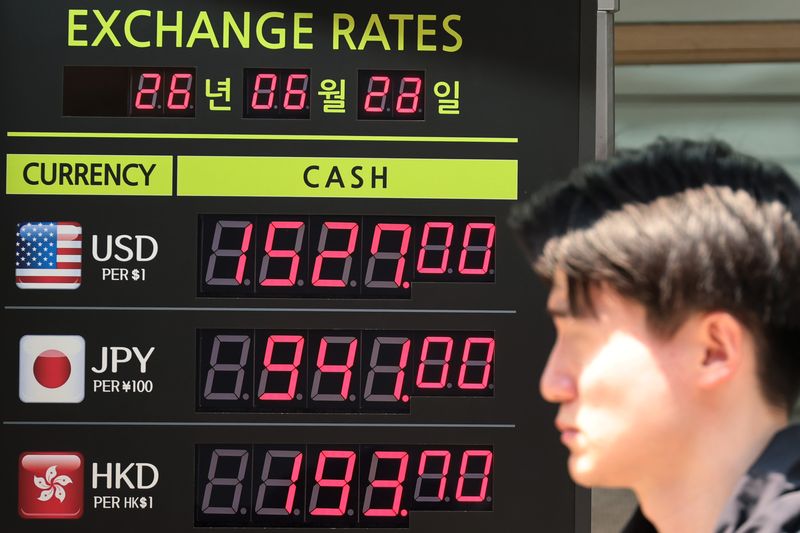
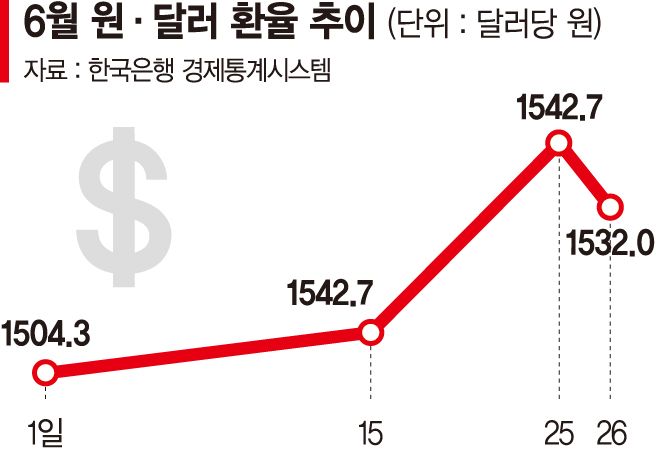
According to the Bank of Korea's Economic Statistics System (ECOS) on the 28th, the average won–dollar exchange rate from the start of this month through the 26th came to 1,525.91 won per dollar, based on the 3:30 p.m. closing price in daytime trading. Excluding February 1998, right after the IMF Crisis, when it reached 1,626.7 won, this is the highest level on record.
That is well above the 2009 March average of 1,453.3 won, when exchange rate volatility was severe in the aftermath of the Financial crisis. Analysts say the recent weakness in the won is unfolding differently from past crisis periods. In particular, the won–dollar exchange rate has stayed above 1,500 won for 29 consecutive trading days in daytime trading since May 15, when it first hit 1,500.8 won. In the past, 1,500 won was a symbolic number signaling instability in the foreign exchange market, but now market participants appear to be treating it as just another price level.
Along with the exchange rate's sharp rise, the won's weakness has continued. The Bank for International Settlements (BIS) reported the Real Effective Exchange Rate Index (REER) at 84.75 in May. That marks a continued decline since January, when the index stood at 87.02, meaning the won's real value has weakened relative to the currencies of trading partners.
Market watchers say the recent rise in the exchange rate cannot be explained by dollar strength alone. In addition to the U.S. tightening stance and a stronger dollar, structural dollar demand tied to increased Investment in the United States is adding pressure on the won. They also point out that exporters, who once helped cushion exchange rate spikes by selling dollars, are not providing enough supply this time. Companies are expected to need dollars again for future overseas investment, so they are more inclined to hold on to their dollars rather than convert them into won.
Baek Yoon-min, a researcher at Kyobo Securities, said, "Authorities can slow the pace of a sharp rise in the exchange rate, but it is not easy to change the direction itself." He added, "The exchange rate will stabilize only when the market regains confidence in a stronger won and companies' dollar-selling flows return."
The shock from the "1,500-won exchange rate" is spreading beyond financial markets into the real economy. The first and most immediate effect is on consumer prices. As import costs rise with the weaker won, upward pressure is continuing across raw material prices and everyday living costs. After consumer prices rose into the 3% range last month, there is a strong chance that the June Consumer Price Trends report, due out on the 2nd of next month, will also show inflation remaining in the 3% range.
If the high exchange rate becomes a structural trend, upward pressure on prices could last even longer. Analysts say that if companies pass higher costs on to product prices, it could add to the burden on consumers and also weigh on the recovery in domestic demand.
[email protected] Hong Ye-ji Kim Tae-il Reporter