President Lee's Social Media Blitz on Honam Semiconductor Investment Draws Fire; Kim Yong-beom Says "Fab Capacity Is King" (Roundup)
- Input
- 2026-06-28 13:17:37
- Updated
- 2026-06-28 13:17:37
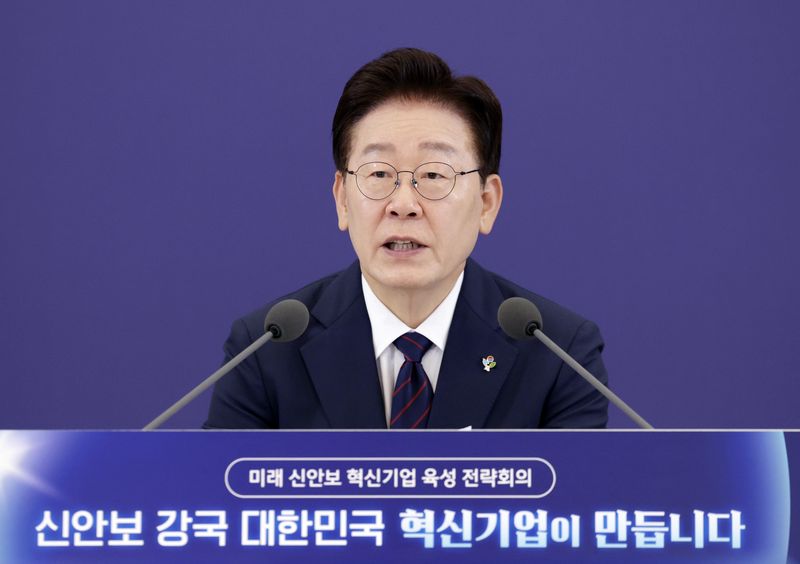
[Financial News] President Lee Jae-myung emphasized that the investment in the Honam semiconductor cluster centered on Samsung Electronics and SK hynix was a "historic achievement," and he posted a series of related messages on social networking service (SNS) platforms. Blue House Chief Presidential Secretary for Policy Kim Yong-beom also came out in support, saying that a large-scale semiconductor fab cluster outside the Capital Region is "a very powerful national strategy."
According to political circles on the 28th, President Lee posted a total of six messages on X (formerly Twitter) on the 27th alone about the large-scale investment in the Honam semiconductor cluster, directly responding to criticism from the opposition. He said the project was "the result of public officials fulfilling their duty to achieve balanced regional development, which has become a survival strategy for the Republic of Korea, and an unprecedentedly large regional investment attraction."
Responding to criticism from the People Power Party and other opposition forces, he said, "To be precise, this was the result of the government creating a business environment by building water, power, land, infrastructure, workforce training, and settlement conditions, and of CEOs making a decision because they judged it would benefit their companies after persuasion and requests from public officials." He added, "This is not something to call abuse of power or coercive orders. It is administrative guidance, or developmental administration." He also noted, "I hope people will not criticize or slander others simply because they assume they would act the same way based on their own past actions or experiences."
On concerns about water shortages, he stressed, "It has been reviewed that if management systems are put in place as needed for the development of advanced cities and water resources are properly allocated and managed, supplying 1 million tons of industrial water per day is possible." He added, "Samsung Electronics and SK hynix, among the world's top one or two semiconductor companies, are not foolish enough to plan ultra-large factories in a region with insufficient water without careful consideration."
He also pointed out, "This was already officially confirmed by the People Power Party government in 2023, during President Yoon Suk-yeol's term, so at the very least, I hope People Power Party lawmakers will refrain from making strange remarks about the location of the Honam semiconductor industry." He further said, "A monk sees a monk, and a pig sees a pig," adding, "People often assume that others think and act the same way they do." A Blue House official said the remarks reflected "a matter of principle," but also expressed regret over "the spread of speculation and false claims about companies concentrating investment in the regions."
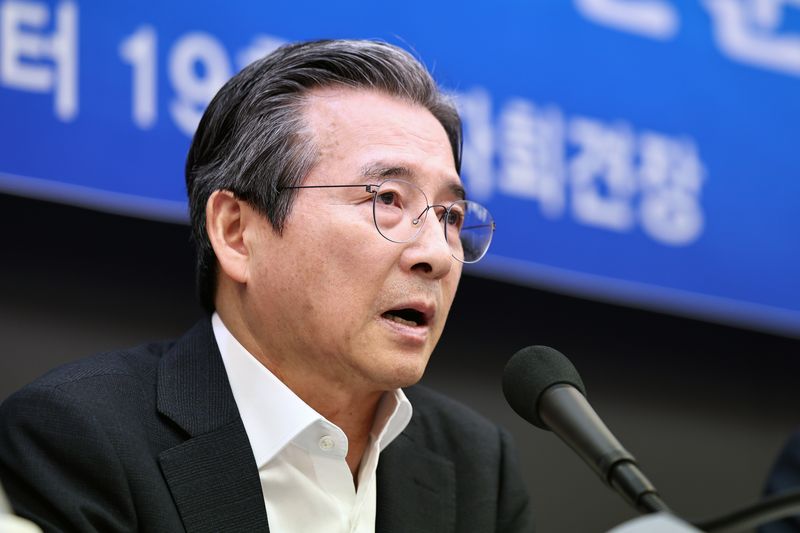
Messages from aides also continued. On the 27th, Kim wrote on Facebook, "Fab Capacity is King," underscoring the need to build the Honam semiconductor cluster. He said the Capital Region cluster will remain the center of South Korea's semiconductor industry, but the production capacity required in the era of artificial intelligence (AI) cannot be handled by a single cluster alone. He added that, given long-term demand for power, water, and land, new production bases must be prepared in advance.
He went on to say, "What the government decides is not the DRAM blueprint, the HBM process, or memory prices. What the government creates is the production platform." He added, "Industrial land for building cutting-edge fabs, a power grid on the scale of several gigawatts (GW), massive supplies of ultrapure water, transmission networks, roads and railways, and environmental permits. These are not problems that individual companies can solve. Only the state and local governments can do that."
Kim continued his social media messages that day as well. He said, "Listed companies' profits could nearly quadruple in just one year. The KOSPI is being reassessed, and nominal economic growth could reach double digits. This may be a historic moment that comes only once in a century." He criticized the public discourse, saying, "When we face such an era, the first thing we must do is leave the past behind. Yet our public sphere is still clinging to the past."
He emphasized that this was "an industrial policy to expand production capacity in the era of AI, not a policy for balanced regional development," and described it as "a macroeconomic policy that channels the excess liquidity created by the semiconductor boom not into real estate, but into factories, power grids, water infrastructure, research facilities, equipment industries, and new cities."
He added, "The world wants AI chips, but if production facilities are lacking, there is only one answer. We must build more fabs, faster. Production capacity is national competitiveness." He said that if the country gets bogged down in wasteful debate and endless procedures, it could miss a once-in-a-lifetime opportunity.
[email protected] Choi Jong-geun Reporter