"Born in 1977, Retirement at 65?" ... Even with a 2 Million Won Monthly Salary, They Would Stay, While a Father Commuting to Work Steps on His Son Who Is 'Just Resting' [Retirement Plan X]
- Input
- 2026-07-04 08:00:00
- Updated
- 2026-07-04 08:00:00
Delaying retirement by just one year can extend National Pension Service (NPS) contribution periods and ease the burden of National Health Insurance. But given opposition from youth employment advocates and the business community, a statutory retirement age of 65 still seems far off.

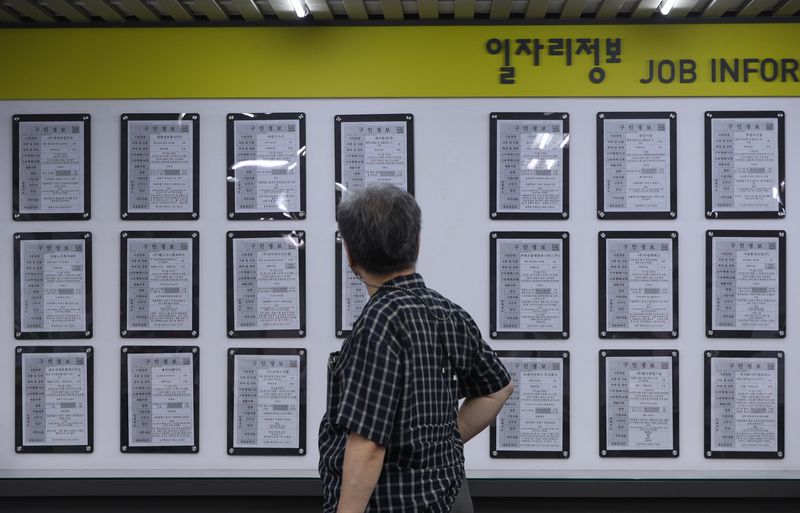
A citizen at the Seoul Western Employment Welfare Plus Center in Mapo District looks at a job information board. /Photo=News 1 [Financial News] Kim Tae-ho, 57, a pseudonym, closely watches the screen whenever news about raising the retirement age appears.It is welcome news, but he cannot simply pin his hopes on it. He will turn 58 next year, and his company’s wage peak system has already begun.His salary is no longer what it used to be, and he has little more than two years left before retirement. What Kim wants is not grand.Even if his monthly pay were a little lower, he would be happy to work at his current company for a few more years. In the past, annual salary mattered most.
Delaying retirement by just one year can extend National Pension Service (NPS) contribution periods and ease the burden of National Health Insurance. But given opposition from youth employment advocates and the business community, a statutory retirement age of 65 still seems far off.
Now, the more urgent question is how long that income can continue. The debate over raising the retirement age may look like a matter of law and policy.
Delaying retirement by just one year can extend National Pension Service (NPS) contribution periods and ease the burden of National Health Insurance. But given opposition from youth employment advocates and the business community, a statutory retirement age of 65 still seems far off.But for those nearing retirement, it is different. It is about how to bridge the income gap before the NPS begins paying out.
Whether one can work one more year or hold out for three more years can determine cash flow in old age. 45 million won.
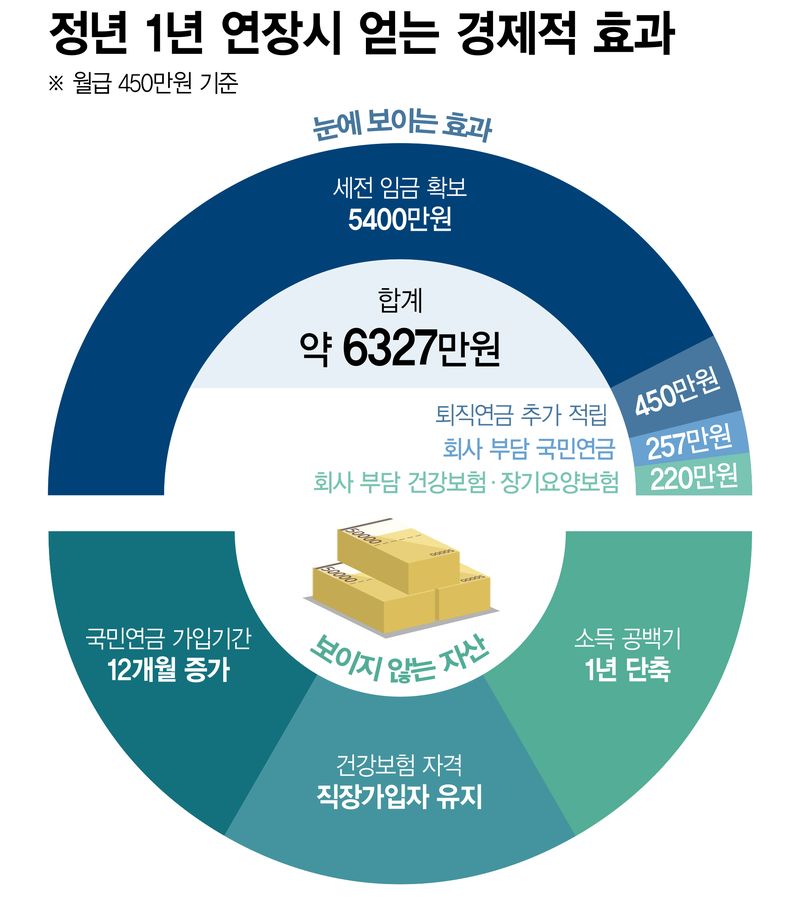
5 million won a month as a benchmark, the financial effect of working one more year is larger than it may seem. Pre-tax annual income alone would add up to 54 million won.
5 million won. If the NPS and National Health Insurance contributions paid by the company are included, the visible economic benefit rises to around 63 million won.
Of course, not all of that money goes directly into a bank account. Taxes and employee-paid social insurance contributions are deducted, and the company-paid portion is not cash received directly.Still, the significance is far from small. Delaying retirement by one year is not just about receiving a salary for one more year.It extends NPS contribution periods by 12 months, keeps one’s eligibility as an employee insured under National Health Insurance, and shortens the income gap before pension payments begin by one year. 5 million won /Graphic=Jung Ki-hyun, reporter That is why the retirement age debate is so sensitive for those preparing to retire.Delaying retirement by just one year can extend National Pension Service (NPS) contribution periods and ease the burden of National Health Insurance. But given opposition from youth employment advocates and the business community, a statutory retirement age of 65 still seems far off.
Using the same wage benchmark, pre-tax earnings alone would total 270 million won. 5 million won.
Delaying retirement by just one year can extend National Pension Service (NPS) contribution periods and ease the burden of National Health Insurance. But given opposition from youth employment advocates and the business community, a statutory retirement age of 65 still seems far off.
If company-paid NPS and National Health Insurance contributions are added, the gap in total compensation becomes even wider. Of course, this is an idealized figure.
Delaying retirement by just one year can extend National Pension Service (NPS) contribution periods and ease the burden of National Health Insurance. But given opposition from youth employment advocates and the business community, a statutory retirement age of 65 still seems far off.There is no guarantee that wages at 65 would remain the same as they were in one’s 50s. Pay may fall if the wage peak system is adjusted or if the worker is rehired under a different arrangement.
Even so, a stable monthly income over time would go a long way toward reducing the income gap. Kim Dong-yeop, executive director at Mirae Asset Investment and Pension Center, said, "The most powerful variable in retirement finances is not investment returns, but the length of income.
" He added, "Given deposit interest rates, earning 1 million won or 2 million won a month is by no means a small amount. 5 million won a month for five years comes to 90 million won.
At 2 million won a month, it reaches 120 million won. That is a sum that is difficult to generate through deposit interest alone.Whether through raising the retirement age or rehiring, the key is ultimately how long income can be extended. More importantly, raising the retirement age also affects the NPS and National Health Insurance.Working longer extends NPS contribution periods and delays the point at which one switches to regional subscriber status after retirement. On the other hand, if a person cannot endure the income gap and chooses early old-age pension, the pension is reduced by 6% for each year it is taken early, and by 30% over a lifetime if taken five years early.That is why the retirement age issue cannot be seen as only a salary question. Those Born in 1968 Lose Out, While Those Born in 1977 Hope As the June 3 local elections ended, the debate over raising the retirement age has begun to gather pace again.
The approach being discussed in political circles is a gradual increase. As of June 2026, the plan under discussion within and around the Democratic Party Special Committee on Raising the Retirement Age would raise the statutory retirement age to 61 starting in 2029, then increase it by one year every two years to reach 65 in 2037.
However, this is not yet a finalized bill. If this approach is adopted, the practical impact will vary greatly by birth year.Birth Year Reaching Age 60 Expected Retirement Age Born in 1968 or earlier Before 2028 Limited Born in 1969-1970 2029-2030 61 Born in 1971-1972 2031-2032 62 Born in 1973-1974 2033-2034 63 Born in 1975-1976 2035-2036 64 Born in 1977 or later After 2037 65 The actual benefit will depend on the effective date, birth date, transitional provisions, and how workers already under the wage peak system are handled. If retirement age increases are combined with rehiring, the practical benefit may be smaller.Business Community Opposition The faster labor wants the change, the stronger the resistance from business becomes. 2 trillion won annually.
KEF argues for rehiring after retirement rather than a blanket extension of the retirement age.
Delaying retirement by just one year can extend National Pension Service (NPS) contribution periods and ease the burden of National Health Insurance. But given opposition from youth employment advocates and the business community, a statutory retirement age of 65 still seems far off.
Its argument is that, with seniority-based pay still accounting for 63% of workplaces with 1,000 or more employees, simply raising the retirement age without reforming wage systems would shift the burden to companies and suppress youth hiring.
Delaying retirement by just one year can extend National Pension Service (NPS) contribution periods and ease the burden of National Health Insurance. But given opposition from youth employment advocates and the business community, a statutory retirement age of 65 still seems far off.Ryu Gi-jeong, executive vice president of KEF, said at an academic seminar last month, "A uniform statutory extension of the retirement age will deepen labor market duality, reduce new hiring of young people, and create generational conflict.
" A look at Japan shows that this is not merely an argument against the policy.
Since 2006, Japan has required companies to guarantee employment until age 65, but it allows firms to choose among raising the retirement age, abolishing retirement age, or continuing employment.1% of companies have chosen rehiring.However, this is not yet a finalized bill. If this approach is adopted, the practical impact will vary greatly by birth year.
The model allows workers to continue at lower pay.
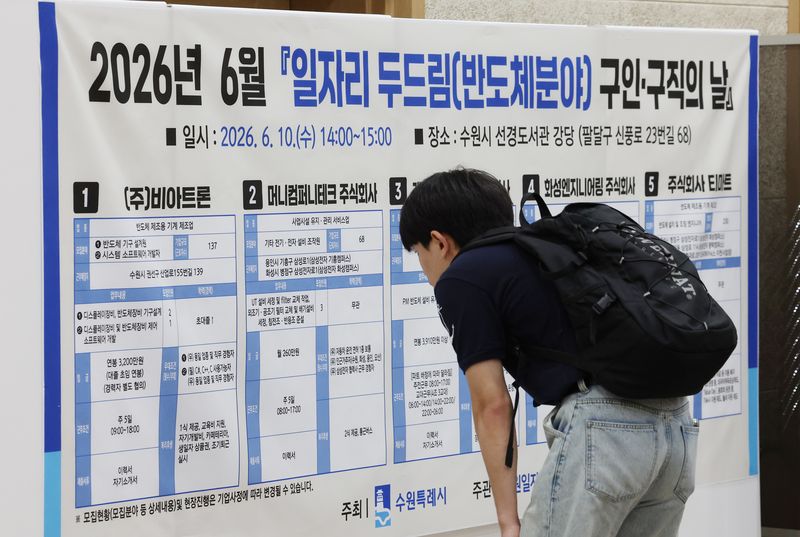
Mixed Feelings When Looking at Sons and Daughters Who Are 'Just Resting' At the 'June Semiconductor Job-Search and Recruitment Day' held on June 10 at the Seonkyung Library in Paldal District, Suwon, Gyeonggi Province, job seekers look at the recruitment board.
10/News 1 Retirement-age extension is highly anticipated by those preparing for retirement.
Looking only at old age, many want to work longer.
But if their children are at the stage of looking for jobs, their feelings become complicated.
There is concern that as the parent generation holds onto jobs longer, the door for the younger generation may narrow.
The youth employment situation is not easy either.
Delaying retirement by just one year can extend National Pension Service (NPS) contribution periods and ease the burden of National Health Insurance. But given opposition from youth employment advocates and the business community, a statutory retirement age of 65 still seems far off.
2%.
Delaying retirement by just one year can extend National Pension Service (NPS) contribution periods and ease the burden of National Health Insurance. But given opposition from youth employment advocates and the business community, a statutory retirement age of 65 still seems far off.The number of employed young people plunged by 255,000, the largest drop since the COVID-19 pandemic.
The number of young people who are 'just resting' has fallen for four straight months, but it still stands at 384,000.
However, this is not yet a finalized bill. If this approach is adopted, the practical impact will vary greatly by birth year.These concerns are not just emotional.A BOK Issue Note No.
2025-8 released by the Bank of Korea’s research department in April this year found that the 2016 retirement age extension did increase employment among older workers, but the benefits were concentrated in unionized and large-company jobs, while side effects included weaker youth employment and more early retirements.
5 workers.
Delaying retirement by just one year can extend National Pension Service (NPS) contribution periods and ease the burden of National Health Insurance. But given opposition from youth employment advocates and the business community, a statutory retirement age of 65 still seems far off.
In the end, the issue is not simply whether people work longer or not.
Delaying retirement by just one year can extend National Pension Service (NPS) contribution periods and ease the burden of National Health Insurance. But given opposition from youth employment advocates and the business community, a statutory retirement age of 65 still seems far off.Delaying retirement by just one year can extend National Pension Service (NPS) contribution periods and ease the burden of National Health Insurance. But given opposition from youth employment advocates and the business community, a statutory retirement age of 65 still seems far off.
People the Law Does Not Reach As the retirement age debate grows, expectations among people in their 50s and 60s are also rising.
But even if a law passes, it will not reach everyone at the same pace.Those already close to 60 may see only limited direct benefits, and if rehiring is adopted, outcomes may depend on each company’s decision.Wage peak systems and job adjustments may also reduce actual monthly pay.
In reality, many people leave their main jobs before reaching the statutory retirement age.
In the National Data Office’s supplementary survey of older adults, the average age at which people left their longest-held job was lower than the statutory retirement age.
At the same time, many people aged 55 to 79 said they still wanted to keep working.
The reality is that while the will to work remains, main jobs often end early, and that is the backdrop to the retirement age debate.That is why interest in raising the retirement age ultimately comes down to the realities inside and outside the company.Whether a company has examples of rehiring or contract-based work after retirement, how much actual pay falls after the wage peak system, and under what conditions senior employees stayed on can all make the same law feel very different.
Delaying retirement by just one year can extend National Pension Service (NPS) contribution periods and ease the burden of National Health Insurance. But given opposition from youth employment advocates and the business community, a statutory retirement age of 65 still seems far off.
The same is true outside the company.
Delaying retirement by just one year can extend National Pension Service (NPS) contribution periods and ease the burden of National Health Insurance. But given opposition from youth employment advocates and the business community, a statutory retirement age of 65 still seems far off.5 million won a month, the income gap narrows by that much.
My Personal Ledger to Open Before the Retirement News Even if a retirement age law passes, not everything will be solved.
The wage peak system may reduce pay in later years.
If a rehiring model is adopted, results may vary depending on the company’s judgment.
For those who have already left their main jobs, it may simply be news that arrived too late.
However, this is not yet a finalized bill. If this approach is adopted, the practical impact will vary greatly by birth year.What is needed now is not just waiting for retirement news.One must open one’s own ledger first.
People should check at what age and how much the NPS will pay, how much can be withdrawn monthly from retirement pensions, and how National Health Insurance premiums will change after retirement.
Delaying retirement by just one year can extend National Pension Service (NPS) contribution periods and ease the burden of National Health Insurance. But given opposition from youth employment advocates and the business community, a statutory retirement age of 65 still seems far off.
Loan principal and interest, support for children, support for parents, and medical expenses should also be considered.
Delaying retirement by just one year can extend National Pension Service (NPS) contribution periods and ease the burden of National Health Insurance. But given opposition from youth employment advocates and the business community, a statutory retirement age of 65 still seems far off.Retirement news matters.
But what protects one’s old age is not the news, but the ledger.
The answer to how income can continue after age 60 must be written first.
The old formula that equated retirement with exit is breaking down.
Delaying retirement by just one year can extend National Pension Service (NPS) contribution periods and ease the burden of National Health Insurance. But given opposition from youth employment advocates and the business community, a statutory retirement age of 65 still seems far off.
In an era when life expectancy reaches 83, Generation X is entering retirement in earnest, and the very concept of retirement is being redefined.The story of their second act in life is captured in [Retirement Plan X] and will meet readers every Saturday morning.You can receive it conveniently by subscribing to the reporter page.
Delaying retirement by just one year can extend National Pension Service (NPS) contribution periods and ease the burden of National Health Insurance. But given opposition from youth employment advocates and the business community, a statutory retirement age of 65 still seems far off.[email protected] Kim Gi-seok Kim Jun-hyeok Reporter