"If I just stay still, I might fall back into a bad path"... Drug recovery participants ran together through the heat
- Input
- 2026-06-28 14:25:57
- Updated
- 2026-06-28 14:25:57
[Financial News] "Treating drug addiction is ultimately not something you do alone. It seems to be something you have to work through with supporters and peers."
A 26-year-old male recovering addict from Busan, identified as A, gave that answer when asked why he took part in the marathon on June 27 at Hwangsaeul Park near the Bundang Tax Office in Seongnam City, Gyeonggi Province. It was a sweltering day, with sunlight pouring through the leaves and the temperature climbing above 30 degrees Celsius, leaving sweat on the back even while standing still. Even so, A wore a navy baseball cap and an orange bandana around his neck as part of his heat precautions, and he was doing warm-up exercises before running with the other participants. "If I stay still, cravings come back and bad thoughts start to creep in," he said. "When I’m with others, I still think I shouldn’t be the only one falling back into a bad path."
Former drug users emphasized that treating addiction is not something done alone, but together with doctors, rehabilitation therapists, and peers.
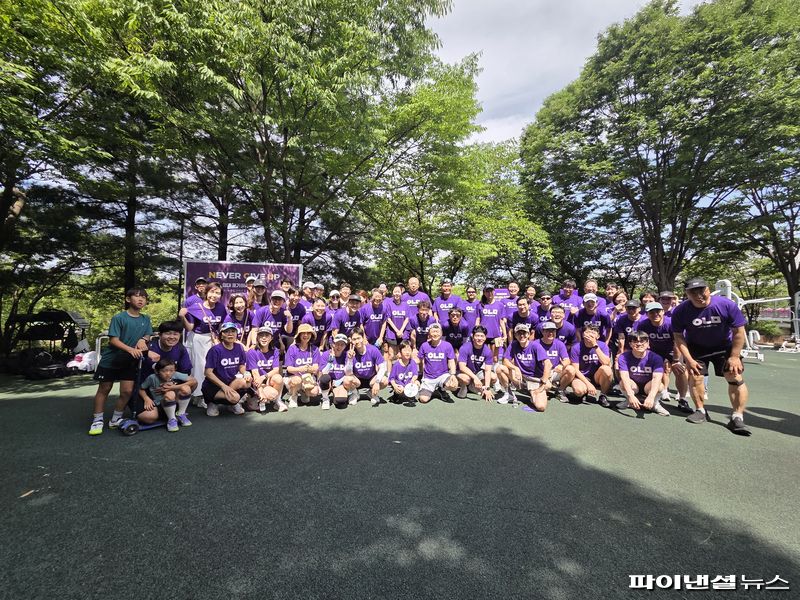
Never Give Up, a drug recovery group, held a marathon on the morning of June 27 along the Tancheon in Seongnam City to commemorate the International Day Against Drug Abuse and Illicit Trafficking. The goal was to show the public that treating drug addiction is not the responsibility of the addict alone, but something achieved with the cooperation of doctors, rehabilitation therapists, local communities, and other members of society. The recovering addicts who joined the event shared their determination to stay drug-free and used the occasion to strengthen that resolve.
At 8:20 a.m., when this reporter arrived at Hwangsaeul Park, about 40 to 50 Gyeonggi residents and others who had given up a "sweet holiday morning" were gathered in purple shirts, the symbolic color of Never Give Up.
A was among them. He said he had used methamphetamine from age 17 until last year. Looking back, he described himself as an ordinary high school student who was not especially good at studying and had no grand dreams. He said he lived without a clear purpose and, with his parents busy earning a living, had nowhere to rely on. In that boredom, he turned to drugs as an escape.
What led A to decide to quit was being investigated by authorities. "Unlike others, I was lucky enough to get the chance to enter National Bugok Hospital at the very moment I was desperate to stop, so I was able to receive treatment for drug addiction in time," he said. "But one stay was not enough, so I was later admitted to the National Forensic Hospital in Gongju and was able to continue treatment."
About 10 recovering addicts from the Busan NA group also joined the event after traveling to Seoul. A man in his 60s, identified as B, said that over the past 20 years he had been in and out of prison 13 times on drug-use charges. He escaped that revolving door of incarceration thanks to admission to the Ministry of Justice's National Forensic Hospital, a treatment facility. "Until I met former Director Cho of the National Forensic Hospital, I had not even thought about quitting," he said. "Director Cho kept giving me his 'nagging' and provided psychiatric treatment, and that is what led me to decide to stop."
Treatment for drug addiction is a medical service carried out by psychiatrists. Doctors, nurses, and rehabilitation therapists work as one team, combining medication, counseling, and monitoring of treatment progress for patients struggling with addiction. Former Director Cho, one of Never Give Up's board members, described drug treatment as "a process of changing values and behavior." "It is basically the same as building muscle," he said. "When a patient thinks, 'I need to quit drugs,' the doctor becomes a personal trainer, coaching them on how to stop. At the same time, psychiatric treatment reinforces that resolve so the patient's will does not weaken along the way."
Never Give Up plans to use the proceeds raised through this campaign as donations to help establish the country's first hospital specializing in drug addiction treatment. Seoul National University Bundang Hospital is expected to operate the hospital under commission, with the goal of opening as early as 2030. Nam Kyung-pil, who leads Never Give Up and previously served as governor of Gyeonggi Province, along with other group members, continues to work toward building a social foundation where treatment, recovery, and prevention reinforce one another.
Drug addiction is at the core of the country's growing drug problem. According to the Supreme Prosecutors' Office of the Republic of Korea (SPO)'s "Drug Crime White Paper," the number of people suspected of drug use has accounted for nearly 50 to 60 percent of all drug offenders over the past 10 years, from 2015 to 2024. Given that the number of drug offenders has already exceeded 20,000 and is nearing 30,000, and that Police Administration Studies estimate the dark figure of drug crime at about 30 times the reported number, drug addiction can no longer be ignored.
In this regard, Nam said, "Preventing drug addiction is not something that can be solved by fear alone. It comes from a culture in which members of society work together to create the value of a healthy life." He added, "Never Give Up will continue its activities so that recovering addicts can find hope and citizens can naturally understand the importance of drug prevention."
[email protected] Kim Dong-gyu Reporter