Three Major Quakes in Three Days: Japan Shaken by a Series of Earthquakes
- Input
- 2026-06-28 09:30:24
- Updated
- 2026-06-28 09:30:24
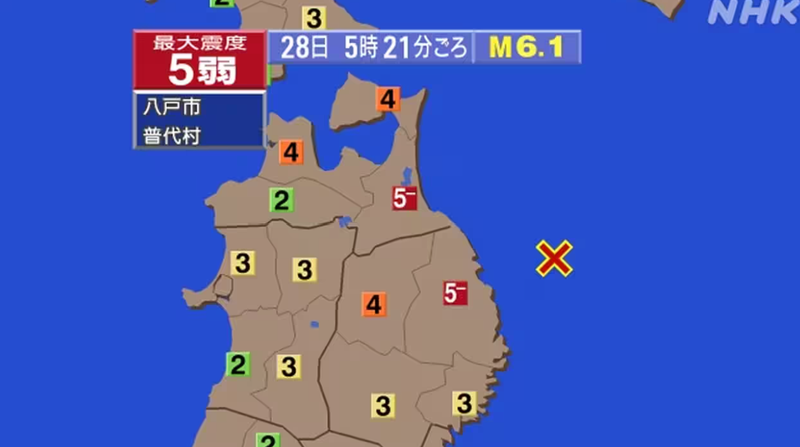
[Financial News, Tokyo = Seo Hye-jin, correspondent] Japan has seen a series of earthquakes measuring magnitude 5 to 7 over the past three days, heightening concern across the country. Experts said the quakes were not all caused by the same factor, but warned that strong tremors of a similar scale could continue for the time being because they occurred in an area with active seismic activity.■Magnitude 6.1 quake off Iwate PrefectureAccording to the Japan Meteorological Agency (JMA) on the 28th, a magnitude 6.1 earthquake struck off the coast of Iwate Prefecture at around 5:21 a.m. that day. Shaking of up to upper 5 on Japan's seismic intensity scale was observed in Hachinohe City, Aomori Prefecture, and Fudai Village, Iwate Prefecture.
Unlike magnitude, which indicates absolute strength, seismic intensity is a relative measure used by the JMA to show how strongly people in a given area felt the quake and how much nearby objects shook. The agency divides earthquake shaking into 10 levels: 0, 1, 2, 3, 4, lower 5, upper 5, lower 6, upper 6 and 7. Upper 5 refers to noticeable shaking that can knock dishes or books off shelves and topple unsecured furniture.
The hypocenter was about 41 kilometers deep, and no tsunami warning was issued.
The quake occurred in the same active zone as the magnitude 7.2 earthquake that struck Aomori Prefecture on the 25th. At that time, strong shaking of up to upper 6 was observed in Aomori Prefecture. Upper 6 means people cannot move without crawling, most furniture falls over, and cracks can appear in concrete walls.
At the time, the JMA had warned that earthquakes of a similar scale could occur for about a week afterward. It said areas that experienced strong shaking may face a higher risk of rockfalls and landslides, and urged residents to prepare for additional damage. The Nuclear Regulation Authority said no abnormalities were found at the Aomori Prefecture Higashidori Nuclear Power Plant.■Yamanashi quake caused by collision of the Philippine Sea PlateEarlier, late on the 26th, a magnitude 5.6 earthquake struck Fujikawaguchiko Town, Yamanashi Prefecture, with shaking of up to upper 6 recorded. Ten people were injured in Yamanashi, Kanagawa and Shizuoka prefectures, but none were seriously hurt.
The Japan Earthquake Research Committee held an emergency meeting and concluded that the quake was a reverse-fault earthquake caused by the collision of the Philippine Sea Plate with the continental plate. It explained that this area is already seismically active, with magnitude 5 earthquakes also occurring in 2012 and 2021, and that in the past, larger quakes had followed the first one.
Kazushige Kohara, head of the committee, said, "We need to prepare with the possibility in mind that earthquakes of the same size or larger could follow."■JMA and experts: "No connection to a Mount Fuji eruption"After the Yamanashi quake, some raised concerns about a possible eruption of Mount Fuji, but the JMA and experts dismissed any link.
The JMA said, "There have been no unusual changes in observation data for Mount Fuji before or after the quake, and there are no signs that volcanic activity has intensified."
The Japan Earthquake Research Committee also explained, "This was not a volcanic earthquake that occurred directly beneath Mount Fuji, but an earthquake caused by the collision of the Philippine Sea Plate," adding that there is no direct connection.
However, the JMA said it could not rule out the possibility of earthquakes with a maximum intensity of upper 6 occurring in Yamanashi, Aomori and Iwate over the next week, and called for continued vigilance.
[email protected] Seo Hye-jin Reporter