"They Won't Be Punished Anyway, Because We're Juvenile Offenders" — How 'Juvenile Offenders' Encourage, Shield, and Reinforce One Another
- Input
- 2026-06-30 08:00:00
- Updated
- 2026-06-30 08:00:00
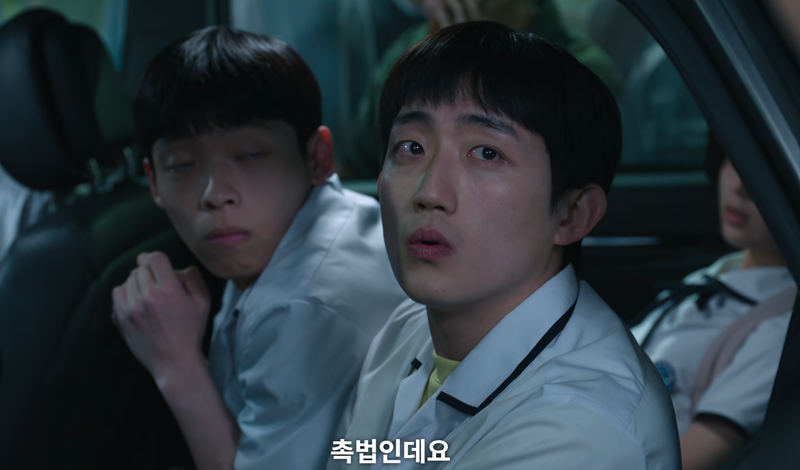
[Financial News] #. In episode 6 of the drama 'True Education,' middle school second-year students who stole a car, drove recklessly, and even tried drugs are caught by the police but then released with a warning. At the police station, the children do not look intimidated. Instead, they proudly introduce themselves as"14-year-olds, juvenile offenders"They say.Juvenile offenders, meaning criminal minors aged 10 to under 14 who have committed acts that violate the law, are exempt from criminal punishment. Instead of criminal penalties, they receive protective measures such as placement in juvenile detention facilities or probation, which do not leave a criminal record. The problem begins with the fact that children know this precisely.
Jae-beom Cho, chair of the Teachers' Rights Committee at the Korean Federation of Teachers' Associations (KFTA), said, "We caught an elementary school student stealing female teachers' bags repeatedly and even obtained a confession, but the student was released with a warning, and the school could do nothing." He added, "A student who committed theft at an unmanned store was even questioned by police, but because he was a juvenile offender, he was released with a warning. After the parents compensated for the damage, he has continued attending school as if nothing happened."
Cho also said KFTA had received reports of other cases, including a student who threatened a teacher during a phone collection process by saying, "I'll stab you to death with a knife," and a student who entered a classroom without permission, shoved a teacher to the floor, and caused injuries requiring 12 weeks of treatment. He also cited a case in which a student assaulted a male teacher in his 50s with a baseball bat during class, breaking his ribs and causing other injuries. "At a time when most of the public already agrees on lowering the age for juvenile offenders, I believe this issue needs to be reviewed once again," he stressed.
A misconception created by drama: "If they're juvenile offenders, they can't be punished at all"
Criticism has also been mounting that the portrayal of juvenile offenders in the drama 'True Education' distorts reality. One prominent example came from Won Min-kyung, Minister of Gender Equality and Family, who pointed out at a press briefing marking the first anniversary of the government on the 11th that "juvenile offenders are often portrayed in distorted ways in dramas and films. The most common public misconception is the belief that juvenile offenders receive no punishment at all."
In response, attorney Na Hyun-kyung of Jinsu Law Firm, a former elementary school teacher, explained, "Even if they are juvenile offenders, if they commit a serious crime, the case is handled as a protective juvenile case. They may live at a juvenile classification review center for up to a month, and investigative records are kept. In many cases, they are then sent to a juvenile detention center or a foster facility." She added, "They receive protective measures instead of criminal punishment, but it is not as if nothing happened."
In fact, juvenile offenders receive protective measures rather than criminal punishment. These measures range from Level 1, which places the child under the care of a guardian, to Level 10, which sends them to a juvenile detention center for an extended period. In serious cases, they can be sent to a juvenile detention center for up to two years. The notion that "nothing is done" is therefore inaccurate.
'Juvenile offenders' have more than tripled in nine years
The real issue is not the misconception that juvenile offenders are not punished, but the reality that children already understand and exploit the loopholes in the law, and that this behavior has entered classrooms. According to the National Police Agency, the number of juvenile offenders apprehended rose from 6,493 in 2016 to 21,095 in 2025, more than tripling in nine years. While the teenage population itself has declined, the number of juvenile-offender crimes has continued to rise steadily.
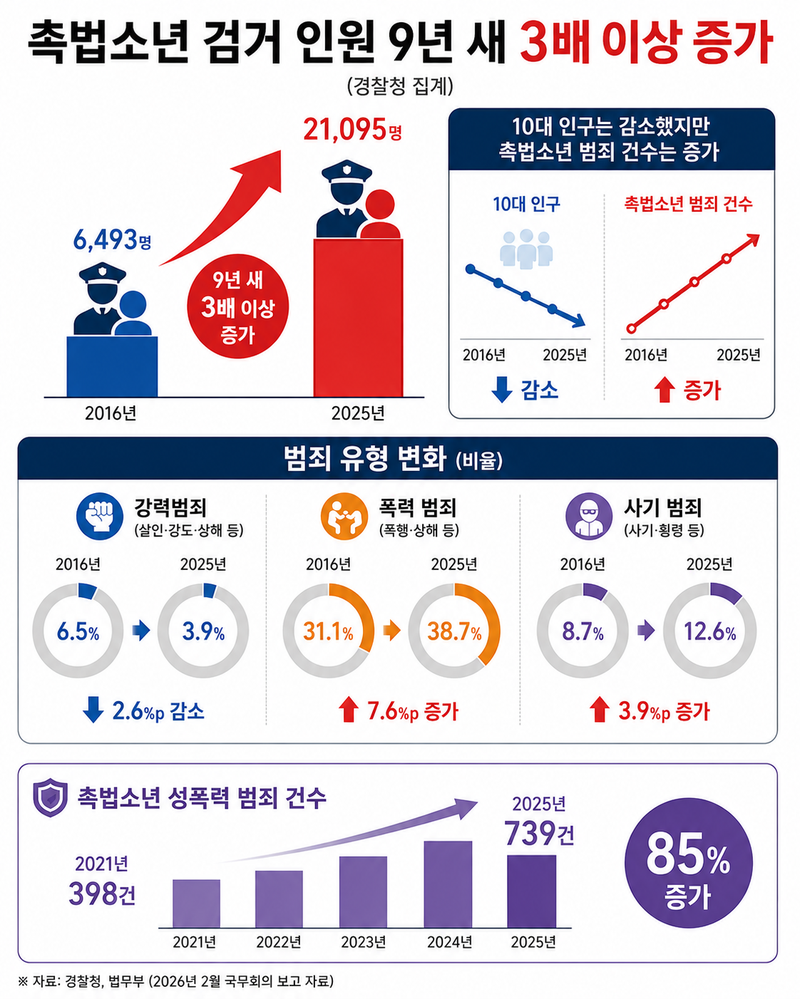
What stands out is the change in the types of crimes. The share of violent crimes fell from 6.5% to 3.9% over the same period, but the shares of violent and fraud-related crimes both increased. Materials reported by the Ministry of Justice at the State Council of South Korea in February 2026 also showed that sexual violence crimes involving juvenile offenders rose 85%, from 398 cases in 2021 to 739 cases in 2025.
An interesting point is how children themselves view juvenile offenders. Lee, an elementary school teacher in Pyeongtaek, Gyeonggi, said, "When I teach opinion writing to sixth graders, many students argue that the age should be lowered or abolished when it comes to juvenile offenders." He added, "Children who are actually victims seem to take these crimes more seriously than adults do."
A middle school teacher in Yangcheon District, Seoul, who requested anonymity, said, "In reality, it is not easy to find students who act so brazenly just because they are 'juvenile offenders,' as shown in the drama." Still, citing recent increases in theft at unmanned stores, the teacher noted, "There are definitely students who think that if they commit crimes like these, they will not face major punishment, based on what they see online or in the media."
The debate over lowering the age for juvenile offenders? What really matters
The main point of contention in the recent debate over juvenile offenders is the standard of "criminal minors under the age of 14," which has remained unchanged since the Criminal Act was enacted in 1953. However, many argue that simply lowering the age for juvenile offenders will not solve the problem. Separate from that debate, they say the distortion in legal awareness must be corrected and the juvenile justice infrastructure must be redesigned at the same time.
Attorney Na Hyun-kyung suggested the need for institutional improvements, including adjusting the maximum period for protective measures, rather than focusing only on lowering the age. Her reasoning was that "in terms of actually separating a child from society and providing proper education, two years, depending on the type of crime, can be a very short time" — referring to the maximum period of juvenile detention.
Chair Cho went a step further and said protection for teachers is also necessary in discussions about juvenile offenders. He argued that "persistent and serious assaults against teachers should be institutionalized in student records." He added that "only when at least some record and accountability for violations of teachers' rights are in place can proper order and respect finally take root in the classroom," stressing the need for institutional support to restore basic educational principles.
[email protected] Kim Hee-sun Reporter