Lee Jae-yong and Choi Tae-won to Attend Blue House Briefing on the 29th in Person... '1,000 Trillion Won Plus Alpha'
- Input
- 2026-06-27 11:47:14
- Updated
- 2026-06-27 11:47:14
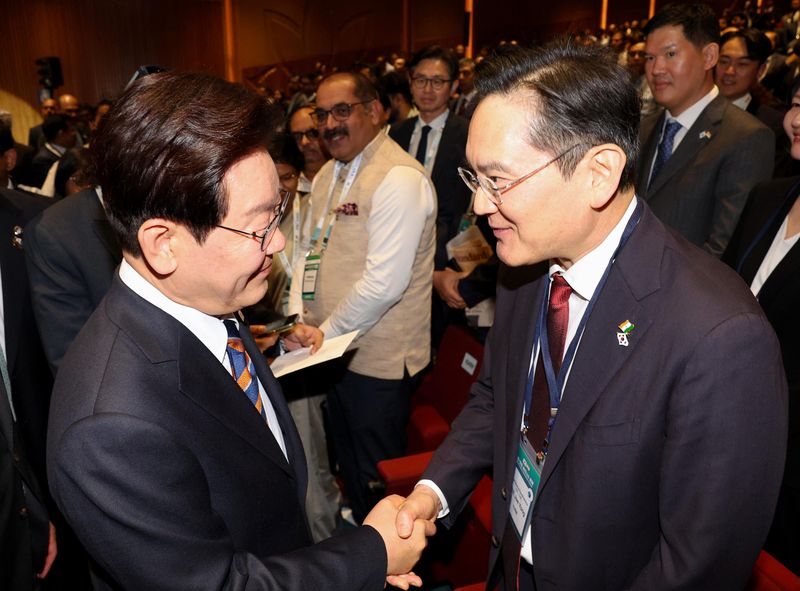
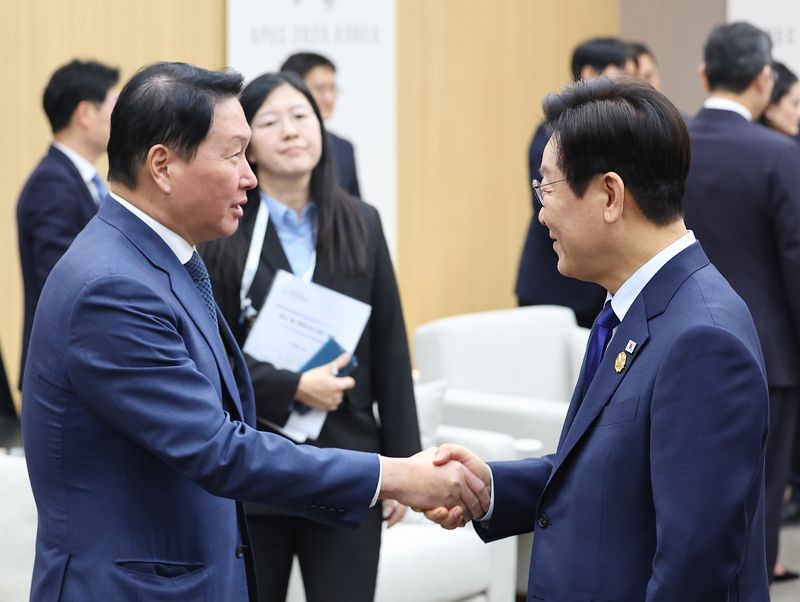
[Financial News] Samsung Electronics Chairman Lee Jae-yong and SK Chairman Choi Tae-won will attend in person the "National Briefing on the Three Major Mega Projects for a Great Leap Forward in the Republic of Korea" at the Blue House on the 29th. As a record-breaking investment scale is expected to be announced that day, the heads of the conglomerates are also expected to be present. According to business and ruling party sources, the briefing will include investment plans worth more than 1,000 trillion won in advanced industries across the regions, led by Samsung Electronics and SK hynix, including the Honam Semiconductor Cluster.
According to the Blue House on the 27th, Lee and Choi will attend the "National Briefing on the Three Major Mega Projects for a Great Leap Forward in the Republic of Korea," hosted by President Lee Jae-myung at the Blue House on the 29th. Lee reportedly met with President Lee at the Blue House on the 25th, while Choi did so on the 19th, to discuss regional investment. Although CEOs had initially been expected to attend, the conglomerate chairmen decided to join the event in person given the importance of the briefing.
The briefing is expected to unveil investment plans by Samsung Electronics and SK hynix in Honam and the Chungcheong region, along with plans to build the Honam Semiconductor Cluster. More specifically, large-scale investment plans are expected to be announced in three areas: semiconductors, physical AI and robots, and data centers.
Kim Yong-beom, chief of staff at the Blue House, said at a Kwanhun Club forum held on the 24th at the Korea Press Center in Seoul that "the discussions are nearing completion" and that "once finalized, we plan to bring companies and ministries together and hold a single event to explain it to the public."
Kim also appeared on the YouTube channel "Kim Eo-jun's News Factory" on the 26th and said of the event on the 29th, "It is a session to explain a program created through joint efforts by the government and companies," adding that "the numbers that come out will be very unfamiliar." He explained, "The plan includes semiconductors, a massive gigawatt-scale artificial intelligence data center, and physical AI and robots, making up the three major sectors," and added, "Because the scale is so large, debate is likely to intensify, starting with whether this is real." He also stressed, "Some may say the government is squeezing companies to make this happen, but these are the world's No. 1 and No. 2 companies. They are not the kind of companies that can be squeezed. We will hold briefing events in relay across the regions."
Earlier, President Lee also reiterated at a senior aides meeting on the 25th that multi-polarization of strategic industries is essential. He said, "To overcome the capital region's one-pole structure, a bold strategy of multi-polarizing strategic industries is essential, expanding large-scale investment in advanced core industries to Yeongnam, Chungcheong, Gangwon, Jeju, Honam and other regions." He added, "While upgrading core infrastructure in the capital region, we must also build new industrial and economic foundations across the provinces so that the capital region and local areas can grow together in a win-win era of growth. We will soon present a concrete blueprint on this to the public."
He said that "the remarkable growth effects of some industries have not spread to the provinces, which account for 90% of the country's land, so the gap in national development and balanced development could become much wider." He warned that "if we fail to overcome the capital region's one-pole structure, the storm of positive change we are experiencing now could fade into a mere breeze in an instant, or it could even turn into a storm of crisis that is hard to imagine." He added that he would "move quickly to revise laws so that more opportunities are given to regions that have been left behind in areas such as fiscal policy, industry, and economic infrastructure."
[email protected] Choi Jong-geun Reporter