"Stocks are in the gutter, so I might as well earn my lunch money"... The real winners of 'app-tech,' where you get paid just for walking [Sweet-and-Savvy Frugality]
- Input
- 2026-06-28 07:00:00
- Updated
- 2026-06-28 07:00:00
'.
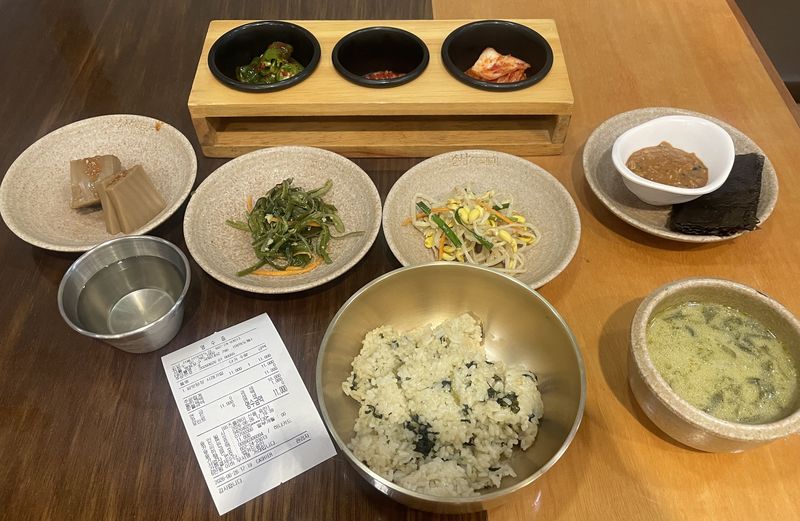
[Financial News] Kim, a 33-year-old office worker, usually eats at the company cafeteria near his office. It is part of his frugal strategy to save on lunch in an era of high prices. Every now and then, though, he orders a slightly more expensive dish at a restaurant he has been watching. His lunch costs are effectively free. More precisely, they are the price of his steps.
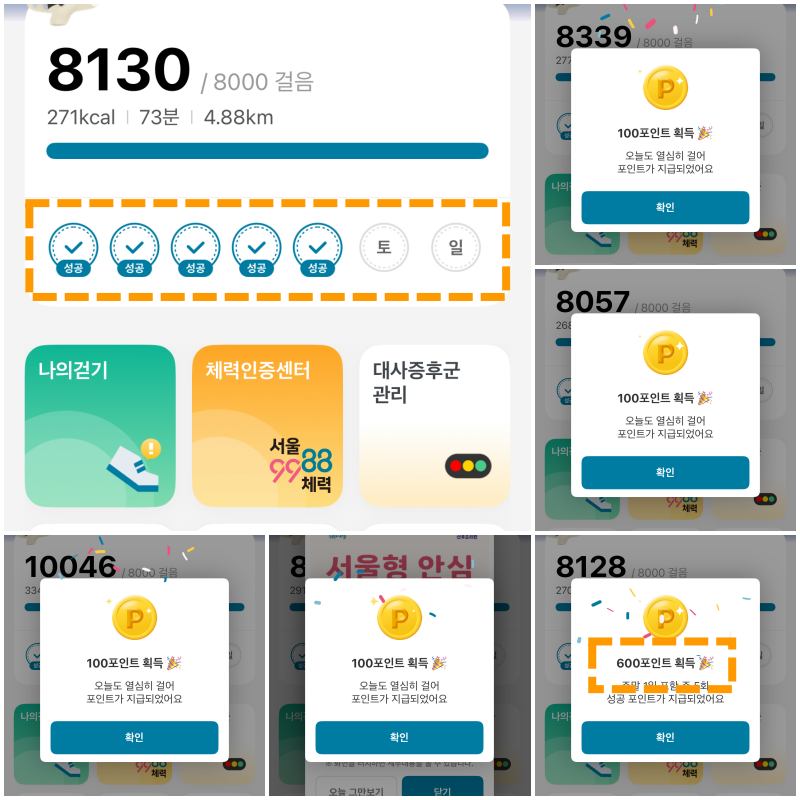
Earlier this month, after consistently walking more than 8,000 steps a day, the Walk Together app credited 100 won per day. On the fifth day, the app added another 500 won. /Photo courtesy of Walk Together 9988When people think of public app-tech, the first thing that comes to mind isWalk Together 9988, the Seoul Metropolitan Government's health management platform
. Seoul residents and people who work in Seoul can earn points by walking and completing health missions. If they reach 8,000 steps a day, or 5,000 steps for those aged 70 or older, they receive 100 points, worth 100 won, each day. If they complete missions at least five times a week, they get an additional 500 points, allowing them to accumulate up to 1,200 points.
These points can be converted into Seoul Pay and used like cash at hospitals, pharmacies, convenience stores, restaurants, and more. The maximum accumulation limit is 100,000 points, or 100,000 won.
The benefits are expanding. Last year, the Seoul Metropolitan Government revamped the app and added a perk for users who hit 8,000 steps a day for at least 20 days a month: they can receive insurance premium discounts of up to 10% for 12 to 60 months on certain private insurance products. The policies are disease insurance products sold by Kyobo Lifeplanet, Samsung Life Insurance, and Hanwha Life Insurance.
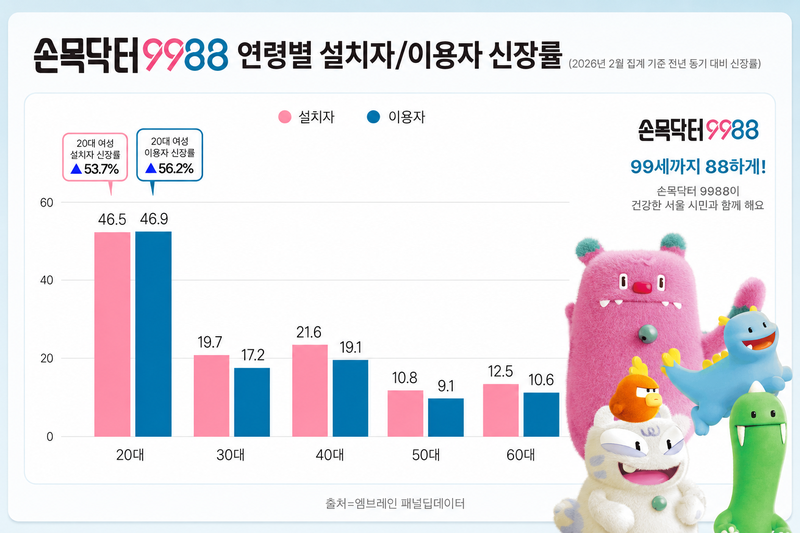
/Graphic by ChatGPT, data from Embrain Panel Deep Data
The advantage of Walk Together is that it does more than simply help users collect points. By making walking a habit, it is also producing health benefits.
According to Seoul Metropolitan Government's analysis of 2.18 million participants from 2021 to 2025, announced in November last year, active users who consistently met their step goals at least three times a week saw their increase in outpatient and inpatient medical expenses fall by 267,593 won compared with less active participants.
As word spreads that people can earn money and improve their health at the same time, the number of users is rising quickly, especially among younger people.
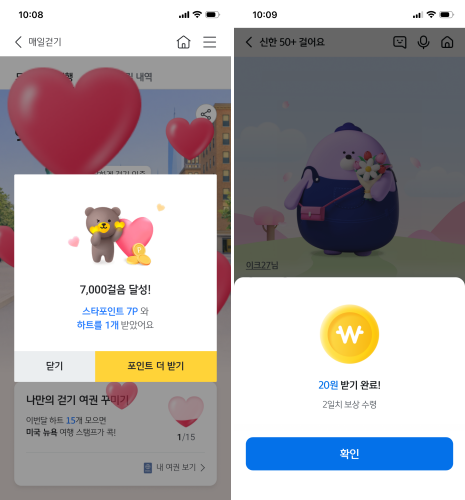
KB Kookmin Bank's Daily Walking service (left) and Shinhan Bank's Shinhan 50+ also offer points or cash when users walk a certain amount. /Photo courtesy of each company appPrivate companies are also fiercely competing in walking app-tech.CashWalk, a pedometer app,
awards points based on step count, which can be exchanged for convenience store and cafe gift cards. MoneyWalk and SuperWalk also offer extra points not only for walking but for quizzes and mission completion.The financial sector has also jumped in.Tossoffers a pedometer servicethat gives users points based on the number of steps they take.Major banks such as KB Kookmin Bank and Shinhan Bank also operate walking-based reward services.Monimo, Samsung Financial Group's integrated app, gives users "jelly" if they walk more than 5,000 steps a day and offers extra rewards for meeting the goal 10 days in a row. The jelly can be converted into cash.
I tried it myself, and lunch and coffee both came to zero won
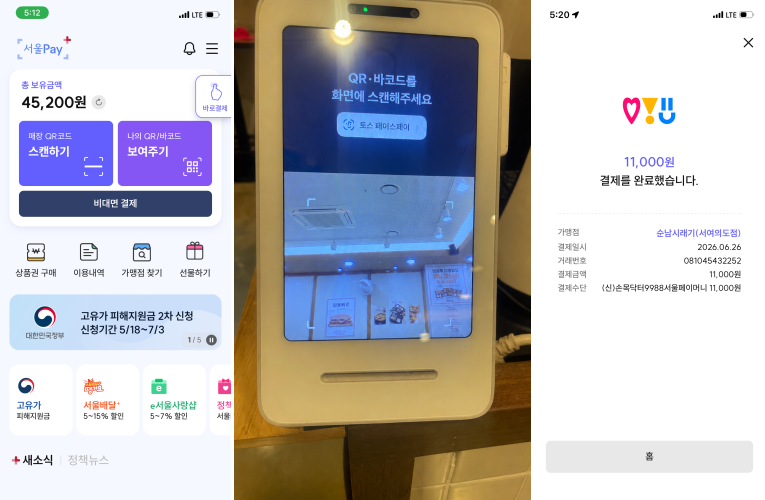
After converting the points earned through Walk Together 9988 into Seoul Pay, I ordered and paid for an 11,000 won meal at a restaurant in Yeouido, Seoul./Photo by Seo Yoon-kyung
Now it was time to put it into practice. I should admit that I had installed Walk Together a year ago. Whenever I used public transportation, I got off two or three stops early and walked the rest of the way. On days when I fell short of my step goal, I would take an extra lap around the neighborhood before going home.
While using Walk Together, I also started collecting walking points in my main bank's app. Unlike Walk Together, which gives 100 won a day, the bank was a bit stingier. Walking 7,000 steps earned only 7 to 10 points.
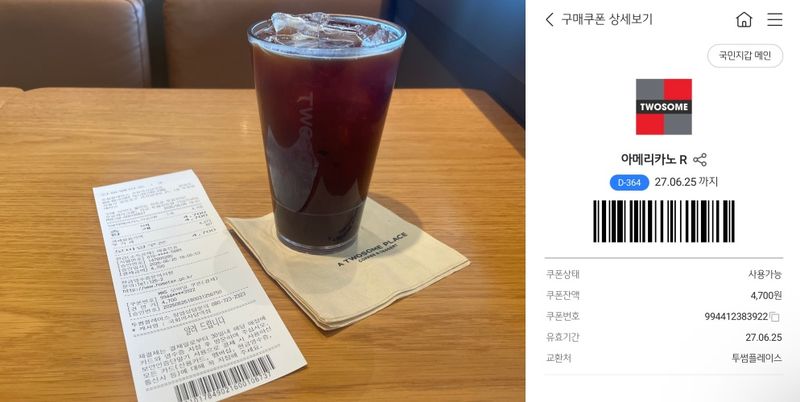
Since it was my first time using the service, there were some trial and error, but I managed to convert the 45,200 points shown in Walk Together into Seoul Pay. I also exchanged the 5,700 points, worth 5,700 won, in my bank app for a drink coupon at a franchise cafe.
First, I opened the Seoul Pay app and searched for affiliated merchants. Restaurants, convenience stores, and pharmacies near my current location in Yeouido, Yeongdeungpo-gu, Seoul, appeared densely on the map. I found an open restaurant among them and ordered a menu item priced at 11,000 won.
The restaurant owner said, "There are more Seoul Pay and Zero Pay users than you might expect. Since it helps bring in customers, most of the restaurants in this building are registered as merchants. If payment doesn't go through, customers may go to another restaurant, so there is no reason not to sign up."
At a franchise cafe in Yeouido, Seoul, I used a free coupon earned through KB Kookmin Bank's walking points to pay for an iced Americano. /Photo by Seo Yoon-kyung, screenshot from KB Kookmin Bank app Dessert was already planned. I went to a franchise cafe near the restaurant and ordered an iced Americano. I paid with a free coupon I had received in the bank app. In the end, I covered both an early dinner and coffee without spending a single won from my wallet. On the way home, I reached my daily goal of 8,000 steps, and points were added to both Walk Together and the bank app.
[email protected] Seo Yoon-kyung Reporter