"I can't walk fast even if I want to"... Crosswalks are too tight for the elderly [Recorder of the Low Places]
- Input
- 2026-06-28 06:00:00
- Updated
- 2026-06-28 06:00:00
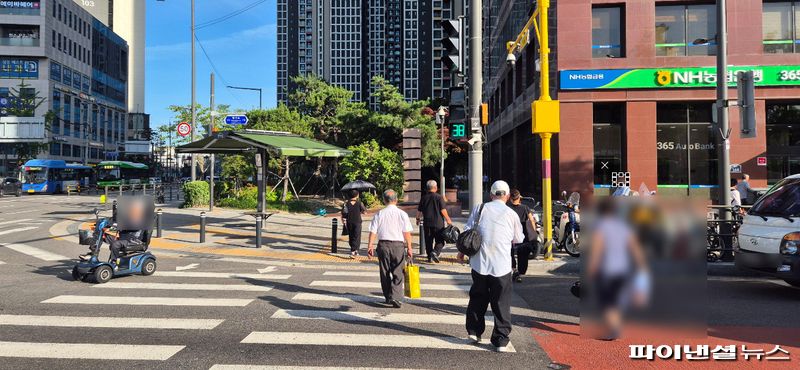
Photo by Reporter Han Seung-gon Accidents involving elderly pedestrians are not solely a matter of signal timing. Even with the same green light, the perceived time varies depending on walking speed, physical condition, the weight of luggage, and the route to the destination. We examined how crosswalks function in residential areas where markets, hospitals, pharmacies, and bus stops are concentrated, through on-site observations near Gyeongdong Market.
In this area, where pharmacies, hospitals, markets, and bus stops are clustered, the elderly, citizens pushing handcarts, and electric wheelchair users crossed the road all at once whenever the pedestrian signal turned green. The signals here were not simply short. Major pedestrian signals measured on-site lasted over 40 seconds.
This was ample time for an average adult walking at a steady pace. However, when the reporter shortened their stride and walked at the speed of elderly pedestrians, the remaining time became the first thing to notice as they passed the halfway point. If one could not start immediately after the signal turned on or slowed down while carrying a shopping bag, even a signal in the 40-second range did not feel sufficient.
The green light, which is not short in numbers, is different on the ground. The area around Gyeongdong Market is home to a high concentration of elderly pedestrians, even within Seoul. Cheongnyangni Fruit and Vegetable Market, Seoul Yangnyeong Market, hospitals, pharmacies, subway stations, and bus stops are all located close together.
Photo by Reporter Han Seung-gon Accidents involving elderly pedestrians are not solely a matter of signal timing. Even with the same green light, the perceived time varies depending on walking speed, physical condition, the weight of luggage, and the route to the destination. We examined how crosswalks function in residential areas where markets, hospitals, pharmacies, and bus stops are concentrated, through on-site observations near Gyeongdong Market.
Citizens who had finished shopping crossed the crosswalks carrying black bags or shopping baskets in both hands, and some were unable to move immediately even after the signal changed. "There are times when I can't get out right away even when the light turns green," said Mr. B, an elderly person in his 70s.
Photo by Reporter Han Seung-gon Accidents involving elderly pedestrians are not solely a matter of signal timing. Even with the same green light, the perceived time varies depending on walking speed, physical condition, the weight of luggage, and the route to the destination. We examined how crosswalks function in residential areas where markets, hospitals, pharmacies, and bus stops are concentrated, through on-site observations near Gyeongdong Market."When there are a lot of people, I walk while watching for others to pass first for fear of bumping into each other. " He lamented, "If what I'm carrying is heavy, my pace slows down even more. I can't walk as fast as young people.
" When comparing distance measurements from Kakao Maps with location data on crosswalks along main roads in Seoul, there were several sections of main road crosswalks exceeding 30 meters in length in the Jegi-dong and Jeonnong-dong areas near Gyeongdong Market and Cheongnyangni Fruit and Vegetable Market. 258m. A crosswalk of around 40 meters is not a significantly burdensome distance for an average adult.
However, for elderly pedestrians, it takes time right from the start. One checks that the signal has changed, moves out of the way of the person next to them, looks at the direction of traffic, and then begins to walk. If using a handcart or a walking aid, it takes a few extra seconds to get your bearings.
When the reporter tried crossing again with a shorter stride, their pace quickened from the middle of the crosswalk. In reality, it wasn't that they were walking fast, but rather that their mind was racing first. An elderly person next to them, carrying a shopping bag, looked at the remaining time and grumbled, "At times like this, even if I wanted to run, I couldn't.
" Elderly people crossing directly rather than going around A citizen is crossing the road outside the crosswalk on a road near Gyeongdong Market. Photo by Reporter Han Seung-gon Jaywalking was also observed at the scene that day. Some citizens crossed the road outside the crosswalk.
Photo by Reporter Han Seung-gon Accidents involving elderly pedestrians are not solely a matter of signal timing. Even with the same green light, the perceived time varies depending on walking speed, physical condition, the weight of luggage, and the route to the destination. We examined how crosswalks function in residential areas where markets, hospitals, pharmacies, and bus stops are concentrated, through on-site observations near Gyeongdong Market.
It appeared they were trying to go directly to a nearby pharmacy, the market entrance, or a bus stop. A man in his 60s said, "If I go all the way to the crosswalk, I have to go around," adding, "Many people hurry over when there are no cars. " He added, "It’s not that I’m good at it, but when my legs hurt, even taking the long way around is difficult.
Photo by Reporter Han Seung-gon Accidents involving elderly pedestrians are not solely a matter of signal timing. Even with the same green light, the perceived time varies depending on walking speed, physical condition, the weight of luggage, and the route to the destination. We examined how crosswalks function in residential areas where markets, hospitals, pharmacies, and bus stops are concentrated, through on-site observations near Gyeongdong Market.Photo by Reporter Han Seung-gon Accidents involving elderly pedestrians are not solely a matter of signal timing. Even with the same green light, the perceived time varies depending on walking speed, physical condition, the weight of luggage, and the route to the destination. We examined how crosswalks function in residential areas where markets, hospitals, pharmacies, and bus stops are concentrated, through on-site observations near Gyeongdong Market.
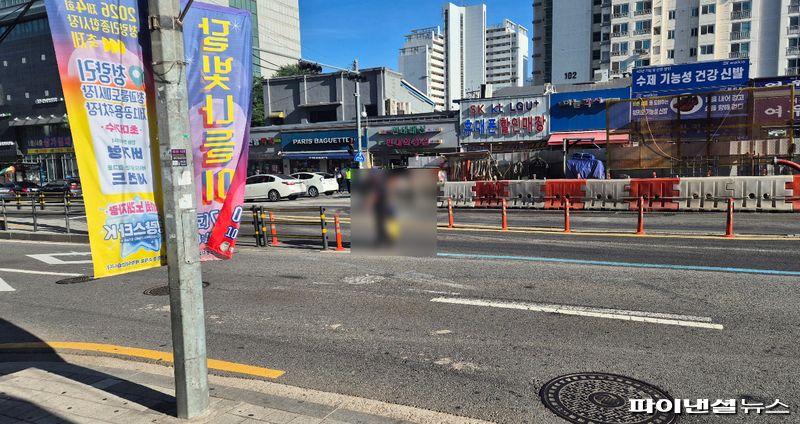
A citizen in an electric wheelchair also entered the crosswalk slowly after the signal turned green. It took longer than for a regular pedestrian to start and change direction. A citizen pulling a handcart slowed down between the curb and the sidewalk blocks.
Even with the same green light, the available time varied for each person. Repeated Pedestrian Accidents Involving the Elderly Around the Market The area around Gyeongdong Market is one of the places where the danger to elderly pedestrians has been repeatedly confirmed. According to the Seoul Metropolitan Government, the section with the highest number of pedestrian accidents involving the elderly in Seoul from 2014 to 2018 was 'Cheongnyangni Gyeongdong Market Road'.
Over the past five years, there were 54 accidents. 7-meter-wide pedestrian walkway in the area and carried out construction to improve the pedestrian environment around the traditional market. The approach involved separating vehicles and pedestrians and expanding pedestrian spaces.
It was an effort to revitalize the market area where accidents were frequent. However, it is difficult to view this as a problem unique to Gyeongdong Market. Similar pedestrian risks arise in areas where hospitals, pharmacies, markets, and bus stops are located nearby.
Photo by Reporter Han Seung-gon Accidents involving elderly pedestrians are not solely a matter of signal timing. Even with the same green light, the perceived time varies depending on walking speed, physical condition, the weight of luggage, and the route to the destination. We examined how crosswalks function in residential areas where markets, hospitals, pharmacies, and bus stops are concentrated, through on-site observations near Gyeongdong Market.
In places with a high concentration of elderly pedestrians, people carrying heavy loads, and complex traffic flow, it is difficult to explain safety solely based on traffic signal timing. National statistics show the same trend. According to traffic accident statistics for 2025 from the National Police Agency and the Korea Road Traffic Authority, there were 35,356 pedestrian traffic accidents in 2024.
Photo by Reporter Han Seung-gon Accidents involving elderly pedestrians are not solely a matter of signal timing. Even with the same green light, the perceived time varies depending on walking speed, physical condition, the weight of luggage, and the route to the destination. We examined how crosswalks function in residential areas where markets, hospitals, pharmacies, and bus stops are concentrated, through on-site observations near Gyeongdong Market.The number of pedestrian fatalities was 926, an increase of 6 from the previous year. Traffic accidents involving elderly pedestrians totaled 11,498, an increase of 197 from the previous year. There were 619 fatalities among elderly pedestrians.
Attempts to change standards based on slow pedestrians On the 23rd, citizens are crossing a crosswalk near Gyeongdong Market in Dongdaemun-gu, Seoul, with the pedestrian signal display showing one second remaining. Photo by Reporter Han Seung-gon Given this situation, pedestrian signal standards are also changing in some ways.
The pedestrian signal time for general crosswalks is based on a walking speed of 1 m/s. This method allocates 1 second per meter of crosswalk length and adds 7 seconds for entry time.
7 m/s. Even for crosswalks of the same length, the pedestrian signal may be longer in areas with a high concentration of vulnerable road users.
Photo by Reporter Han Seung-gon Accidents involving elderly pedestrians are not solely a matter of signal timing. Even with the same green light, the perceived time varies depending on walking speed, physical condition, the weight of luggage, and the route to the destination. We examined how crosswalks function in residential areas where markets, hospitals, pharmacies, and bus stops are concentrated, through on-site observations near Gyeongdong Market.
In 2024, the Seoul Metropolitan Government, together with the Seoul Metropolitan Police Agency and the Autonomous Police Commission, also promoted a project to extend pedestrian signal times by 3 to 6 seconds at crosswalks with high traffic volume by vulnerable road users, such as the elderly. Some local governments are introducing or piloting "smart crosswalks" that use artificial intelligence (AI) video analysis to automatically extend traffic signals when pedestrians are present.
Photo by Reporter Han Seung-gon Accidents involving elderly pedestrians are not solely a matter of signal timing. Even with the same green light, the perceived time varies depending on walking speed, physical condition, the weight of luggage, and the route to the destination. We examined how crosswalks function in residential areas where markets, hospitals, pharmacies, and bus stops are concentrated, through on-site observations near Gyeongdong Market.Photo by Reporter Han Seung-gon Accidents involving elderly pedestrians are not solely a matter of signal timing. Even with the same green light, the perceived time varies depending on walking speed, physical condition, the weight of luggage, and the route to the destination. We examined how crosswalks function in residential areas where markets, hospitals, pharmacies, and bus stops are concentrated, through on-site observations near Gyeongdong Market.
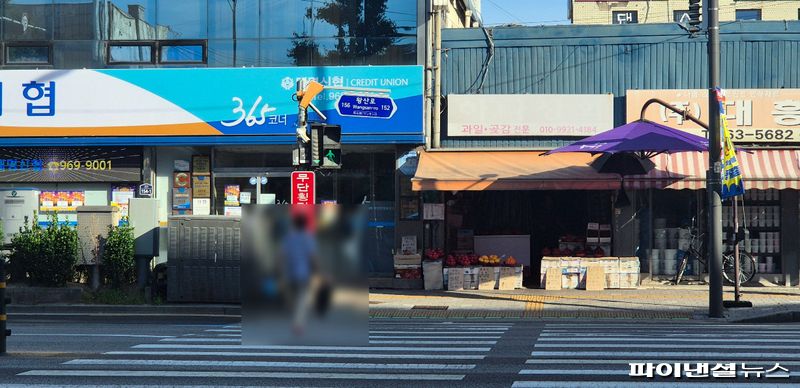
It is a system designed to allow them to wait for the same signal as general pedestrians but receive longer crossing time when needed. Hong Kong also operates smart devices for the elderly and disabled.
Hong Kong provides information on devices that extend crossing time when a transportation card, such as an Octopus card or a designated card, is tapped on the signal terminal. Rather than separating those with slower walking speeds, this method provides additional time within the existing crosswalk system.
The "Puffin Crosswalk" used in some parts of the UK is also worth noting. It is a system that detects whether a pedestrian remains on the crosswalk and adjusts the timing of traffic signal changes accordingly.
It resembles domestic smart crosswalks in that it reflects actual pedestrian movements in signal operation, rather than a structure that ends simply after a set time has passed following a button press. **Blinking Green Lights on Crosswalks.
Not the Same for Everyone** A main road near Gyeongdong Market. Long crosswalks line this area where the routes of the market, hospital, and bus stop overlap.
Photo by Reporter Han Seung-gon Looking solely at the signal duration, it is difficult to conclude that the crosswalks near Gyeongdong Market are short. The signal observed on-site lasted over 40 seconds, and most average adult pedestrians crossed within the signal period.
Photo by Reporter Han Seung-gon Accidents involving elderly pedestrians are not solely a matter of signal timing. Even with the same green light, the perceived time varies depending on walking speed, physical condition, the weight of luggage, and the route to the destination. We examined how crosswalks function in residential areas where markets, hospitals, pharmacies, and bus stops are concentrated, through on-site observations near Gyeongdong Market.
However, the significance of the green light changes when viewed from the perspective of elderly pedestrians. The few seconds they are unable to move immediately after the signal turns on, the weight of shopping baskets, mobility aids, handcarts, and the time spent checking for right-turning vehicles all affected the crossing time.
Photo by Reporter Han Seung-gon Accidents involving elderly pedestrians are not solely a matter of signal timing. Even with the same green light, the perceived time varies depending on walking speed, physical condition, the weight of luggage, and the route to the destination. We examined how crosswalks function in residential areas where markets, hospitals, pharmacies, and bus stops are concentrated, through on-site observations near Gyeongdong Market.Photo by Reporter Han Seung-gon Accidents involving elderly pedestrians are not solely a matter of signal timing. Even with the same green light, the perceived time varies depending on walking speed, physical condition, the weight of luggage, and the route to the destination. We examined how crosswalks function in residential areas where markets, hospitals, pharmacies, and bus stops are concentrated, through on-site observations near Gyeongdong Market.
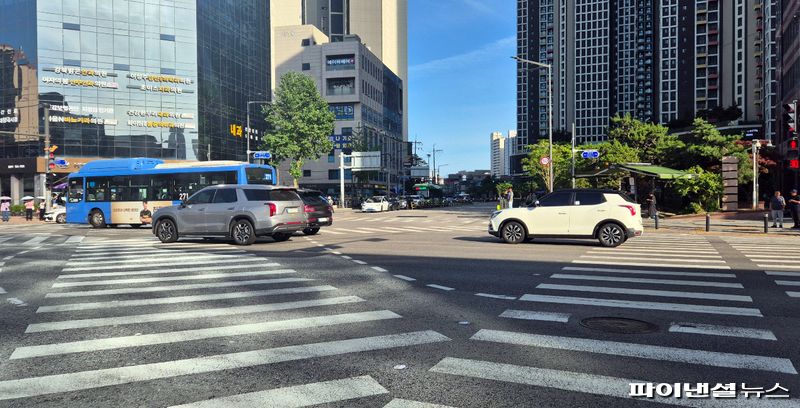
Consequently, the pedestrian dangers for the elderly observed in this area could not be explained solely by the green light. Even the same 40 seconds were used differently by those walking empty-handed, those carrying shopping bags, and those using walking aids.
There were elderly people who paused briefly after reaching the end of the crosswalk, unable to move on immediately. After crossing the crosswalk, a citizen in their 70s put down the shopping bag they were holding and caught their breath.
After looking back at the traffic light, they said: "Young people get there in no time. Even if we want to walk fast, we can't.
The green light looks long, but it feels short when you actually cross. " We record the earnest stories of life in print.
We capture the words gathered from the field exactly as they are, even if they are rough. Records of ordinary days we have passed through—from alleys and markets to someone's workplace—come to our readers.
Photo by Reporter Han Seung-gon Accidents involving elderly pedestrians are not solely a matter of signal timing. Even with the same green light, the perceived time varies depending on walking speed, physical condition, the weight of luggage, and the route to the destination. We examined how crosswalks function in residential areas where markets, hospitals, pharmacies, and bus stops are concentrated, through on-site observations near Gyeongdong Market.
Please subscribe to the reporter's page to conveniently receive [Recorder of the Lowly Places].
Photo by Reporter Han Seung-gon Accidents involving elderly pedestrians are not solely a matter of signal timing. Even with the same green light, the perceived time varies depending on walking speed, physical condition, the weight of luggage, and the route to the destination. We examined how crosswalks function in residential areas where markets, hospitals, pharmacies, and bus stops are concentrated, through on-site observations near Gyeongdong Market.[email protected] Han Seung-gon Reporter