Jeju Forum Declares Peace Vision for the Next 10 Years, Emerging as a Multilateral Diplomacy Platform
- Input
- 2026-06-27 08:44:07
- Updated
- 2026-06-27 08:44:07
[Financial News, Jeju = Jeong Yong-bok] At a time when the international order is being shaken by division and competition, Jeju has put forward a new vision for peace diplomacy over the next decade. The 21st Jeju Forum for Peace and Prosperity is being seen as having moved up a level, evolving from a local government-led international conference into a multilateral cooperation platform representing Korea, helped by this year's co-hosting by the Ministry of Foreign Affairs and a session featuring candidates for the next UN secretary-general.
The 21st Jeju Forum for Peace and Prosperity, held from the 24th to the 26th at Haevichi Hotel and the Jeju Stone Park in Pyoseon-myeon, Seogwipo City, concluded its three-day run with the closing ceremony on this day.
The 21st Jeju Forum for Peace and Prosperity was co-hosted by the Ministry of Foreign Affairs, Jeju Special Self-Governing Province, the International Peace Foundation, and the East Asia Foundation, and organized by the Jeju Peace Institute.
This year's main theme was "Reimagining Cooperation in an Age of Division." Leaders from around the world, officials from international organizations, and experts from academia and civil society came together to discuss complex challenges facing the global community at once, including geopolitical conflict, the climate crisis, artificial intelligence (AI) and digital transformation, the situation in the Middle East, and the crisis of multilateralism.
Some 6,000 experts and global leaders from 85 countries took part in this year's forum. A total of 68 sessions were held across fields including diplomacy and security, climate, the economy, culture, education, and health care. A key feature was that the Jeju Forum no longer remained focused solely on peace on the Korean Peninsula, but expanded into a comprehensive multilateral cooperation stage covering the climate crisis, AI governance, energy transition, local diplomacy, and youth exchanges.
This year was especially notable because the Ministry of Foreign Affairs joined as a co-host. As the forum was run jointly by Jeju Special Self-Governing Province, the International Peace Foundation, the East Asia Foundation, and the Ministry of Foreign Affairs, with the Jeju Peace Institute in charge of operations, the forum's role as a national diplomacy platform became even stronger. Another change this year was that the Minister of Foreign Affairs served as a co-chair of the organizing committee alongside the governor of Jeju.
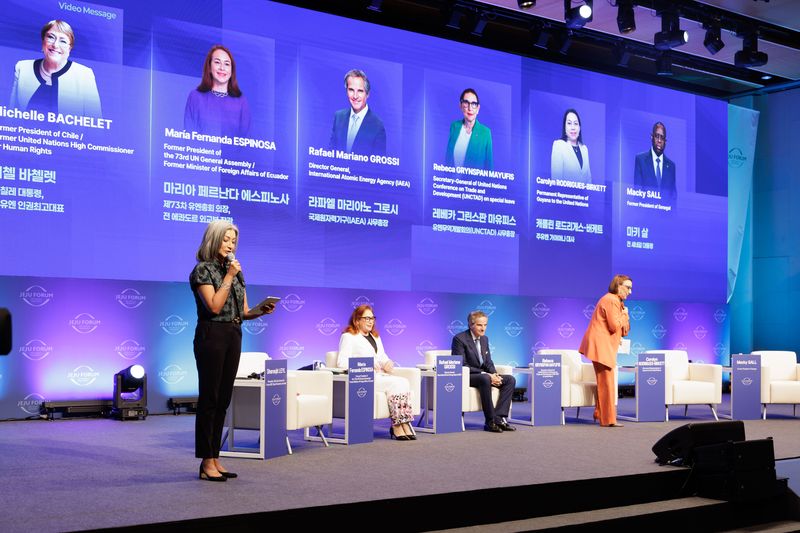
The most attention-grabbing event was the dialogue with candidates for the next UN secretary-general. Rafael Mariano Grossi, Director General of the International Atomic Energy Agency (IAEA); Rebeca Grynspan Mayufis, Secretary-General of the United Nations Conference on Trade and Development (UNCTAD); María Fernanda Espinosa, President of the 73rd UN General Assembly; and former Senegalese President Macky Sall discussed the future of multilateralism and the direction of UN reform in Jeju.
The fact that UN candidates gathered in one place added to the forum's international symbolism. However, the failure to secure participation from a North Korean figure who could have symbolically highlighted the peace agenda on the Korean Peninsula remains a task for the future. There is also growing recognition that, as the Jeju Forum expands into a global multilateral diplomacy stage, it must also consider how to reconnect its identity as the "Island of World Peace" with practical peace efforts on the Korean Peninsula.
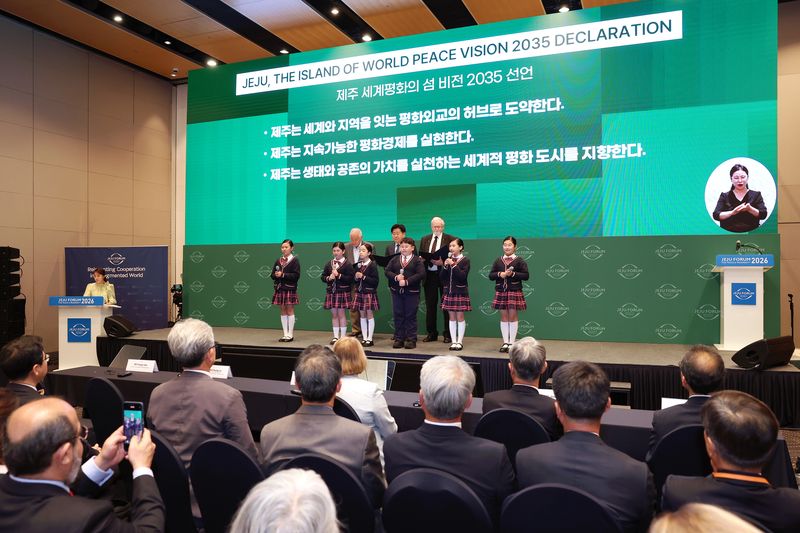
The centerpiece of the closing ceremony was the "Jeju Island Vision 2035 Declaration for the Island of World Peace." It is a blueprint for how Jeju will develop as a peace city over the next 10 years, marking 21 years since the island was designated the Island of World Peace.
The declaration lays out a vision for Jeju to emerge as a central hub for peace diplomacy connecting the world and the region. It calls for upgrading the Jeju Forum into a global public platform and expanding ties with international organizations, peace cities, and youth networks.
The concept of peace was also broadened. While peace in the past was centered on security and preventing war and conflict, Vision 2035 brings climate crisis, energy transition, economic inequality, the digital divide, and ecological threats into the peace agenda. It also presents a "peace economy" vision that links carbon neutrality, renewable energy, green hydrogen, and digital innovation to the local economy and improved quality of life for residents.
The vision for an eco-friendly peace city based on Jeju's unique assets was also included. It calls for preserving the island's natural and cultural resources, such as the sea, forests, oreum volcanic cones, gotjawal forests, and haenyeo culture, while creating a city model in which humans and nature coexist. This is seen as an attempt to turn the vulnerabilities faced by island regions in the climate crisis era into an agenda for international cooperation.
The spirit of reconciliation and coexistence embodied in the Jeju April 3 Incident was also presented as an important pillar. The declaration reflects a commitment to sharing the values of the Jeju April 3 Incident, widely regarded as a model for resolving historical grievances, with the international community as a universal peace value. It means expanding a painful local history into a global peace discourse.
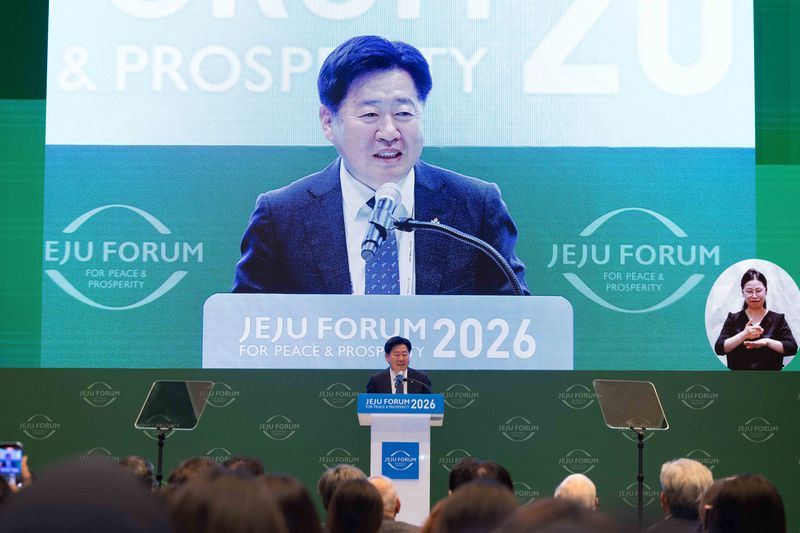
In his closing remarks, Governor Oh Young-hun said, "Through this Jeju Forum, we confirmed the possibility of cooperation for peace and prosperity," adding, "The fact that candidates for the next UN secretary-general gathered in one place and shared their visions shows that the Jeju Forum has taken a leap forward as a global diplomacy platform."
Oh also said, "This year's Jeju Forum, with the Ministry of Foreign Affairs joining as co-host, became a turning point in expanding Jeju's accumulated experience in peace and cooperation into national and international agendas," and added, "We will share the peace and coexistence values of the Jeju April 3 Incident with the world and lead coexistence in the new era."
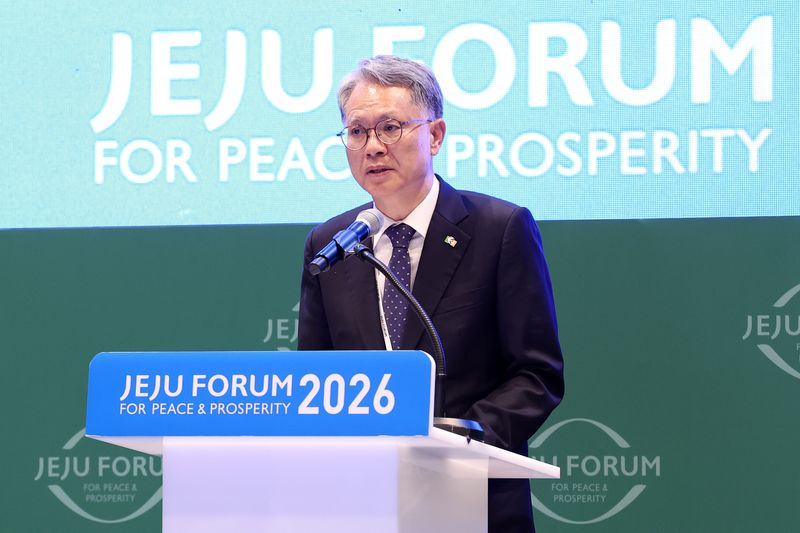
Kang Jeong-sik, who delivered the closing declaration, found the meaning of this forum in the "accumulation of discussion" and the "link to implementation." He said, "What matters most is that the discussions accumulated at this forum do not end with a declaration, but lead to actual policy and international cooperation," adding, "The Jeju Peace Institute will expand these discussions into follow-up research and global networks."
As the organization that oversees the Jeju Forum, the Jeju Peace Institute plans to carry this year's discussions into follow-up research, agenda development, and the expansion of domestic and international networks.
The challenges facing the Jeju Forum have also become clear. While the forum has grown in scale and scope, there is increasing demand for its outcomes to lead to actual policy changes and local transformation. For Vision 2035 to avoid remaining merely a declaration, Jeju must connect peace diplomacy, the peace economy, eco-friendly peace initiatives, the global promotion of the Jeju April 3 Incident, and youth networks to concrete projects.
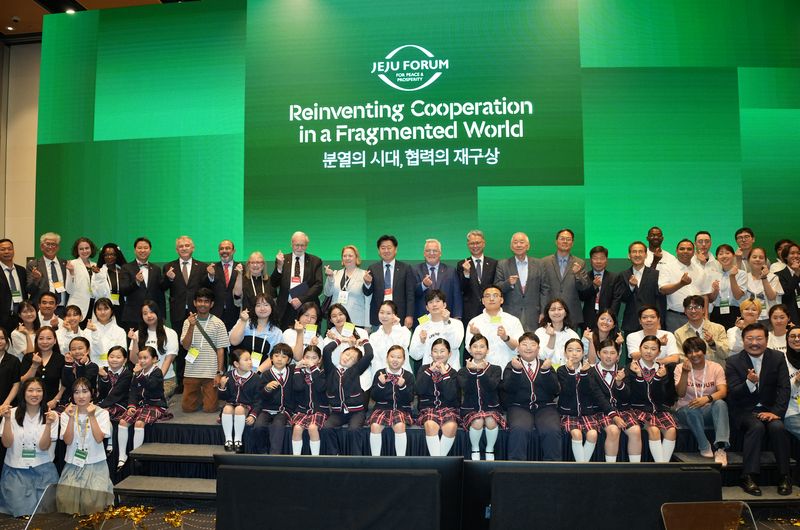
The Ministry of Foreign Affairs, Jeju Special Self-Governing Province, and the Jeju Peace Institute, which served as the host and organizing bodies, plan to analyze the agenda and session outcomes from this forum and reflect them in preparations for next year's 22nd Jeju Forum. If this year's forum broadened its international reach through the Ministry of Foreign Affairs' co-hosting and the dialogue with candidates for UN secretary-general, the next task is to turn the "Jeju Island Vision 2035 Declaration for the Island of World Peace" into a practical cooperation model that can be implemented with the international community rather than leaving it as a declaration.
Whether the Jeju Forum can establish itself not just as a venue for dialogue among countries around the world, but as a platform that connects peace diplomacy, responses to the climate crisis, sustainable development, and the spread of the peace values of the Jeju April 3 Incident into tangible cooperation, is expected to be the key issue over the next 10 years.
[email protected] Jeong Yong-bok Reporter