"Stocks Are Still Necessary"... Put Away Retirement Money for 20 Years Instead of Jeonse Funds You’ll Need in Three Months [Investing or Gambling? 3·End]
- Input
- 2026-07-01 05:00:00
- Updated
- 2026-07-01 05:00:00
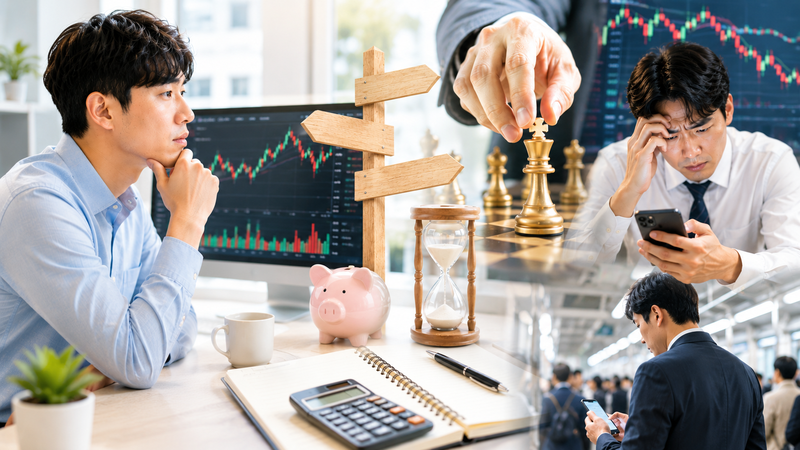
Photo=ChatGPT Stocks remain an important way for office workers to build assets. But if the purpose of the money, the holding period and the acceptable level of loss are not clearly defined, investing can easily turn into a short-term contest rather than a long-term plan.
Here, we look at the standards salaried investors should set first in a volatile market. [Financial News] Stocks are still a necessary investment tool for office workers who find it difficult to grow their assets on salary alone.
Photo=ChatGPT Stocks remain an important way for office workers to build assets. But if the purpose of the money, the holding period and the acceptable level of loss are not clearly defined, investing can easily turn into a short-term contest rather than a long-term plan.They allow investors to take part in corporate growth and can be used over the long term to prepare for retirement or build wealth. But participating in the stock market is different from being drawn to the order book, chat rooms and leveraged products and buying and selling quickly.
Without clear trading rules, investing can become more like a short-term contest than a plan. The stock market has recently swung between record highs and sharp declines.
Photo=ChatGPT Stocks remain an important way for office workers to build assets. But if the purpose of the money, the holding period and the acceptable level of loss are not clearly defined, investing can easily turn into a short-term contest rather than a long-term plan.
Many investors worry that if they stay out, they will fall behind in asset growth, but if they jump in, they fear losses. In such conditions, the first thing to consider before choosing stocks is the nature of the money, the holding period and how much loss can be tolerated.
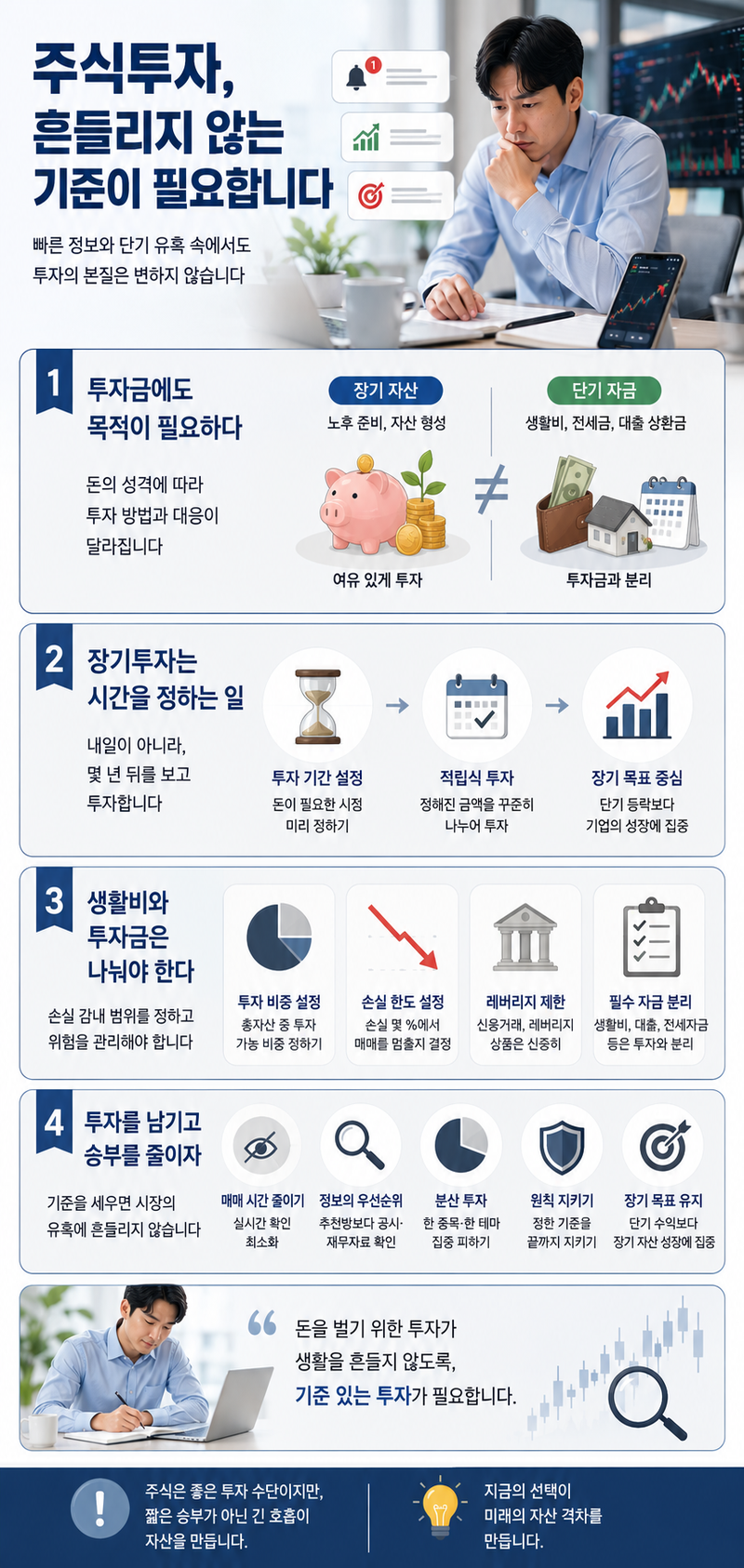
Photo=ChatGPT Stocks remain an important way for office workers to build assets. But if the purpose of the money, the holding period and the acceptable level of loss are not clearly defined, investing can easily turn into a short-term contest rather than a long-term plan.Start by separating the purpose of the money Not all the money in a stock account is the same. Money meant to be invested for retirement over many years is different from money that will be needed for a jeonse deposit in a few months.If essential funds such as living expenses or loan repayments are put into a stock account, investment decisions are bound to be shaken when share prices move. The investment horizon also depends on the purpose of the money.If the money is to be used as retirement savings 10 years from now, there is room to endure short-term fluctuations. But if it will be needed in three months, even a small loss becomes a burden.Even when buying the same stock, an investor’s response changes depending on what kind of money was used. A salaried worker in his 30s, identified as A, said, "At first I planned to buy an ETF for retirement, but I get swayed whenever I hear people around me talking about soaring stocks." He added, "I started out calling it long-term investing, but I still keep checking the daily return. " Cut down on short-term trading and aim for long-term investing One of the key ways to distinguish investing from short-term trading is time.
Behavior changes depending on whether you are betting on a stock that may rise tomorrow or buying an asset you plan to hold for years. Long-term investing is not simply about holding on for a long time.
Photo=ChatGPT Stocks remain an important way for office workers to build assets. But if the purpose of the money, the holding period and the acceptable level of loss are not clearly defined, investing can easily turn into a short-term contest rather than a long-term plan.
It means deciding in advance when the money will be needed and how much volatility you can withstand. In a report released in June last year, the Korea Financial Investment Education Association said that investing should be viewed not as a speculative tool for making a lot of money in a short time, but as a means of achieving the long-term goals of life-cycle financial planning.
Photo=ChatGPT Stocks remain an important way for office workers to build assets. But if the purpose of the money, the holding period and the acceptable level of loss are not clearly defined, investing can easily turn into a short-term contest rather than a long-term plan.It also stressed the importance of not making investment decisions based only on recommendations from experts or acquaintances without reliable, objective evidence. Regular investing follows the same logic.Instead of putting in a large sum at once, investing a fixed amount in installments can reduce the pressure of choosing the right entry point.It is an approach based on the reality that it is difficult to time the market bottom accurately.
A salaried worker in his 40s, identified as B, said, "I changed to buying the same amount of ETF every payday." He added, "The returns are not flashy, but I definitely check the order book less often at work." Trading size tends to grow after losses After a loss, trading size often increases.
Investors try to recover losses by buying riskier stocks or increasing the amount of money they trade through margin or leveraged products.
Photo=ChatGPT Stocks remain an important way for office workers to build assets. But if the purpose of the money, the holding period and the acceptable level of loss are not clearly defined, investing can easily turn into a short-term contest rather than a long-term plan.
What began as an investment can suddenly turn into money that must be recovered.
Photo=ChatGPT Stocks remain an important way for office workers to build assets. But if the purpose of the money, the holding period and the acceptable level of loss are not clearly defined, investing can easily turn into a short-term contest rather than a long-term plan.Before investing, investors should set a loss limit.That means deciding how much of total assets can go into stocks, how much of that can be allocated to high-risk products, and at what loss level trading should stop.Living expenses, loan repayments, jeonse funds and family joint funds should be kept separate from investment money.
The Financial Supervisory Service has advised that investors using leveraged trading such as margin loans must fully understand the structure and the risk of forced liquidation.
When the market is rising, borrowing to invest may seem manageable, but in a sharp downturn, forced liquidation and interest costs can remain as additional burdens.
Photo=ChatGPT Stocks remain an important way for office workers to build assets. But if the purpose of the money, the holding period and the acceptable level of loss are not clearly defined, investing can easily turn into a short-term contest rather than a long-term plan.
For many office workers, stocks have already become a way to manage assets beyond their monthly salary.
Photo=ChatGPT Stocks remain an important way for office workers to build assets. But if the purpose of the money, the holding period and the acceptable level of loss are not clearly defined, investing can easily turn into a short-term contest rather than a long-term plan.What is needed is not the conclusion that people should avoid stocks altogether, but standards that reduce short-term speculation within stock investing.The rules are not complicated.Set the purpose of the money, reduce trading frequency, limit margin trading and lower the concentration in a single stock or theme.
It is also important to look at the investment horizon before checking profit screenshots, and to review disclosures and financial statements before following stock tips.
The Korea Financial Investment Education Association said in an investor education report that investment decisions require reliable information and long-term financial goals.
It emphasized that investors should not make decisions based only on recommendations from experts or acquaintances without objective evidence.B, the office worker, said, "I’m not saying I won’t invest in stocks, but I want to cut back on the kind of trading that keeps me glued to my screen all day at work." "If you started to make money but your life is thrown off balance, can you really call that investing?" he said.
[email protected] Han Seung-gon Reporter