"Stock recommendation chat rooms, real-time alerts, 2x ETFs" ... Retail investors pushed by a sense of urgency end up hitting the buy button [Investing or gambling? 2]
- Input
- 2026-06-30 05:00:00
- Updated
- 2026-06-30 05:00:00

We are in an era where a single "surge" alert can lead directly to a trade. A stock app opened to check holdings now exposes investors to theme stocks, recommendation rooms and high-risk products. This article looks at what needs to be checked so that investing does not drift into betting in a more convenient investment environment.
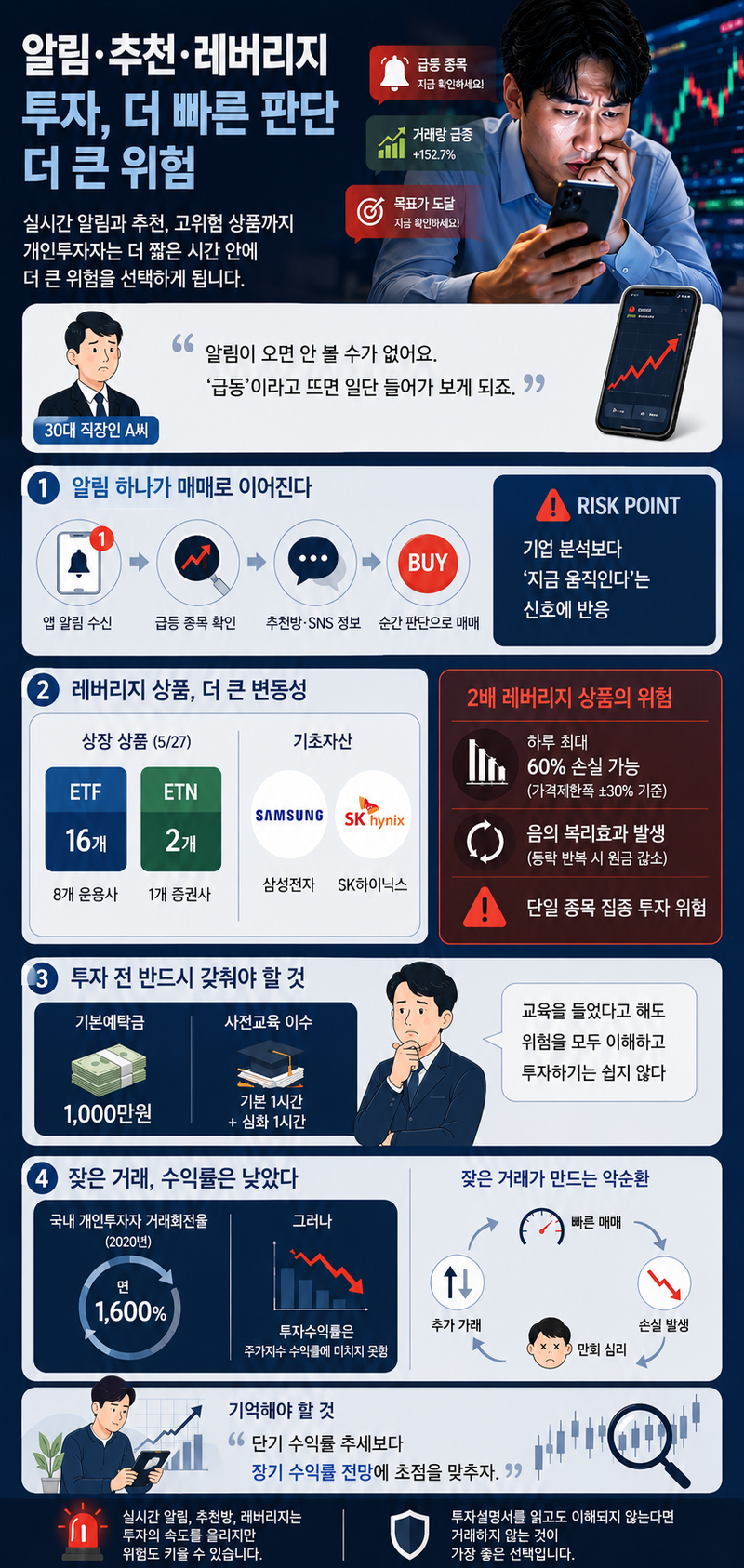
[Financial News] "When an alert comes in, you can't help but look. If it says 'surge,' you end up opening it right away."A salaried worker in his 30s, identified as A, said he cannot turn off alerts from his securities app. When notifications about price spikes, trading volume increases or target prices being reached come in, he checks his phone even during work. A said, "At first I only opened it to look at the stocks I already held, but then I started checking the stocks that appeared in alerts too," adding, "As you keep looking, there is always a stock you start wanting to buy."
The stock investment environment has become more convenient than before. Securities apps now provide real-time alerts on sharp gains and losses, while opinions on buying and selling pour in nonstop through Social Networking Service (SNS) and stock recommendation chat rooms. With the arrival of single-stock leveraged products, individual investors are now in an environment where they can choose greater risk in a short period of time.
In this context, investors should check whether their stock investing is in fact drifting into gambling. Before looking at returns, they should examine why they are buying, where they will cut losses, and how much loss they can afford. Without those three elements, investing can become closer to a bet on luck than a rational decision.
When one alert leads to a trade
App alerts widen an investor's attention beyond the stocks they originally intended to watch. A person may open the app to check the price of a held stock, only to end up seeing a list of surging stocks, theme-stock news and real-time trading volume rankings. In such cases, the reason for buying is not company analysis but a signal that the stock is "moving now."
Stock recommendation chat rooms work in a similar way. A common tactic is to start with a free chat room and then encourage users to join a paid room. More recently, some operators have used SNS and video platforms to lure users into private chat rooms. Screens showing profit verification, screenshots of soaring stocks and phrases such as "If not now, it's too late" are used to stimulate investors.
The Financial Supervisory Service has said that stock recommendation chat rooms may be run by quasi-investment advisory businesses or ordinary individuals whose financial expertise has not been verified. It has also pointed out the problem of operators demanding high fees while citing unsubstantiated performance claims such as returns and stock-picking accuracy.
A salaried worker in his 40s, identified as B, said, "At first I went in just to watch the free room, but I kept getting shaken by the profit screenshots being posted," adding, "More often than not, I look at stocks not because I studied them, but because I feel like I can't afford to miss them."
2x products tied to Samsung Electronics and SK hynix appear
Recently, high-risk products have also become part of individual investors' choices. In May, the Financial Services Commission (FSC) issued guidance on investing in single-stock leveraged and inverse products. According to the FSC, leveraged and inverse products based on a single stock were listed on May 27. Until now, leveraged products were mainly traded on indices or baskets of stocks, but products whose returns are linked to the movement of individual names such as Samsung Electronics and SK hynix have now appeared.
The listed products introduced by the FSC included 16 ETFs and two ETNs. The ETFs were launched by eight asset managers, while one securities firm introduced two directional ETN products. The underlying assets are Samsung Electronics and SK hynix. The two stocks are representative large-cap semiconductor names that account for a large share of trading value and market capitalization in the domestic market. They are familiar to individual investors, but leveraged products based on them are structured differently from ordinary stock purchases.
A single-stock leveraged product does not track the entire market index. Instead, it multiplies the daily return of one specific stock. If Samsung Electronics or SK hynix rises, returns can increase sharply. But if the stock moves the other way, losses can also grow quickly. The product's price reflects earnings outlooks, industry news and changes in supply and demand for that one stock. Because diversification effects are limited, it can be shaken more heavily by issues involving a specific company or changes in the semiconductor cycle.
The FSC explained that, given Korea's 30% upper and lower price limits for stocks, a 2x leveraged product could theoretically lose as much as 60% in a single day. It also said that if a single stock repeatedly rises and falls, cumulative returns may differ from twice the return of the underlying asset. Although such products may appear to be designed for short-term directional bets, the longer the holding period, the greater the risk of losses for investors who do not understand the pricing structure.
Risk remains even after education
To invest in single-stock leveraged and inverse products, investors must deposit a base margin of 10 million won and complete prior education. In addition to the existing one-hour general education for leveraged ETFs and ETNs, they must also take an additional one-hour advanced course. The education is only a minimum step to help investors check the product structure and risks.
However, completing the course does not necessarily mean the product is fully understood. Tracking error, the negative compounding effect and concentration risk in a single stock are difficult to feel until actual price swings are experienced. In particular, when stock prices are rising rapidly, investors tend to focus first on expected returns and the timing of a purchase rather than on risk explanations.
B said, "I took the course, but to be honest, I took it because I wanted to trade," adding, "I didn't fully understand the product structure. I just took it because I was told I couldn't buy it without the course." He added, "When the market actually moves, I think first about whether to buy now, not about what I learned in the course."
You need to understand your investment products properly
When recommendation rooms are combined with high-risk products, investors do not have much time to review. When phrases such as "today only," "at the open" and "let's make 2x" are repeated, the return screen catches the eye before the product disclosure does. Even after a purchase leads to losses, the recommendation room keeps moving on to another stock or additional buying.
In its February report, "Analysis of Individual Investors' Overseas Investment Characteristics and Performance," the Korea Capital Market Institute said small investors tended to trade foreign derivative ETPs such as high-leverage products frequently with small amounts of capital. The report said more rigorous review is needed on whether derivative ETFs encourage excessive trading by individual investors or expose them to additional risk factors.
Derivative ETPs are exchange-traded products designed to generate returns using derivatives such as futures and options, based on the movement of stock indices, commodities or exchange rates. Leveraged and inverse products are typical examples.
The FSC also said single-stock leveraged products are designed to concentrate investment in a specific stock and magnify gains and losses. It added that they are not suitable for investors who cannot afford losses or who do not fully understand investment risks. The commission explained that if investors still do not clearly understand the product structure and risks after reading the prospectus, it is better not to trade.
[email protected] Han Seung-gon Reporter