"Ah, I could have made money this time"... Why has my investing turned into gambling? [Investing or Gambling? 1]
- Input
- 2026-06-29 05:00:00
- Updated
- 2026-06-29 05:00:00

Photo = ChatGPT Office workers earn their salaries at the company, but their minds are increasingly fixed on the stock market's intraday order book. As they repeatedly check stocks for five minutes at lunch, briefly before and after meetings, and trade on the way home, their investment decisions are becoming shorter-term as well.
This article looks at the short-term trading culture that has taken root in the daily lives of office worker investors. [Financial News] "I looked for five minutes before going out for lunch and bought it, but when I checked after my afternoon meeting, the stock price had already fallen.
Photo = ChatGPT Office workers earn their salaries at the company, but their minds are increasingly fixed on the stock market's intraday order book. As they repeatedly check stocks for five minutes at lunch, briefly before and after meetings, and trade on the way home, their investment decisions are becoming shorter-term as well." A salaried worker in his 30s, identified as A, recently opened a stock trading app during lunch and bought a soaring stock. The stock had risen by double digits in the morning session.A said, "I could not keep watching it at work, so I just took a quick look and went in. But after I bought it, I could not focus on my work." The trading time of office worker investors is getting shorter. Market hours overlap with working hours, and apps deliver real-time alerts on sharp rises and falls.
As buying and selling of soaring stocks and theme stocks is repeated before and after meetings, during lunch, and on the way home, investment decisions are shifting away from long-term corporate value and toward immediate returns and the order book. Stock apps opened during work hours For office worker investors, intraday trading time is limited.
Photo = ChatGPT Office workers earn their salaries at the company, but their minds are increasingly fixed on the stock market's intraday order book. As they repeatedly check stocks for five minutes at lunch, briefly before and after meetings, and trade on the way home, their investment decisions are becoming shorter-term as well.
Before a morning meeting, during lunch, on a quick trip to the restroom, or on the subway ride home, these become trading windows. B, a worker in his 40s, said, "In the past, I used to check only the closing price after work, but recently I look several times a day.
Photo = ChatGPT Office workers earn their salaries at the company, but their minds are increasingly fixed on the stock market's intraday order book. As they repeatedly check stocks for five minutes at lunch, briefly before and after meetings, and trade on the way home, their investment decisions are becoming shorter-term as well." He added, "Because stock prices move so much in a single day, it feels like I am the only one missing out if I do not check. " He added, "Sometimes I look at the order book before I look at my meal during lunch.
" When the time spent analyzing stocks is short, decisions are also likely to become short-term. Instead of corporate earnings or industry conditions, investors first look at whether prices are rising now, who is buying, and how online message boards are reacting.After chasing a soaring stock and then seeing the price fall, some investors move on to another stock and repeat the same pattern. Mobile trading has made this kind of behavior even easier.With just a mobile phone, investors can check the market and place orders even while working. In a February 2022 report titled "Behavioral Biases and Trading Behaviors of Domestic Individual Investors," the Korea Capital Market Institute analyzed trading records of 134,000 domestic individual investors from March to October 2020.
The report found that mobile investors had higher turnover and a larger share of intraday trading than users of other trading channels, and that they were more likely to buy stocks that had already surged.Debt-fueled investing after the bull market The stock market has recently swung between record highs and sharp declines.A brief profit in a rising market can lead to more trades, while a steep drop can trigger attempts to recover losses.
09 points from the previous session.
81%.
Photo = ChatGPT Office workers earn their salaries at the company, but their minds are increasingly fixed on the stock market's intraday order book. As they repeatedly check stocks for five minutes at lunch, briefly before and after meetings, and trade on the way home, their investment decisions are becoming shorter-term as well.
During the session, losses widened to more than 8%, triggering a circuit breaker mechanism.
Photo = ChatGPT Office workers earn their salaries at the company, but their minds are increasingly fixed on the stock market's intraday order book. As they repeatedly check stocks for five minutes at lunch, briefly before and after meetings, and trade on the way home, their investment decisions are becoming shorter-term as well.36% to 2,673,000 won.
55.
With sharp gains and losses repeating within just a few days, individual investors are being pushed to make faster decisions.
The scale of borrowing to invest has also grown.Margin loans may look like a way to boost profits in a rising market, but in a falling market they can come back as forced selling and repayment pressure.2 billion won from the previous day.
4786 trillion won set on the 19th, marking a new all-time high.
Margin Loan refers to the amount an investor has borrowed from a securities firm to buy stocks and has not yet repaid.
It can magnify gains when stock prices rise, but it can also deepen losses when prices fall.If the collateral ratio becomes insufficient, forced selling may occur.C, an office worker, said, "If I had only invested my own money, I would have waited, but using margin makes every day feel different.
Photo = ChatGPT Office workers earn their salaries at the company, but their minds are increasingly fixed on the stock market's intraday order book. As they repeatedly check stocks for five minutes at lunch, briefly before and after meetings, and trade on the way home, their investment decisions are becoming shorter-term as well.
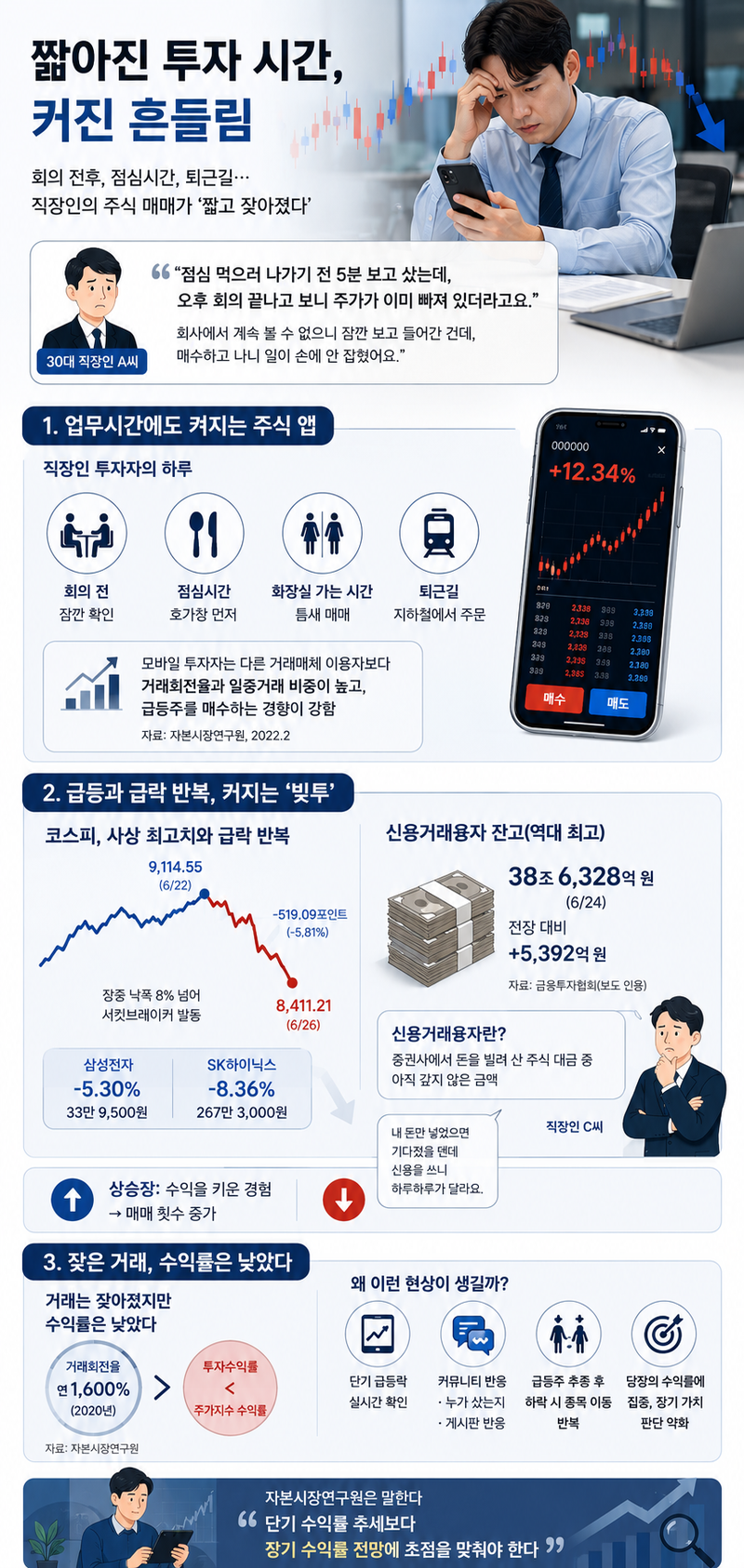
" AI-generated infographic Investors should think about long-term returns, not just immediate profits The more short-term trading is repeated, the harder it becomes for investors to admit losses.
Photo = ChatGPT Office workers earn their salaries at the company, but their minds are increasingly fixed on the stock market's intraday order book. As they repeatedly check stocks for five minutes at lunch, briefly before and after meetings, and trade on the way home, their investment decisions are becoming shorter-term as well.Without fully accepting losses, they look for stocks that promise even bigger returns and keep trading in an attempt to recover quickly.
Investors who have experienced one or two short-term gains may easily believe the same judgment will work again in the next trade.
Frequent trading does not guarantee higher returns.As the number of trades increases, so do commission and tax burdens, and buy and sell decisions can become more unstable.According to the research report "Behavioral Biases and Trading Behaviors of Domestic Individual Investors" published by the Korea Capital Market Institute, the annual turnover rate of domestic individual investors in 2020, during the COVID-19 period, reached 1,600% But their investment returns still fell short of stock index returns.The report explained that the higher the market return in the previous period, the more trading volume individual investors showed, and that this tendency was even stronger among investors with high trading frequency.The institute also stressed that, in a mobile trading environment, investors should be able to focus on "long-term return prospects rather than short-term return trends.
"
[email protected] Han Seung-gon Reporter