"Monthly rent alone is 800,000 won, so why live separately?"... Full-time children who do a bit of dishwashing and get 400,000 won in pocket money [Retirement Plan X]
- Input
- 2026-06-27 08:00:00
- Updated
- 2026-06-27 08:00:00
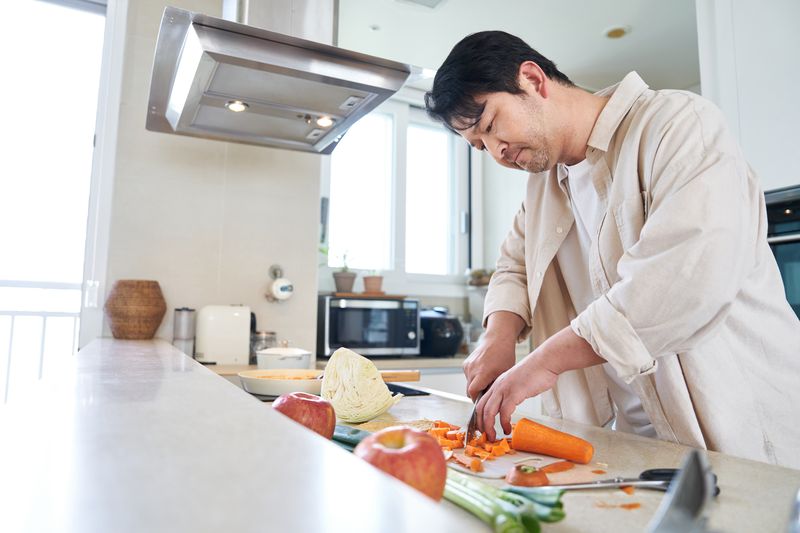

[Financial News] Choi Hee-young, 58, a pseudonym, who lives in Nowon District, Seoul, opens her smartphone bank transfer app on the first day of every month. The recipient is her 31-year-old son, who lives with her. The amount is 400,000 won. He does not currently have a job. Instead, he handles the housework. He cleans, does laundry, shops for groceries, and even takes care of his parents' hospital appointments. He also prepares meals from time to time.
Choi said, "He's not just sitting around doing nothing. I think he is playing a role in his own way." She added, "I don't know how long we will have to live like this."
The change that came after the Kangaroo Tribe
Adult children living with their parents were once called the Kangaroo Tribe. The term compares children who live off their parents' homes to baby kangaroos that never leave their mother's pouch.
More recently, another new term has emerged: full-time child. It was coined in China, where the youth unemployment rate surged to 21.3% in 2023. It refers to a child without a job who takes full responsibility for housework and receives compensation from their parents.
There is a difference between the Kangaroo Tribe and full-time children.While the Kangaroo Tribe depended on their parents one-sidedly, full-time children differ in that they still play some role within the family unit. They may accompany parents to hospital visits, shop for groceries, do housework, handle digital tasks, and provide simple care.
However, the form may have changed, but the essence has not. The children are still staying outside the labor market.
This phenomenon is not limited to full-time children. More people are unable to become independent even when they have jobs. In some cases, married couples are also living with their parents.
Living together is no longer an unusual sight
Living with adult children is no longer unusual.
According to the 2024 Youth Life Survey conducted by the Office for Government Policy Coordination on about 15,000 households with youth members aged 19 to 34, 45.6% of young people were living independently. In other words, more than half were either living with their parents or not yet independent.
The reason young people cannot easily leave their parents' homes ultimately comes down to money.
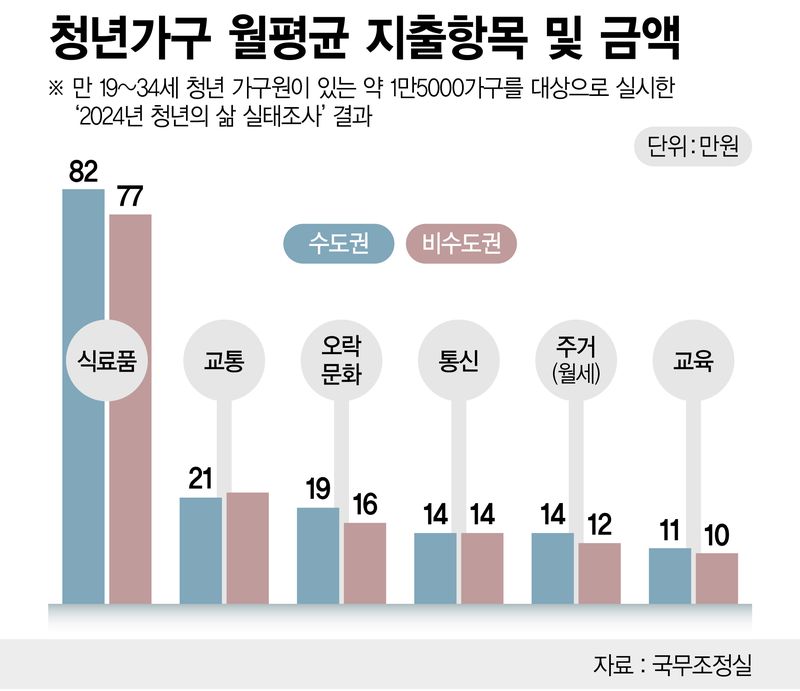
In the same survey,the average monthly living cost for young households was 2.13 million won . In the Seoul metropolitan area, it was 2.2 million won, while in non-capital regions it was 2.06 million won.The average annual income of young people was 26.25 million won, or about 2.18 million won per month . For employed respondents, monthly income averaged 2.66 million won.
Of course, personal income and household living expenses cannot be compared directly. Still, it is clear that the cost structure required for independence is not light. When rent, food, transportation, phone bills, and job-search expenses are taken into account, staying at home is not necessarily an irrational choice for children.
Not disappearing costs, but shifted costs
Living together is not necessarily a bad choice. Children can reduce their housing burden. Parents can gain emotional stability and practical help in daily life. It can also lower total family expenses compared with each person living separately in one-person households.
One thing is clear, however: if children do not become independent, the costs do not disappear. They are simply shifted to someone else.
Parents often say"What burden is there in adding one more spoon?"they say.
That sounds reasonable. In fact, when a family lives under one roof, they share one rent payment, one set of maintenance fees, and one refrigerator. From society's perspective, costs can also be lower than when children live separately.
But the household ledger tells a different story.
When one adult child stays at home, food and daily necessities become more expensive. Electricity, gas, and water bills also rise. Some parents also cover phone bills, transportation costs, job-seeking expenses, medical bills, and insurance premiums. Add pocket money on top of that, and the amount quietly grows.
The problem is not the amount itself, but the fact that the spending is hard to see.
600,000 won a month may seem manageable. But over three years, that comes to 21.6 million won. Over five years, it reaches 36 million won. At 1 million won a month, five years adds up to 60 million won.
Most of that money disappears into the parents' living expenses.It gets mixed into grocery bills, card payments, phone bills, and maintenance fees. That is why parents often do not feel the burden at first. Only later, after checking their bank accounts, do they say, "I spent more than I thought."
The burden on parents appears late
The difficulty of supporting children is not only about money. For parents, helping their children is more emotional than mathematical.
It is hard to turn away when a child says life is difficult. It is also hard to tell a child to leave home when they cannot find a job. Parents begin with the thought that "things will work out once they get settled later." Few plan for long-term support from the start.
But the timeline for the parent generation is different now, too.
According to the KB Golden Life Report 2025 by the KB Financial Group Management Research Institute, there is a significant gap between the retirement age working households hope for and the age at which they actually retire. In reality, retirement comes earlier than expected. Children may still be unable to become independent while parents' earned income is already declining.
It is not easy to cover retirement living expenses with the National Pension Service (NPS) alone. As of January 2026, the average old-age pension payment was 704,427 won per month. Supporting a child with 600,000 won a month for five years would total 36 million won. Converted into the average pension amount, that is about 51 months' worth.
This calculation does not mean parents should stop supporting their children. It does mean that money parents think of as "just a little help" can, over time, amount to several years of retirement income.
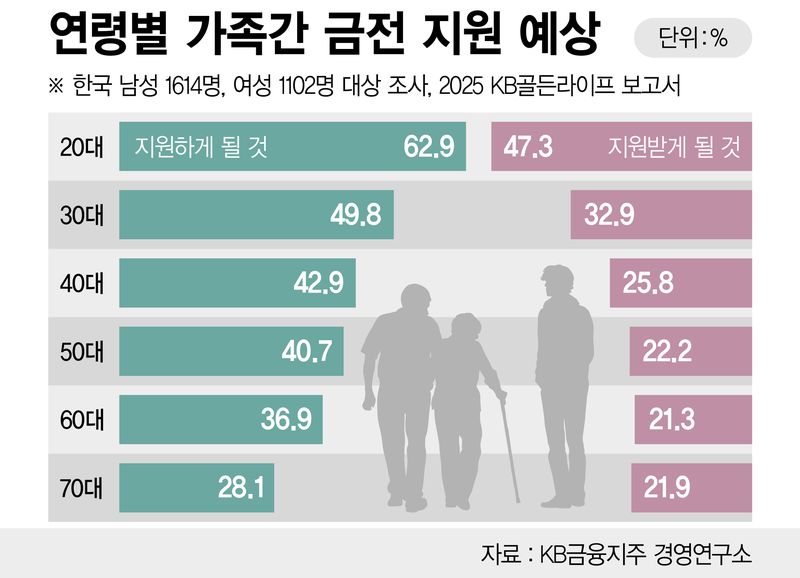
Perceptions of financial support within families also reflect this. According to the KB Golden Life Report 2025, 40.7% of people in their 50s, 36.9% in their 60s, and 28.1% in their 70s expected to provide financial support to family members. By contrast, the share expecting to receive support was only 22.2% among those in their 50s, 21.3% among those in their 60s, and 21.9% among those in their 70s.
Even as they age, people see the burden they will carry as greater than the help they will receive. That is the reality for Korea's parent generation.
In the end, the variable is time
Experts say this phenomenon does not have to be viewed only negatively. A system in which parents provide children with a certain amount of living expenses and children share housework and caregiving responsibilities could becomea new division of roles within the family in a super-aged society.
Jeon Young-soo, a professor at Hanyang University Graduate School of International Studies, said, "There is no need to view full-time children as entirely negative," but added, "What matters is distinguishing whether the cohabitation is a temporary buffer or whether it is solidifying into a long-term structure of dependence."
In fact, living with children can benefit both sides. Children can reduce housing costs, while parents gain emotional stability and practical help in daily life.
There is, however, one variable: time.
Whether this cohabitation is a brief pause to catch one's breath or a prolonged way of life changes its meaning entirely.In the end, only time will show whether today's support is creating time to endure or simply extending the time spent staying in place.Living together can be a choice. But how long that choice lasts, and who is bearing how much of the cost, only becomes clear with time.
The old formula that equates retirement with stepping out of life is breaking down. In an era when life expectancy reaches 83, Generation X is entering full retirement, and the very concept of retirement is being redefined. Every Saturday morning, readers can find stories about their second act in[Retirement Plan X] . Subscribe to the reporter page to receive it conveniently.
[email protected] Kim Gi-seok, Park Ji-young Reporter