U.S. Department of State Says It Understands South Korea's Push for Early OPCON Transfer, Will Work to Meet Conditions as Quickly as Possible
- Input
- 2026-06-26 09:38:11
- Updated
- 2026-06-26 09:38:11
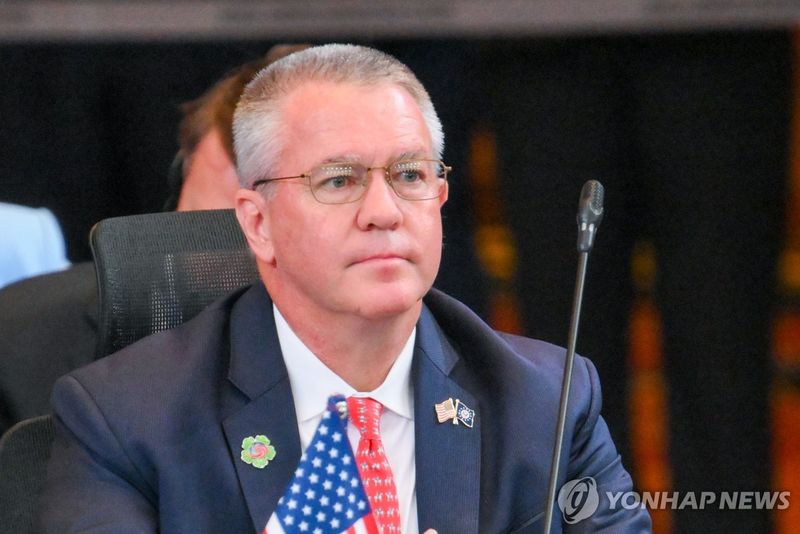
[Financial News] The U.S. Department of State said it understands the Government of South Korea's desire for an early transfer of Wartime Operational Control (OPCON) and is focused on meeting the conditions required for the transfer as quickly as possible. It also reaffirmed its longstanding position that OPCON transfer is a process based strictly on conditions.
Michael George DeSombre, Assistant Secretary of State for East Asian and Pacific Affairs, said this during a hearing on the 25th local time before the U.S. House Foreign Affairs Committee Subcommittee on East Asia and the Pacific. He was responding to a question from Subcommittee Chair Young Kim, a Republican from California, and said, "OPCON transfer is a condition-based agreement."
He explained that both sides must be confident the United States can maintain the level of deterrence needed even after South Korea takes over OPCON. He added that several conditions must be met to make that possible.
He continued, "Discussions on the exact timing are still ongoing." He added, "We understand the Government of South Korea's willingness to move forward with OPCON transfer as soon as possible, and we are focused on ensuring the necessary conditions are met as quickly as possible."
The Government of South Korea is pushing for an early OPCON transfer. Some observers say a transfer could come as early as next year. The U.S. military, however, has maintained that meeting the conditions must come first.
The hearing also touched on South Korea's regulations affecting U.S. companies.
DeSombre said in connection with the South Korean government's treatment of U.S. companies such as Coupang, "The U.S.-ROK Joint Fact Sheet released last year includes language saying that U.S. companies will not be discriminated against." He added, "The Coupang issue is one that the United States has discussed in depth with South Korea."
He went on to say, "We have made it clear that we are not satisfied with the way South Korea treats Coupang." He added that the United States has worked hard to make clear that Coupang should be treated under the same standards as South Korean companies, and that this will remain a major topic of discussion.
He also said that removing non-tariff barriers in the automobile and agricultural sectors is part of the agreement in the joint fact sheet, and that the United States will continue discussions on South Korea's non-tariff barriers.
Meanwhile, Ami Bera, a Democratic Party lawmaker known for his pro-Korea stance, said in his opening remarks that he had discussed the issue with President Lee Jae-myung during his visit to South Korea in late March.
Bera said, "I explained that South Korea does not need to worry about the U.S. nuclear umbrella commitment and has no reason to pursue its own nuclear capabilities."
He also stressed that the visa quota issue for South Korean technical workers should be resolved quickly in order to expand South Korea's investment in the United States.
[email protected] Kim Kyung-min Reporter