Government to Keep Oil Price Cap, Inject 1 Trillion Won to Hold Inflation Within 3%
- Input
- 2026-06-26 08:59:50
- Updated
- 2026-06-26 08:59:50
[Financial News] The government will keep the oil price cap in place until consumer prices stabilize and will inject 1 trillion won in fiscal support for discounts on agricultural, livestock and fishery products. It also plans to mobilize all available measures to keep inflation within 3% in the second half of the year.
On the 26th, Deputy Prime Minister for Economic Affairs and Minister of Economy and Finance Koo Yun-cheol said, "The seventh oil price cap will be lowered from the current level, taking into account the drop in global oil prices, the burden on livelihoods and fiscal conditions." He added, "We will maintain the oil price cap until consumer prices for petroleum products stabilize."
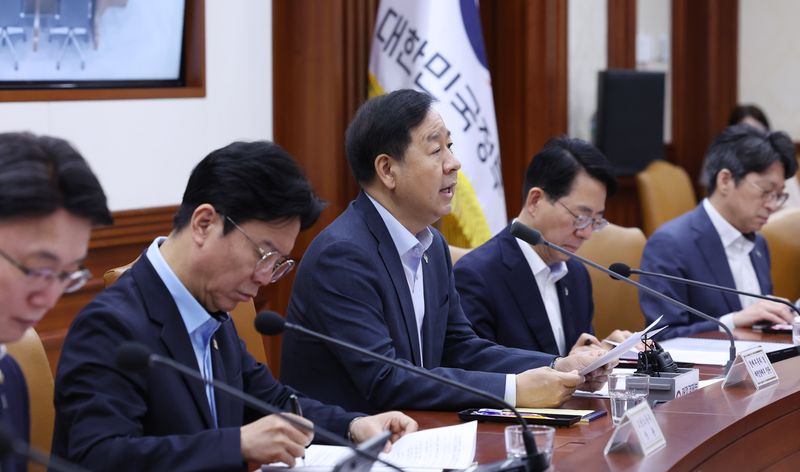
At the meeting held that day at Government Complex Seoul, Koo said, "We will closely review the Middle East war and the state of our economy, and gradually adjust the emergency response measures currently in place." He made the remarks while chairing the meeting of the Emergency Economic Headquarters, the Council of Economic Ministers and the Ministerial Task Force on Special Management of Consumer Prices.
Koo said, "Uncertainty remains even after the signing of the MOU on ending the Middle East war, so burdens on daily life from high inflation, a weak won, high interest rates and slower employment growth are continuing." He added, "We will also quickly prepare and announce support measures for small and medium-sized companies affected by the strong won."
The meeting discussed responses related to the Middle East war, measures to stabilize consumer prices and ease the burden on ordinary people, and the basic employment stability plan for industrial transition.
The government will mobilize all available tools to keep inflation from exceeding 3%. It will also inject 1 trillion won in fiscal support for small business owners hit by high oil prices.
To ease food price burdens, the government will hold the largest-ever discount event for all eligible agricultural, livestock and fishery products in July and August.
To stabilize egg prices, the government will more than sextuple imports of fresh eggs and bring in an additional 200 million eggs.
Next month, it will dispatch a special delegation to directly import 2,000 tons of Norwegian mackerel and supply it at low prices.
To reduce the burden of energy prices, electricity and gas rates, along with other major public utility charges, will be frozen through the second half of the year.
The levy on LPG butane sales will also be temporarily waived until the end of this year.
Households receiving Energy Vouchers and using kerosene or LPG will receive an additional 147,000 won, which can be used from October this year through May next year.
To support small business owners affected by high oil prices, the loan program under 'Hope Dream for Small Businesses' will also be doubled from 150 billion won to 300 billion won.
The government will also expand toll discounts on expressways for people with disabilities and national merit recipients.
A basic employment stability plan for industrial transition will also be prepared soon. The goal is to reduce job shocks from the AI and green transformation and support a smooth industrial transition.
The government will build a system to proactively identify and systematically analyze job impacts by industry and region resulting from industrial restructuring. Regions hit hardest by industrial transition, such as those affected by coal-fired power plant closures, will be predesignated as Just Transition Special Zones and given strong protection.
It will also support vocational training specialized in AI and Green technology for existing workers and young people preparing for jobs. In particular, through intensive training in advanced sectors for young people, the government aims to train 1,000 AI specialists in the second half of the year and link them to employment and entrepreneurship.
[email protected] Jung Sang-gyun Reporter