"Rushing Into Semiconductors," Gold Falls 29% From Its Peak as 100 Billion Won Exits ETFs
- Input
- 2026-06-26 13:02:59
- Updated
- 2026-06-26 13:02:59
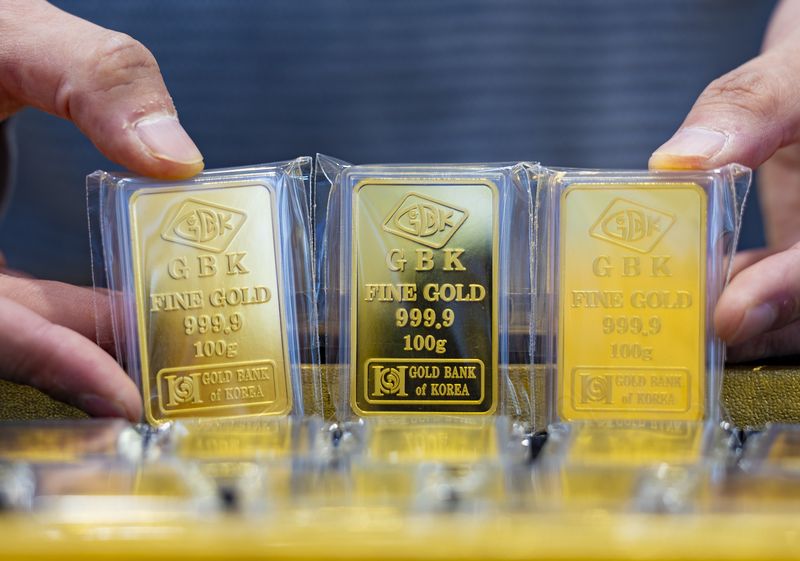
[Financial News] Gold, widely regarded as a classic safe-haven asset, is plunging. Concerns over additional tightening in the United States, a stronger dollar, and the artificial intelligence (AI) investment boom have combined to push international gold prices below $4,000 per ounce for the first time in seven months.
Spot gold closed at $3,992.44 per ounce in New York on the 24th, down 3.0% from the previous trading day. That is about 28.6% below the all-time high of $5,594 per ounce set in January. A drop of more than 20% from a peak is generally seen as a sign of a bear market.
A day later, on the 25th, it edged up 1.01% from the previous close to $4,030.50 per ounce, but it also slipped to around $3,970 during the session, suggesting the momentum has weakened.
As international gold prices have fallen, domestic spot gold prices, which had approached 270,000 won per gram at the end of January, have also dropped below 200,000 won. According to the Korea Exchange, domestic gold closed on the 25th at 196,110 won, down 2.72% from the previous day. That is about 27% below the January 29 peak of 269,810 won.
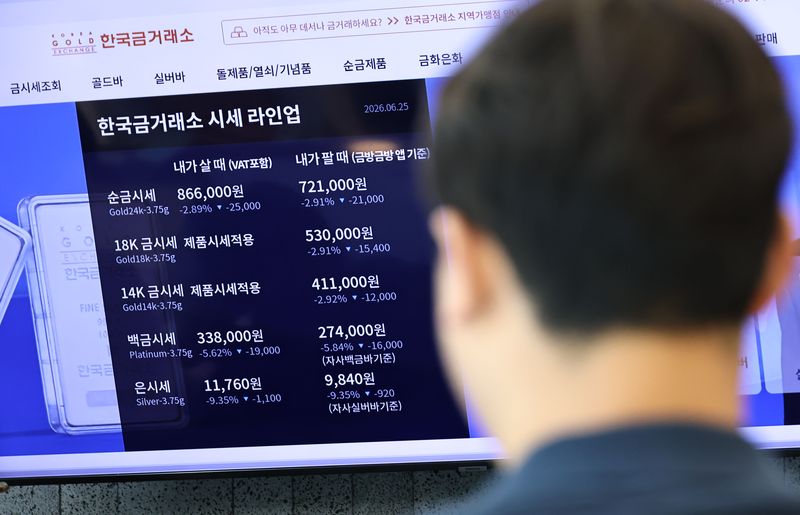
Pure gold, or one don of 3.75 grams, is trading in the 860,000-won range to buy and the 720,000-won range to sell. According to the Korea Standard Gold Exchange, the buying price for pure gold stood at 865,000 won on the day, down 255,000 won, or 22.7%, from the January 29 high of 1.12 million won. The selling price also fell 210,000 won, or 22.4%, from 935,000 won to 725,000 won over the same period.
Gold-related exchange-traded funds (ETFs) are also seeing continued outflows. According to Koscom Corporation's ETF Check, 104.8 billion won left ACE KRX Physical Gold ETF over the past month. TIGER KRX Gold Spot (-51.3 billion won) and KODEX Gold Futures (-22.3 billion won) have also seen similar outflows.
The decline is being attributed to easing geopolitical risks, including follow-up negotiations after the end of the U.S.-Iran conflict, while the possibility of additional tightening by the Federal Reserve System (the Fed) has pushed Treasury yields and the dollar higher, reducing gold's appeal as an investment. The AI investment boom has also driven a 'risk-on' shift, with capital moving out of safe-haven assets such as gold and into the stock market.
Park Sang-hyun, a researcher at iM Securities, said, "Not only gold, but also silver, bitcoin, copper and other major asset prices are falling together," adding, "These declines are not just a short-term plunge, but a trend-like downtrend."
He added, "Speculative demand that had been betting on rallies in gold, silver and oil has also dropped sharply amid concerns over tightening and a stronger dollar," and noted, "Weak investment outside AI is also dragging down asset prices other than stocks."
Some say gold trading has been sidelined and could remain range-bound for an extended period. Still, there is also a view that support may form around $3,900 as central banks continue to buy gold.
Independent metals trader Tai Wong said, "A stronger dollar and lower inflation expectations are putting pressure on precious metal prices," and added, "Central banks around the world are still buying gold, so support is likely to form around $3,900 per ounce."
bng@fnnews.com Kim Hee-sun Reporter