Will the National Pension Service Join as a Retirement Pension Operator? Concerns Grow Over Criticism of "Pension Absolutism"
- Input
- 2026-06-25 18:06:26
- Updated
- 2026-06-25 18:06:26
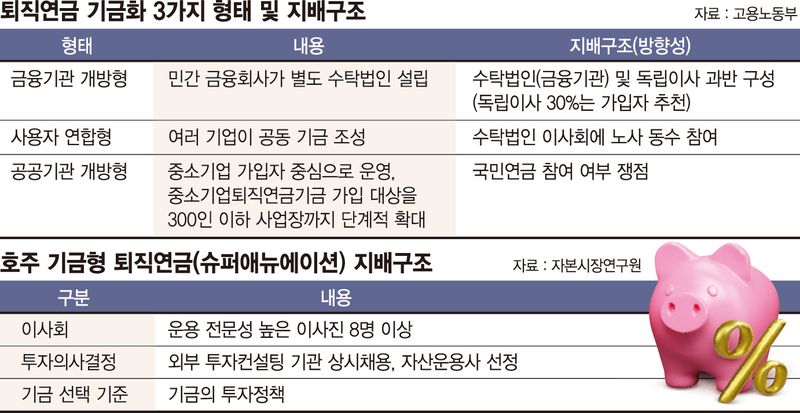
■ Governance and regulatory issues for entrusted entities
According to the government and the financial sector on the 25th, labor authorities are moving quickly to design the Retirement Pension fund system, with a goal of announcing it by the end of July. The main issues have been narrowed down to the following: board composition by fund type, whether NPS will participate, whether a Retirement Pension fund agency should be established, the timing of application by workplace type and size, and the abolition of lump-sum retirement benefits. The Tripartite Labor-Management-Government Task Force is currently conducting a comprehensive review of these issues.
The core issue is how to design the governance structure of the entrusted entity. At present, the most likely model is one in which worker representatives are assigned to a certain proportion of the board of the entrusted entity for all funds, including the open financial institution model, the consortium model, and the public-institution open model. A MOEL official said, "It has not yet been decided in what form, or at what ratio, workers will join the board," but added, "We are discussing a plan in which workers participate at a certain ratio in each fund." A worker-participation Retirement Pension fund has long been a demand of labor groups.
However, there is still no consensus on whether the board of each fund’s entrusted entity should be divided into a supervisory board and an executive board, or whether it should be unified for cost reasons. In advanced countries, it is common to have an executive board made up of investment experts and a supervisory board or committee to check it. A source from the working-level task force said, "If the governance structure of the entrusted entity becomes too complicated, operating costs will rise," adding, "If the board is unified, it will likely be composed equally of labor and management, with experts included as well." The financial sector also argues that the most important issue in fund-based Retirement Pension reform is the form and governance of the entrusted entity, and that existing Retirement Pension operators in the market should not be excluded from the discussion so that on-the-ground views can be reflected.
Who will regulate and supervise the entrusted entity of the Retirement Pension fund, which would effectively become a new financial institution, is also seen as a sensitive issue. Under the current contract-based Retirement Pension system, legal revisions are handled by the labor ministry, while supervision of Retirement Pension operators is delegated to the FSC. Observers expect that regulation and supervision of fund-based Retirement Pension plans will likely follow the current framework.
■ Will NPS join?
Whether NPS will participate as a public-institution open operator is the biggest concern in the financial sector. Kim Sung-ju, chairman of NPS, recently made a strong case for participation at a press briefing, saying that "direct participation is essential." He emphasized, "If NPS participates in fund-based Retirement Pension plans, it can offer the public lower fees and higher returns," adding, "The participation of NPS, which has stably managed and delivered results with a massive fund of more than 1,500 trillion won, is essential."
In the financial sector, there are concerns that if NPS joins Retirement Pension plans, it could lead to so-called "pension absolutism," given that the National Pension Fund Management Committee cannot be fully free from government influence. A financial industry source said, "NPS is being used not only to defend the won but also to support the domestic stock market. If the time comes for selling, Retirement Pension subscribers who end up absorbing NPS’s sell orders will inevitably suffer losses," adding, "I question whether this is the right direction for the capital market and whether it is healthy to bring it into the Retirement Pension ecosystem."
■ Returns vs. a stock market safety net
If the ruling and opposition parties move in earnest to legislate Retirement Pension fund reform in the second half of the year, debate is expected to intensify not only over the policy goal of higher returns but also over whether the system should serve as a "safety net for the stock market."
Inside government think tanks, discussions on fund-based Retirement Pension reform have been underway for a long time, and since advanced countries have already improved returns through such systems, they see institutionalization as a natural next step. Park Sung-wook, senior research fellow at KIF, said, "Because this discussion is coming up at a time of an unprecedented stock market boom, people seem to suspect that it is meant to boost the market," adding, "But this is not a new idea. It has been discussed for a long time, and major advanced countries with Retirement Pension systems have already achieved results through fund-based models."
The ruling Democratic Party of Korea remains cautious for now. A ruling party official said, "Retirement Pension fund reform has been pursued for a long time, regardless of stock market support," adding, "It may have a secondary effect on the market, but the goal is to maximize subscriber returns and manage pensions more effectively."
Park So-hyun, Kim Jun-hyuk, Park Moon-soo