Lowest chance of June rainy season... If it starts in July, it will be the third 'late rainy season' on record
- Input
- 2026-06-25 15:07:48
- Updated
- 2026-06-25 15:07:48
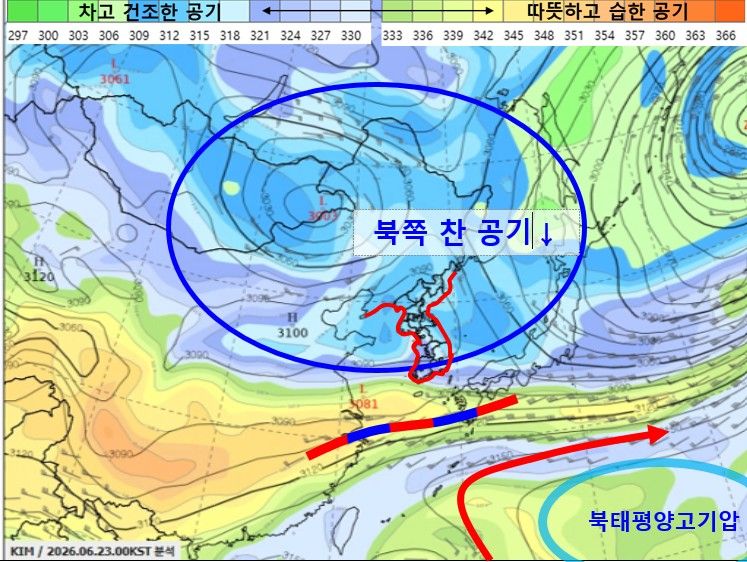
This rain is not monsoon rain caused by a stationary front, but rather showery precipitation resulting from atmospheric instability. Monsoon front lingers south of Jeju Provided by the Korea Meteorological Administration During a forecast briefing on the 25th, Gong Sang-min, a forecast analyst at the Korea Meteorological Administration, stated, "Currently, Korea is still mainly under the influence of cold, dry air from the north. " He added, "The stationary front is located around 30 degrees North latitude, that is, in the waters south of Jeju Island, and the North Pacific High is also still lingering in the waters south of Japan, unable to sufficiently expand toward Korea.
" For the monsoon season to begin, the stationary front lingering south of Jeju must move northward toward the Korean Peninsula. However, the stationary front is currently lingering in the waters south of Jeju Island. The North Pacific High, which brings hot and humid summer air, is also still lingering south of Japan, failing to push the stationary front northward.
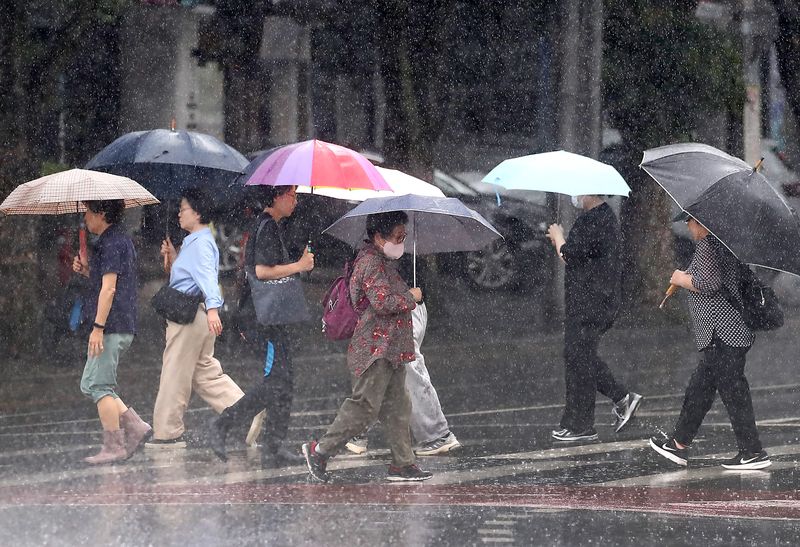
c News1 Reporter Gong Jeong-sik / Photo = News1 [Financial News] There is a growing possibility that the start of this year's rainy season will be pushed back into July, extending beyond this month. The stationary front driving the monsoon is still lingering in the waters south of Jeju Island, and the North Pacific high-pressure system, which would push it northward toward the Korean Peninsula, has not been able to expand sufficiently. However, strong showers of around 30 mm per hour are expected to fall mainly in the central region and northern Gyeongbuk between late afternoon on the 25th and dawn on the 26th.
Simply put, while the rain clouds that would create the monsoon are waiting in the south, the force to pull them up to the Korean Peninsula is still weak. Conversely, cold, dry air from the north is affecting the area around the Korean Peninsula, preventing the monsoon front from easily advancing northward. Jeju Island, where the monsoon season typically arrives earliest, has already passed its average start date.
c News1 Reporter Gong Jeong-sik / Photo = News1 [Financial News] There is a growing possibility that the start of this year's rainy season will be pushed back into July, extending beyond this month. The stationary front driving the monsoon is still lingering in the waters south of Jeju Island, and the North Pacific high-pressure system, which would push it northward toward the Korean Peninsula, has not been able to expand sufficiently. However, strong showers of around 30 mm per hour are expected to fall mainly in the central region and northern Gyeongbuk between late afternoon on the 25th and dawn on the 26th.c News1 Reporter Gong Jeong-sik / Photo = News1 [Financial News] There is a growing possibility that the start of this year's rainy season will be pushed back into July, extending beyond this month. The stationary front driving the monsoon is still lingering in the waters south of Jeju Island, and the North Pacific high-pressure system, which would push it northward toward the Korean Peninsula, has not been able to expand sufficiently. However, strong showers of around 30 mm per hour are expected to fall mainly in the central region and northern Gyeongbuk between late afternoon on the 25th and dawn on the 26th.
A July monsoon is also a rare occurrence in the southern and central regions. Since 1973, the southern region has seen the monsoon start in July only five times, while the central region has seen it only six.
Last year, the monsoon in Jeju began on June 12, marking the third earliest start on record, but this year, the opposite scenario is increasing, raising the possibility of a late monsoon. However, it is difficult to pinpoint the exact start date of the monsoon season.
The Korea Meteorological Administration explained that while they initially anticipated rain between June 30 and July 1, the precipitation system and start time were delayed, so the current forecast reflects rainfall starting from July 1. However, there remains a possibility that the forecast could be moved back to June 30 or adjusted sooner.
Whether the North Pacific High expands next week is also a variable. While there is a possibility that the North Pacific High will expand toward the Korean Peninsula after Typhoon Mekala (Typhoon No.
7) passes south of Japan, it is difficult to forecast definitively at this time. Forecasts from numerical weather prediction models are also conflicting due to the possibility of a tropical depression forming near the Philippines.
The KMA predicted that there is a possibility of rain centered around Jeju Island around next Wednesday, July 1. However, it remains to be seen whether this rain immediately signifies the start of the monsoon season.
This is because it is still uncertain whether the stationary front will actually move northward or if a trough will develop to expand the rain cloud band. **Heavy Showers from Night of the 25th to Early Morning of the 26th** Although the rainy season is delayed, heavy showers are expected in various inland areas from late afternoon on the 25th to the early morning of the 26th.
This is showery precipitation caused by the meeting of cold air lingering over the Korean Peninsula and ground temperatures rising during the day. 5 km, passes over the Korean Peninsula.
c News1 Reporter Gong Jeong-sik / Photo = News1 [Financial News] There is a growing possibility that the start of this year's rainy season will be pushed back into July, extending beyond this month. The stationary front driving the monsoon is still lingering in the waters south of Jeju Island, and the North Pacific high-pressure system, which would push it northward toward the Korean Peninsula, has not been able to expand sufficiently. However, strong showers of around 30 mm per hour are expected to fall mainly in the central region and northern Gyeongbuk between late afternoon on the 25th and dawn on the 26th.
They explained that localized shower clouds could develop as ground temperatures rise during the day and surrounding air currents converge. In particular, atmospheric instability is expected to be strongest from late afternoon to night on the 25th.
c News1 Reporter Gong Jeong-sik / Photo = News1 [Financial News] There is a growing possibility that the start of this year's rainy season will be pushed back into July, extending beyond this month. The stationary front driving the monsoon is still lingering in the waters south of Jeju Island, and the North Pacific high-pressure system, which would push it northward toward the Korean Peninsula, has not been able to expand sufficiently. However, strong showers of around 30 mm per hour are expected to fall mainly in the central region and northern Gyeongbuk between late afternoon on the 25th and dawn on the 26th.There may be areas, mainly in the central region and northern Gyeongbuk, experiencing heavy showers of around 30 mm per hour. Heavy rainfall of up to around 80 mm is expected in the inland and mountainous areas of Gangwon Province.
A characteristic of these showers is the significant regional variation. Even in adjacent areas, one may receive almost no rain while the other experiences torrential downpours equivalent to a heavy rain warning.
Since the intensity can suddenly increase even if the rain does not last long, caution should be exercised regarding flooding on riverside walking paths, underpasses, and low-lying areas. Woo Jin-gyu, a weather forecaster at the Korea Meteorological Administration, urged, "These showers may be accompanied by gusts of wind, thunder, lightning, and hail, so attention must be paid to facility management and safety accidents.
"
c News1 Reporter Gong Jeong-sik / Photo = News1 [Financial News] There is a growing possibility that the start of this year's rainy season will be pushed back into July, extending beyond this month. The stationary front driving the monsoon is still lingering in the waters south of Jeju Island, and the North Pacific high-pressure system, which would push it northward toward the Korean Peninsula, has not been able to expand sufficiently. However, strong showers of around 30 mm per hour are expected to fall mainly in the central region and northern Gyeongbuk between late afternoon on the 25th and dawn on the 26th.
[email protected] Lee Bo-mi Reporter