96% of people say heat waves cause stress, and many have cut food and medical spending to cover cooling costs
- Input
- 2026-06-25 00:44:58
- Updated
- 2026-06-25 00:44:58
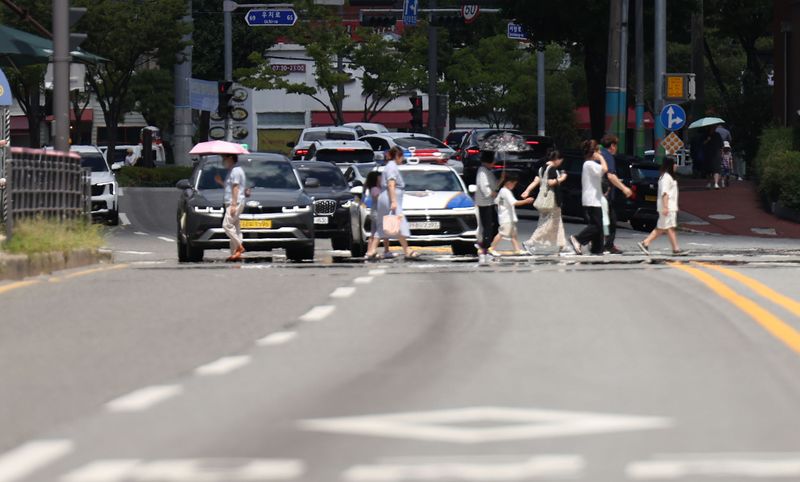
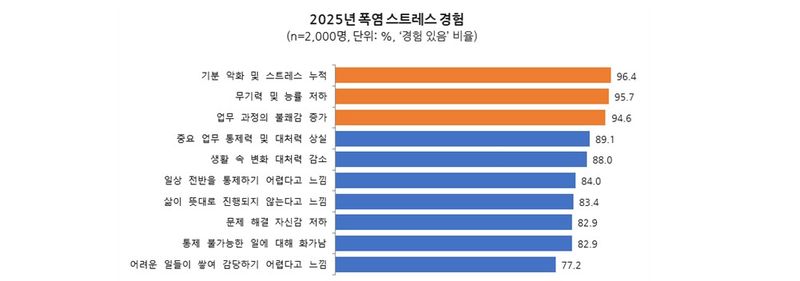
[Financial News] A survey found that 96.4% of people who experienced heat waves last year said they felt worse and accumulated stress even without any particular reason. Another 95.7% said they felt lethargic and had reduced ability to get things done, while 94.6% said they felt irritated and bothered. The findings suggest that heat waves are spreading beyond a simple issue of hot weather or heat-related illness and becoming a social disaster that affects mental health, daily life and household spending.
The Graduate School of Public Health at Seoul National University announced the results on the 25th of a nationwide survey of 2,000 adult men and women aged 19 and older on public perceptions of heat waves and social mental health. Respondents ranked heat waves as the second biggest factor threatening health and well-being, after emerging infectious diseases.
Professor Yoo Myung-soon of the Graduate School of Public Health at Seoul National University, who oversaw the survey, said, "We confirmed that people already perceive heat waves not as a weather issue, but as an issue of the people's quality of life."
Heat waves rank second after infectious diseases as a threat to health and well-being
Respondents already viewed heat waves as a major risk factor. When asked about the biggest threat to their health and well-being, emerging infectious diseases ranked first at 31.3%, followed by heat waves at 21.5%. Economic slowdown came next at 18.9%, meaning heat waves ranked higher than a recession.
Concerns about heat-wave damage this year were also high. 67.6% said there was a high chance of heat-wave damage in South Korea this year. If damage occurs, 68.9% said it would be severe, and 66.2% said they were worried. The results also showed a tendency to view heat waves as a national risk rather than a personal one.
Respondents most often identified the elderly as the most vulnerable group to heat waves, at 37.0%. They were followed by socially disadvantaged groups such as people in poverty and the homeless at 30.1%, and people with chronic illnesses at 14.3%.
The share of respondents who said they themselves were vulnerable to heat waves reached 41.2%. Among daily laborers, in particular, 54.8% saw themselves as vulnerable. Professor Yoo explained, "The fact that labor conditions and housing conditions were cited as key factors in explaining heat-wave vulnerability shows that people understand heat-wave damage as a structural social problem."
They read disaster alerts, but say they come too often
Public evaluations of heat-wave responses by the central government and local governments were mixed. 68.9% said the central government handled heat-wave preparedness and response well, while 60.7% said the same of local governments. For both, the most common reason for a positive assessment was the delivery of heat-wave information and guidance.
The reasons for negative assessments were different. For the central government, the top issue was emergency response and medical systems. For local governments, it was support for energy welfare, such as cooling costs. The findings suggest that basic information delivery is working to some extent, but medical response and support for vulnerable groups are still lacking.
Fatigue with disaster alerts was also evident. 5.9% said they did not receive any heat-wave safety alerts at all, while 13.3% said they received them but did not read them. The most common reason for ignoring the messages was that alerts and notifications came too often, cited by 57.7%. Another 23.2% said they were not needed, and 19.3% said they were not delivered in time.
Professor Yoo said, "Heat-wave information was reaching many people, but fatigue with disaster alerts was also evident." She added, "Future communication on heat-wave risks must go beyond simply delivering information."
Four in 10 said they gave up spending because of cooling costs
Heat waves also had a direct impact on daily life. The activity most often reduced during last year's heat waves was physical activity such as exercise, at 54.6%. 44.2% said social interactions or activities such as gatherings decreased, 40.9% said sleep decreased, and 30.4% said work or school productivity declined.
The emotional impact was also significant. More than 90% of respondents said they experienced stress, lethargy and irritability because of last year's heat waves. Professor Yoo said, "This shows that heat waves are having a broad impact on mental health beyond physical health problems such as heatstroke." She added, "It is important to expand health protection from heat waves to include mental health."
Household burdens were also confirmed. 42.5% of all respondents said they had reduced or given up essential spending last year because of cooling costs during the heat-wave period. The items they cut back on were leisure and cultural spending at 60.5%, clothing and household goods at 51.6%, and food expenses at 48.6%. 11.5% also said they reduced medical spending.
Awareness of the climate crisis and heat waves was high. 58.8% of respondents said the seriousness of heat waves and climate change was underestimated in reality. More than half also said the government and local governments should prioritize response over economic growth when dealing with heat waves and the climate crisis.
The Seoul National University research team said the survey shows that heat waves should be seen not as a weather issue, but as a social risk that weakens daily life, health and economic activity.
Professor Yoo said, "Government and local governments should move beyond simply delivering weather information in their heat-wave response and communication. They should address heat waves from the perspective of a social risk, expand protection and support not only for physical health but also for mental and psychological health, and improve the quality of communication so that people can understand heat-wave risks and act on them."
Meanwhile, the survey was conducted by Kstat Research from April 13 to 20, and the margin of error was plus or minus 2.19 percentage points at the 95% confidence level.
[email protected] Lee Bomi Reporter